Why are ferns, spike mosses and horsetails able to grow taller than bryophytes?
Why are ferns, spike mosses and horsetails able to grow taller than bryophytes?
Homework Answers
Height of a plant is determined by the type of conducting tissue present in it. Bryophytes are very small as compared to ferns, spike mosses and even other higher plants like gymnosperms and angiosperms. It is because bryophytes have a very primitive type of conducting tissue which is known as conducting cell and conducting tissue. It is responsible for the conduction of water and nutrients across the plant body. Because of this Limited functioning of this tissue, bryophytes are not able to grow taller. In tall plants it becomes difficult to transport water and nutrients to great height.
Where as in pteridophytes, a vascular tissue is present. It is differentiated into xylem and phloem. Although the xylem and phloem of primitive nature, but they are still more efficient than the conducting cell and tissue found in bryophytes. They can conduct water upto Greater height and therefore pteridophytes are taller than bryophytes.
Please rate.
Add Answer to:
Why are ferns, spike mosses and horsetails able to
grow taller than bryophytes?
Which of the following are not a monophyletic group? angiosperms ferns gymnosperms lycophytes bryophytes ferns/horsetails and...
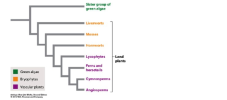 Which of the following are not a monophyletic group?
angiosperms
ferns
gymnosperms
lycophytes
bryophytes
ferns/horsetails and bryophytes
ferns/horsetails
Sister group of green algae Liverworts Mosses Hornworts Lycophytes Land plants Ferns and horsetails Green algae Bryophytes Gymnosperms Vascular plants Angiosperms De How We Seed Cation HO
Which of the following are not a monophyletic group?
angiosperms
ferns
gymnosperms
lycophytes
bryophytes
ferns/horsetails and bryophytes
ferns/horsetails
Sister group of green algae Liverworts Mosses Hornworts Lycophytes Land plants Ferns and horsetails Green algae Bryophytes Gymnosperms Vascular plants Angiosperms De How We Seed Cation HO
Which of the following are not a monophyletic group? Other options include angiosperms bryophytes ferns/horsetails and...
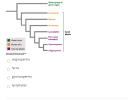 Which of the following are not a monophyletic group?
Other options include
angiosperms
bryophytes
ferns/horsetails and bryophytes
ferns/horsetails
gymnosperms
Please select all of them
Sister group of green algae Liverworts Mosses Hornworts Lycophytes Land plants Ferns and horsetails Green algae Bryophytes Gymnosperms Vascular plants Angiosperms Dirbour How LoneWres Sound MENNO angiosperms o ferns O gymnosperms olycophytes
Which of the following are not a monophyletic group?
Other options include
angiosperms
bryophytes
ferns/horsetails and bryophytes
ferns/horsetails
gymnosperms
Please select all of them
Sister group of green algae Liverworts Mosses Hornworts Lycophytes Land plants Ferns and horsetails Green algae Bryophytes Gymnosperms Vascular plants Angiosperms Dirbour How LoneWres Sound MENNO angiosperms o ferns O gymnosperms olycophytes
Why are conifers considered more advanced or successful than ferns and mosses?
Why are conifers considered more advanced or successful than ferns and mosses?
Plants reproducing by-spores such as mosses and ferns are grouped under the general term (a) cryptogams...
Plants reproducing by-spores such as mosses and ferns are grouped under the general term (a) cryptogams (b) bryophytes (c) sporophytes (d) thallophytes
The main groups of bryophytes include all except _____. A. Hornworts B. Liverworts C. Mosses D....
The main groups of bryophytes include all except _____. A. Hornworts B. Liverworts C. Mosses D. Whisk Ferns
Draw a phylogeny of the plants that includes the following taxa: Green algae Liverworts Mosses Hornworts...
Draw a phylogeny of the plants that includes the following taxa: Green algae Liverworts Mosses Hornworts Lycophytes Ferns & horsetails Gymnosperm Angiosperm And the following adaptations: Sporophyte Cuticle Stem cells Xylem & phloem Lignin Seeds Flowers Lastly, indicate which of the taxa are classified as, non-vascular, vascular, bryophytes, seed, and flowering plants.
Name the gametophyte structure and the sporophyte structure of both bryophytes and ferns. Also know whether...
Name the gametophyte structure and the sporophyte structure of both bryophytes and ferns. Also know whether they are haploid or diploid, and which is the more easily recognized (dominant). Be able to tell which gametangia the reproductive structures of moss and ferns are (archegonium or antheridium). Know the terms: rhizoid, rhizome, gemmae cups, prothallus, sorus, sporangia, alternation of generations (explain what it is)
Among bryophytes, stomata are restricted to the sporophyte life stage (found in mosses and some hornworts)....
Among bryophytes, stomata are restricted to the sporophyte life stage (found in mosses and some hornworts). Why? Why might it be adaptive for only the sporophyte and not the gametophyte stage in the life cycle to possess stomata?
Bryophytes & Seedless vascular plants: Be able to define a true “plant” Know how plants differ...
Bryophytes & Seedless vascular plants: Be able to define a true “plant” Know how plants differ from other photosynthetic organisms (green algae, cyanobacteria) Understand that land plants share a common ancestor with green algae Be familiar with the four stages in land plant evolution, and know that both bryophytes and seedless vascular plants arose in the first stage seedless vascular plants diversified and dominated the Earth in the second stage, during the Carboniferous Period (~350-300 MYA), when coal deposits were...
I'm just curious as to what the correct answer is to this question? I really thought...
 I'm
just curious as to what the correct answer is to this question? I
really thought it was "Ferns do not require water to reproduce."
But it is notand it wont tell me the correct one. I'm just curious
as to what the correct one is.
The first land plants were bryophytes, which then branched into ferns, gymnosperms, and finally angiosperms. What key adaptation distinguishes the ferns from the bryophytes? Select one a. ferns are able to do photosynthesis. b....
I'm
just curious as to what the correct answer is to this question? I
really thought it was "Ferns do not require water to reproduce."
But it is notand it wont tell me the correct one. I'm just curious
as to what the correct one is.
The first land plants were bryophytes, which then branched into ferns, gymnosperms, and finally angiosperms. What key adaptation distinguishes the ferns from the bryophytes? Select one a. ferns are able to do photosynthesis. b....
 Which of the following are not a monophyletic group?
angiosperms
ferns
gymnosperms
lycophytes
bryophytes
ferns/horsetails and bryophytes
ferns/horsetails
Sister group of green algae Liverworts Mosses Hornworts Lycophytes Land plants Ferns and horsetails Green algae Bryophytes Gymnosperms Vascular plants Angiosperms De How We Seed Cation HO
Which of the following are not a monophyletic group?
angiosperms
ferns
gymnosperms
lycophytes
bryophytes
ferns/horsetails and bryophytes
ferns/horsetails
Sister group of green algae Liverworts Mosses Hornworts Lycophytes Land plants Ferns and horsetails Green algae Bryophytes Gymnosperms Vascular plants Angiosperms De How We Seed Cation HO
 Which of the following are not a monophyletic group?
Other options include
angiosperms
bryophytes
ferns/horsetails and bryophytes
ferns/horsetails
gymnosperms
Please select all of them
Sister group of green algae Liverworts Mosses Hornworts Lycophytes Land plants Ferns and horsetails Green algae Bryophytes Gymnosperms Vascular plants Angiosperms Dirbour How LoneWres Sound MENNO angiosperms o ferns O gymnosperms olycophytes
Which of the following are not a monophyletic group?
Other options include
angiosperms
bryophytes
ferns/horsetails and bryophytes
ferns/horsetails
gymnosperms
Please select all of them
Sister group of green algae Liverworts Mosses Hornworts Lycophytes Land plants Ferns and horsetails Green algae Bryophytes Gymnosperms Vascular plants Angiosperms Dirbour How LoneWres Sound MENNO angiosperms o ferns O gymnosperms olycophytes
 I'm
just curious as to what the correct answer is to this question? I
really thought it was "Ferns do not require water to reproduce."
But it is notand it wont tell me the correct one. I'm just curious
as to what the correct one is.
The first land plants were bryophytes, which then branched into ferns, gymnosperms, and finally angiosperms. What key adaptation distinguishes the ferns from the bryophytes? Select one a. ferns are able to do photosynthesis. b....
I'm
just curious as to what the correct answer is to this question? I
really thought it was "Ferns do not require water to reproduce."
But it is notand it wont tell me the correct one. I'm just curious
as to what the correct one is.
The first land plants were bryophytes, which then branched into ferns, gymnosperms, and finally angiosperms. What key adaptation distinguishes the ferns from the bryophytes? Select one a. ferns are able to do photosynthesis. b....
Most questions answered within 3 hours.
-
Where is the error in this code sequence?
String s1 = "Hello";
String s2 = "ello";...
asked 11 months ago -
Financial data for Joel de Paris, Inc., for last year
follow:
Joel de Paris, Inc.
Balance...
asked 11 months ago -
Consider this reaction:
Al2(SO4)3 (aq)+ BaCl3
(aq) Al2Cl6 (aq)- +
3BaSO4(s) . What is the...
asked 11 months ago -
Suppose that Savneet is considering increasing her
recent random sample from 20 car rentals to 40...
asked 11 months ago -
Trucks arrive at an unloading terminal at an average rate of 120
per hour.
Trucks arrive...
asked 11 months ago -
Why are methanol and ethanol completely soluble in water while
octanol is not very little soluble....
asked 11 months ago -
A facilities manager at a university reads in a research report
that the mean amount of...
asked 11 months ago -
When the CuSO4 is rehydrated by adding water to the anhydrous
compound, is this an endothermic...
asked 11 months ago -
A ray of sunlight is passing from diamond into crown glass; the
angle of incidence is...
asked 11 months ago -
A block of mass 0.249 kg is placed on top of a light, vertical
spring of...
asked 11 months ago -
how do the kidneys compensate in the presences of acidosis
a) trigger hyperventilate
b) reserve acid...
asked 11 months ago -
Question 501 pts
The rental rate of capital to the firm increases. Which of the
following...
asked 11 months ago