) Determine the theoretical conversion efficiency for a methane/oxygen fuel cell that operates at a temperature...
) Determine the theoretical conversion efficiency for a methane/oxygen fuel cell that operates at a temperature of 500 K. CH4 + 2O2 →CO2 + 2H2O Each component gas is considered to be at a pressure of 1 atm.
3) Consider the fuel cell reaction in problem 2. The conversion efficiency of the real fuel cell is 0.60. The cell has an output of 5 kW. The current density is 1000 A/m2 . The voltage load is 62% of the reversible voltage. Calculate the fuel consumption rate [kg/hr] and determine the electrode area.
Homework Answers

Add Answer to:
) Determine the theoretical conversion efficiency for a
methane/oxygen fuel cell that operates at a temperature...
A fuel cell car runs on hydrogen produced from steam-methane reforming reaction. The efficiency of the...
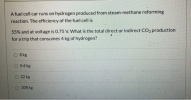 A fuel cell car runs on hydrogen produced from steam-methane reforming reaction. The efficiency of the fuel cell is 55% and at voltage is 0.75 V. What is the total direct or indirect CO2 production for a trip that consumes 4 kg of hydrogen? O 8kg O 0.4 kg o 22 kg 108 kg
The thermodynamic data for the oxidation of one mole of hydrogen (hydrogen- oxygen fuel cell reaction)...
 The thermodynamic data for the oxidation of one mole of hydrogen (hydrogen- oxygen fuel cell reaction) at 25 and 200 degree C temperatures are given in the table Calculate, The reversible voltage (E_r) and thermo-neutral voltage (E_tn) at 25 degree C and 200 degree C The theoretical (thermodynamic efficiency at 25 degree C and 200 degree C The rate of thermodynamic heat generation at 25 degree C and 200 degree C in kJ/mol The rate of thermodynamic heat generation at...
J8-16. A hydrogen-oxygen fuel cell delivers one ampere at 0.72 V with a fuel flow of...
 J8-16. A hydrogen-oxygen fuel cell delivers one ampere at 0.72 V with a fuel flow of 10.00 cm3/min. Independent measurement shows that 2.25 cm/min of fuel is escaping through the electrolyte unreacted. The cell operates in the standard state of 298°K and 1 atm. (a) Find the actual voltage and current efficiency. (b) Fid the magnitude of the three major contributions to heat transfer from the cell.
Methane (CH4) and oxygen (O2) react to form formaldehyde (CH2O) (reaction #1), with a competing side...
Methane (CH4) and oxygen (O2) react to form formaldehyde (CH2O) (reaction #1), with a competing side reaction (#2) in which methane and oxygen form carbon dioxide (CO2): CH4(v) + O2(g) -> CH2O(v) + H2O(l) (reaction #1) CH4(v) + 2O2(g) -> CO2(g) + 2H2O(l) (reaction #2) A fresh feed of an equimolar gas mixture of CH4 and O2 is combined with a recycle stream and fed to a reactor. The single-pass conversion of CH4 is 30% and the selectivity of CH2O...
A fuel cell designed to react grain alcohol with oxygen has the following net reaction: C2H5OH(l)...
A fuel cell designed to react grain alcohol with oxygen has the following net reaction: C2H5OH(l) + 3 O2(g) –––> 2 CO2(g) + 3 H2O(l) The maximum work that 1 mole of alcohol can yield by this process is 1320 kJ. What is the theoretical maximum voltage that this cell can achieve? NOTE: The first step in solving this problem is to determine n, the number of moles of electrons transferred when this reaction takes place as written. A) 1.14...
 A fuel cell car runs on hydrogen produced from steam-methane reforming reaction. The efficiency of the fuel cell is 55% and at voltage is 0.75 V. What is the total direct or indirect CO2 production for a trip that consumes 4 kg of hydrogen? O 8kg O 0.4 kg o 22 kg 108 kg
 The thermodynamic data for the oxidation of one mole of hydrogen (hydrogen- oxygen fuel cell reaction) at 25 and 200 degree C temperatures are given in the table Calculate, The reversible voltage (E_r) and thermo-neutral voltage (E_tn) at 25 degree C and 200 degree C The theoretical (thermodynamic efficiency at 25 degree C and 200 degree C The rate of thermodynamic heat generation at 25 degree C and 200 degree C in kJ/mol The rate of thermodynamic heat generation at...
 J8-16. A hydrogen-oxygen fuel cell delivers one ampere at 0.72 V with a fuel flow of 10.00 cm3/min. Independent measurement shows that 2.25 cm/min of fuel is escaping through the electrolyte unreacted. The cell operates in the standard state of 298°K and 1 atm. (a) Find the actual voltage and current efficiency. (b) Fid the magnitude of the three major contributions to heat transfer from the cell.
Most questions answered within 3 hours.
-
Where is the error in this code sequence?
String s1 = "Hello";
String s2 = "ello";...
asked 11 months ago -
Financial data for Joel de Paris, Inc., for last year
follow:
Joel de Paris, Inc.
Balance...
asked 11 months ago -
Consider this reaction:
Al2(SO4)3 (aq)+ BaCl3
(aq) Al2Cl6 (aq)- +
3BaSO4(s) . What is the...
asked 11 months ago -
Suppose that Savneet is considering increasing her
recent random sample from 20 car rentals to 40...
asked 11 months ago -
Trucks arrive at an unloading terminal at an average rate of 120
per hour.
Trucks arrive...
asked 11 months ago -
Why are methanol and ethanol completely soluble in water while
octanol is not very little soluble....
asked 11 months ago -
A facilities manager at a university reads in a research report
that the mean amount of...
asked 11 months ago -
When the CuSO4 is rehydrated by adding water to the anhydrous
compound, is this an endothermic...
asked 11 months ago -
A ray of sunlight is passing from diamond into crown glass; the
angle of incidence is...
asked 11 months ago -
A block of mass 0.249 kg is placed on top of a light, vertical
spring of...
asked 11 months ago -
how do the kidneys compensate in the presences of acidosis
a) trigger hyperventilate
b) reserve acid...
asked 11 months ago -
Question 501 pts
The rental rate of capital to the firm increases. Which of the
following...
asked 11 months ago