Question about PHASE CHANGES and CALCULATING HEAT. Question: There is 50g of ice at -10 degrees...
Question about PHASE CHANGES and CALCULATING HEAT.
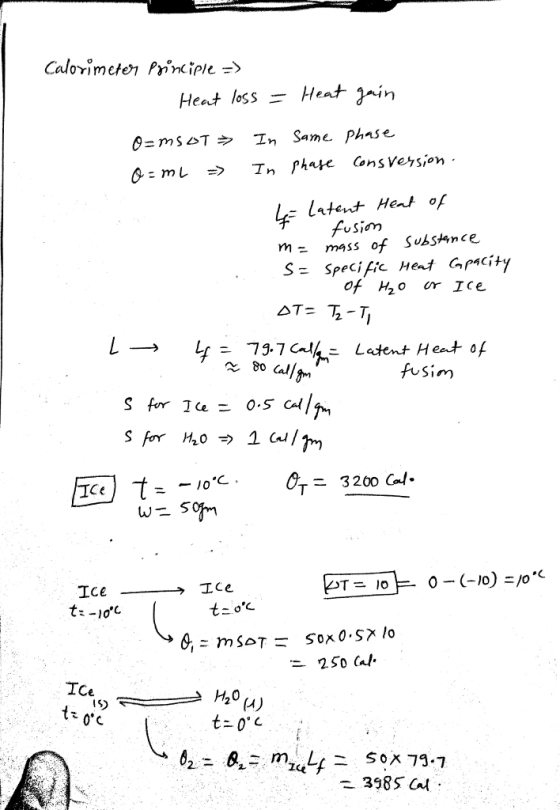
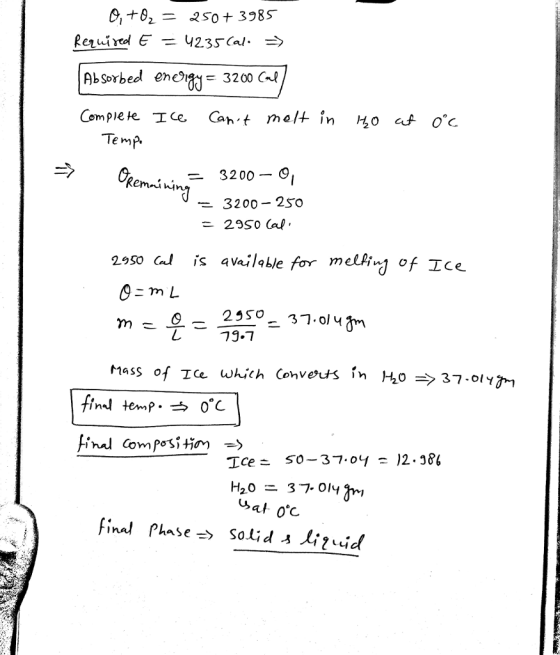
Question: There is 50g of ice at -10 degrees Celsius. If 3200 cal of energy is absorbed, what is the final phase of the material? Consider that q=mc(delta T) for no phase change, and q=mL for phase change. Please show all your work.
Homework Answers
Heat loss = Heat gain .
Energy can't destroyed or created.
Q= mS∆T
Q = heat
m= Mass of substance
∆T = change in temperature.
Add Answer to:
Question about PHASE CHANGES and CALCULATING HEAT.
Question: There is 50g of ice at -10 degrees...
Please Help!!!! QUESTION 16 A 1.00 kg block of ice (specific heat 0.500 cal/g deg C)...
 Please Help!!!!
QUESTION 16 A 1.00 kg block of ice (specific heat 0.500 cal/g deg C) is removed from the freezer where it was kept at -13.2 degrees Celsius. How much heat energy (in cal) has it absorbed when its temperature is -5 degrees Celsius? QUESTION 17 How much heat energy (in cal) is required to heat the block from the previous problem from -5 deg Celsius to 0 deg Celsius?
Please Help!!!!
QUESTION 16 A 1.00 kg block of ice (specific heat 0.500 cal/g deg C) is removed from the freezer where it was kept at -13.2 degrees Celsius. How much heat energy (in cal) has it absorbed when its temperature is -5 degrees Celsius? QUESTION 17 How much heat energy (in cal) is required to heat the block from the previous problem from -5 deg Celsius to 0 deg Celsius?
please answer all questions Temperature Change and Phase Change - Specific Heat and Latent Heat -...
 please answer all questions
Temperature Change and Phase Change - Specific Heat and Latent Heat - From COLD ICE to Warm Water The quantitative relationship between heat transfer and temperature change is Q = mcAT, where Q is heat transfer, m is the mass of the substance, and AT is the change in temperature. The symbol c stands for specific heat which depends on the material and phase (for exmample, water and ice have different specific heat). The specific heat...
please answer all questions
Temperature Change and Phase Change - Specific Heat and Latent Heat - From COLD ICE to Warm Water The quantitative relationship between heat transfer and temperature change is Q = mcAT, where Q is heat transfer, m is the mass of the substance, and AT is the change in temperature. The symbol c stands for specific heat which depends on the material and phase (for exmample, water and ice have different specific heat). The specific heat...
cork thermometer plastic lid ← stirrer insulator ring reservoir ice and water aluminum container Figure 5.1:...
 cork thermometer plastic lid ← stirrer insulator ring reservoir ice and water aluminum container Figure 5.1: A Simple Calorimeter In the other direction, when the phase change is from liquid to solid, the sample must release the same amount of energy. For water at its normal freezing or melting temperature, Lf=79.5 cal/g = 333 kJ/kg (5.2) This lab employs a double-wall calorimeter as shown in Figure 5.1 to measure the heat of fusion for ice. The calorimeter consists of an...
O Assignment Score: 40.9% Resources Hint Check Answer Question 22 of 22 > Phase changes are...
 O Assignment Score: 40.9% Resources Hint Check Answer Question 22 of 22 > Phase changes are transitions between solid, liquid, and gas phases. For example, ice melting is an example of a phase change from a solid (ice) to a liquid (water). Phase changes involve changes in energy. Which of the statements regarding phase changes are true? Deposition is the conversion of a gas to a solid. Melting is the conversion of a solid to a liquid. Sublimation is the...
do numbers 5-10, show work, circle answer A. 3 cm B.6.29 cm C. 0.3 m 5....
 do numbers 5-10, show work, circle answer
A. 3 cm B.6.29 cm C. 0.3 m 5. A block is 5 cm x 7 cm x 2cm and has a mass of 128 g. If the density of water is 1 g/cc what is the apparant mass for the block once its submerged in Water? A. 58 g B. 70 g C. 140 g 6. Water is in a container that is open at the top and has hole at the...
do numbers 5-10, show work, circle answer
A. 3 cm B.6.29 cm C. 0.3 m 5. A block is 5 cm x 7 cm x 2cm and has a mass of 128 g. If the density of water is 1 g/cc what is the apparant mass for the block once its submerged in Water? A. 58 g B. 70 g C. 140 g 6. Water is in a container that is open at the top and has hole at the...
B. 10 points In the Calorimetry lab you determined an experimental value for the heat of...
 B. 10 points In the Calorimetry lab you determined an experimental value for the heat of fusion of ice. The density of water is exactly 1 g/mL ATater is the temperature change of the water after the ice cube has melted. Tr-T, ke ATal is the total temperature change of the calorimeter Tr T, cal Use the data in the table to determine an experimental value for AHsi Determine a percent error if the known value is 6.02 kJ/mole Show...
Olive Oil is almost pure glyceryl trioleate, C57H104O6. The equation for the combustion of glyceryl trioleate...
Olive Oil is almost pure glyceryl trioleate, C57H104O6. The equation for the combustion of glyceryl trioleate is: C57H104O6 + 80 O2 -> 57 CO2 + 52 H20. What is the change in the internal energy, delta E, in kJ for the combustion of 1 mol glyceryl trioleate? ANS: -1.93*10^3 kJ/mol glycerol trioleate I was provided the answer, but I don't know how to solve. Please show your work so I can understand. Previous question before this was: 1.000 g olive...
Please help me solve this problem. (5 points) Table 1: Heat Content of a Snack Food...
 Please help me solve this problem.
(5 points) Table 1: Heat Content of a Snack Food using Calorimetry-see below for calculations PROPERTY TRIAL1 TRIAL 2 TRİAL3 Dorito Snack Used Volume of water (mL) Mass of water (g) Mass of snack (g) Initial temperature (°C) Final temperature (°C) Change in temperature (°C) Heat absorbed by water (cal) 9 ml 个1 19 ml 991 o 346 24.5 33.1 c 8,6 C 2 53 04Ss 24.S C 37.S Heat released by snack (food...
Please help me solve this problem.
(5 points) Table 1: Heat Content of a Snack Food using Calorimetry-see below for calculations PROPERTY TRIAL1 TRIAL 2 TRİAL3 Dorito Snack Used Volume of water (mL) Mass of water (g) Mass of snack (g) Initial temperature (°C) Final temperature (°C) Change in temperature (°C) Heat absorbed by water (cal) 9 ml 个1 19 ml 991 o 346 24.5 33.1 c 8,6 C 2 53 04Ss 24.S C 37.S Heat released by snack (food...
please answer all questions Temperature Change and Heat Capacity - Calorimetry- Two substances The quantitative relationship...
 please answer all questions
Temperature Change and Heat Capacity - Calorimetry- Two substances The quantitative relationship between heat transfer and temperature change is Q = mcAT, where Q is heat transfer, m is the mass of the substance, and AT is the change in temperature. The symbol c stands for specific heat and depends on the material and phase. The specific heat c is the amount of heat necessary to change the temperature of 1.00 kg of mass by 1.00°C....
please answer all questions
Temperature Change and Heat Capacity - Calorimetry- Two substances The quantitative relationship between heat transfer and temperature change is Q = mcAT, where Q is heat transfer, m is the mass of the substance, and AT is the change in temperature. The symbol c stands for specific heat and depends on the material and phase. The specific heat c is the amount of heat necessary to change the temperature of 1.00 kg of mass by 1.00°C....
3. Here we use 4.184 for our calorimetry constant, since that is how much energy it...
 3. Here we use 4.184 for our calorimetry constant, since that is how much energy it takes to raise 1 gram of water by 1 degree Celsius. But what if we did not know that? How could I calibrate our calorimeter to find this value? -10 points 4. What are 2 sources of error for this experiment (you cannot simply say human error)? how would the error effect the measurement? - 10 points 5. How much energy would be transferred...
 Please Help!!!!
QUESTION 16 A 1.00 kg block of ice (specific heat 0.500 cal/g deg C) is removed from the freezer where it was kept at -13.2 degrees Celsius. How much heat energy (in cal) has it absorbed when its temperature is -5 degrees Celsius? QUESTION 17 How much heat energy (in cal) is required to heat the block from the previous problem from -5 deg Celsius to 0 deg Celsius?
Please Help!!!!
QUESTION 16 A 1.00 kg block of ice (specific heat 0.500 cal/g deg C) is removed from the freezer where it was kept at -13.2 degrees Celsius. How much heat energy (in cal) has it absorbed when its temperature is -5 degrees Celsius? QUESTION 17 How much heat energy (in cal) is required to heat the block from the previous problem from -5 deg Celsius to 0 deg Celsius?
 please answer all questions
Temperature Change and Phase Change - Specific Heat and Latent Heat - From COLD ICE to Warm Water The quantitative relationship between heat transfer and temperature change is Q = mcAT, where Q is heat transfer, m is the mass of the substance, and AT is the change in temperature. The symbol c stands for specific heat which depends on the material and phase (for exmample, water and ice have different specific heat). The specific heat...
please answer all questions
Temperature Change and Phase Change - Specific Heat and Latent Heat - From COLD ICE to Warm Water The quantitative relationship between heat transfer and temperature change is Q = mcAT, where Q is heat transfer, m is the mass of the substance, and AT is the change in temperature. The symbol c stands for specific heat which depends on the material and phase (for exmample, water and ice have different specific heat). The specific heat...
 cork thermometer plastic lid ← stirrer insulator ring reservoir ice and water aluminum container Figure 5.1: A Simple Calorimeter In the other direction, when the phase change is from liquid to solid, the sample must release the same amount of energy. For water at its normal freezing or melting temperature, Lf=79.5 cal/g = 333 kJ/kg (5.2) This lab employs a double-wall calorimeter as shown in Figure 5.1 to measure the heat of fusion for ice. The calorimeter consists of an...
 O Assignment Score: 40.9% Resources Hint Check Answer Question 22 of 22 > Phase changes are transitions between solid, liquid, and gas phases. For example, ice melting is an example of a phase change from a solid (ice) to a liquid (water). Phase changes involve changes in energy. Which of the statements regarding phase changes are true? Deposition is the conversion of a gas to a solid. Melting is the conversion of a solid to a liquid. Sublimation is the...
 do numbers 5-10, show work, circle answer
A. 3 cm B.6.29 cm C. 0.3 m 5. A block is 5 cm x 7 cm x 2cm and has a mass of 128 g. If the density of water is 1 g/cc what is the apparant mass for the block once its submerged in Water? A. 58 g B. 70 g C. 140 g 6. Water is in a container that is open at the top and has hole at the...
do numbers 5-10, show work, circle answer
A. 3 cm B.6.29 cm C. 0.3 m 5. A block is 5 cm x 7 cm x 2cm and has a mass of 128 g. If the density of water is 1 g/cc what is the apparant mass for the block once its submerged in Water? A. 58 g B. 70 g C. 140 g 6. Water is in a container that is open at the top and has hole at the...
 B. 10 points In the Calorimetry lab you determined an experimental value for the heat of fusion of ice. The density of water is exactly 1 g/mL ATater is the temperature change of the water after the ice cube has melted. Tr-T, ke ATal is the total temperature change of the calorimeter Tr T, cal Use the data in the table to determine an experimental value for AHsi Determine a percent error if the known value is 6.02 kJ/mole Show...
 Please help me solve this problem.
(5 points) Table 1: Heat Content of a Snack Food using Calorimetry-see below for calculations PROPERTY TRIAL1 TRIAL 2 TRİAL3 Dorito Snack Used Volume of water (mL) Mass of water (g) Mass of snack (g) Initial temperature (°C) Final temperature (°C) Change in temperature (°C) Heat absorbed by water (cal) 9 ml 个1 19 ml 991 o 346 24.5 33.1 c 8,6 C 2 53 04Ss 24.S C 37.S Heat released by snack (food...
Please help me solve this problem.
(5 points) Table 1: Heat Content of a Snack Food using Calorimetry-see below for calculations PROPERTY TRIAL1 TRIAL 2 TRİAL3 Dorito Snack Used Volume of water (mL) Mass of water (g) Mass of snack (g) Initial temperature (°C) Final temperature (°C) Change in temperature (°C) Heat absorbed by water (cal) 9 ml 个1 19 ml 991 o 346 24.5 33.1 c 8,6 C 2 53 04Ss 24.S C 37.S Heat released by snack (food...
 please answer all questions
Temperature Change and Heat Capacity - Calorimetry- Two substances The quantitative relationship between heat transfer and temperature change is Q = mcAT, where Q is heat transfer, m is the mass of the substance, and AT is the change in temperature. The symbol c stands for specific heat and depends on the material and phase. The specific heat c is the amount of heat necessary to change the temperature of 1.00 kg of mass by 1.00°C....
please answer all questions
Temperature Change and Heat Capacity - Calorimetry- Two substances The quantitative relationship between heat transfer and temperature change is Q = mcAT, where Q is heat transfer, m is the mass of the substance, and AT is the change in temperature. The symbol c stands for specific heat and depends on the material and phase. The specific heat c is the amount of heat necessary to change the temperature of 1.00 kg of mass by 1.00°C....
 3. Here we use 4.184 for our calorimetry constant, since that is how much energy it takes to raise 1 gram of water by 1 degree Celsius. But what if we did not know that? How could I calibrate our calorimeter to find this value? -10 points 4. What are 2 sources of error for this experiment (you cannot simply say human error)? how would the error effect the measurement? - 10 points 5. How much energy would be transferred...
Most questions answered within 3 hours.
-
Where is the error in this code sequence?
String s1 = "Hello";
String s2 = "ello";...
asked 10 months ago -
Financial data for Joel de Paris, Inc., for last year
follow:
Joel de Paris, Inc.
Balance...
asked 10 months ago -
Consider this reaction:
Al2(SO4)3 (aq)+ BaCl3
(aq) Al2Cl6 (aq)- +
3BaSO4(s) . What is the...
asked 10 months ago -
Suppose that Savneet is considering increasing her
recent random sample from 20 car rentals to 40...
asked 10 months ago -
Trucks arrive at an unloading terminal at an average rate of 120
per hour.
Trucks arrive...
asked 10 months ago -
Why are methanol and ethanol completely soluble in water while
octanol is not very little soluble....
asked 10 months ago -
A facilities manager at a university reads in a research report
that the mean amount of...
asked 10 months ago -
When the CuSO4 is rehydrated by adding water to the anhydrous
compound, is this an endothermic...
asked 10 months ago -
A ray of sunlight is passing from diamond into crown glass; the
angle of incidence is...
asked 10 months ago -
A block of mass 0.249 kg is placed on top of a light, vertical
spring of...
asked 10 months ago -
how do the kidneys compensate in the presences of acidosis
a) trigger hyperventilate
b) reserve acid...
asked 10 months ago -
Question 501 pts
The rental rate of capital to the firm increases. Which of the
following...
asked 10 months ago