a cart moves along a frictionless track on a rainy day. The rain falls straight down,...
a cart moves along a frictionless track on a rainy day. The rain falls straight down, and some of it lands in the open cart. The raindrops fall in such a way that they either land in the cart or do not hit it at all. There is no air resistance. Does the cart slow down, speed up, or maintains constant speed? Explain.
Homework Answers
By law of conservation of momentum
Product of mass and velocity remains constant. In other words, momentum remains constant. Mass is inversely proportional to the velocity of the cart.
As the mass of the cart increases due to rain drop falling in it, velocity of the new car mass system starts to decrease proportionally.
Add Answer to:
a cart moves along a frictionless track on a rainy day. The rain
falls straight down,...
Suppose that while a mining cart is rolling along a straight, frictionless, horizontal track with some...
Suppose that while a mining cart is rolling along a straight, frictionless, horizontal track with some initial speed, it starts to rain. If the rain falls vertically into the cart and begins to accumulate within it, flooding the cart, determine the following 19. is the momentum of the system conserved in the horizontal direction? a. Yes b. No 20. Is the momentum of the system conserved in the vertical direction? a. Yes b. No 22.If a 1200 kg train car...
A negatively charged cart moves along a frictionless track from point A to point B. The...
 A negatively charged cart moves along a frictionless track from
point A to point B. The cart has enough speed to make it all the
way to point B. There is a non-constant electric field along the
track. The field values change at each meter of the track and are
known ( Toward B). This info is given below. At which meter marker
is the cart moving the fastest? Explain
ITHAT THE E. He started in 1991. seen as a...
A negatively charged cart moves along a frictionless track from
point A to point B. The cart has enough speed to make it all the
way to point B. There is a non-constant electric field along the
track. The field values change at each meter of the track and are
known ( Toward B). This info is given below. At which meter marker
is the cart moving the fastest? Explain
ITHAT THE E. He started in 1991. seen as a...
QUESTION 7 A trolley of mass 400 kg moves along a frictionless track from left to...
 QUESTION 7 A trolley of mass 400 kg moves along a frictionless track from left to right, as shown in the diagram. At point A it has a speed of 12.5 m/s. What will the speed of the trolley be at point D, in units of m/s? Assume that air resistance is negligible. 550m 3.50m 8.00 m 4.00 m 2.50 B C
A cart is moving along a long, frictionless horizontal air track. Two students are pushing on...
A cart is moving along a long, frictionless horizontal air track. Two students are pushing on it: Bob is doing positive work, and Alice is doing negative work If the cart is moving to the left and slowing down, which statement below is true? A) Bob pushes to the right; the net work done on the cart is positive, B) Bob pushes to the left; the net work done on the cart is positive C) Bob pushes to the right:...
5. Moving Vehicle and Falling rain 0 0 0 rain frictionless A vehicle of'dry' mass mo...
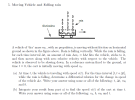 5. Moving Vehicle and Falling rain 0 0 0 rain frictionless A vehicle of'dry' mass mo , with no propulsion, is moving without friction on horizontal ground as shown in the figure above. Rain is falling vertically. While the rain is falling, for each time interval Δt, an amount of rain Δmr-łAt hits the vehicle, sticks to it and then moves along with zero relative velocity with respect to the vehicle. The vehicle is observed to be slowing down. In...
3. A freight car moves along a frictionless level railroad track at constant speed. The car...
 3. A freight car moves along a frictionless level railroad track at constant speed. The car is open on top. A large load of coal is suddenly dumped into the car. What happens to the velocity of the car? A) It increases. B) It remains the same. C) It decreases D) cannot be determined from the information given
Block 1, of mass m1 = 3.50 kg , moves along a frictionless air track with...
Block 1, of mass m1 = 3.50 kg , moves along a frictionless air track with speed v1 = 11.0 m/s . It collides with block 2, of mass m2 = 43.0 kg , which was initially at rest. The blocks stick together after the collision. What is the change ΔK=Kfinal−Kinitial in the two-block system's kinetic energy due to the collision?
Block 1, of mass m1 = 8.90 kg , moves along a frictionless air track with...
Block 1, of mass m1 = 8.90 kg , moves along a frictionless air track with speed v1 = 31.0 m/s . It collides with block 2, of mass m2 = 15.0 kg , which was initially at rest. The blocks stick together after the collision. (Figure 1) What is the change ΔK=Kfinal−Kinitial in the two-block system's kinetic energy due to the collision?
Block 1, of mass m1 = 9.10 kg , moves along a frictionless air track with...
 Block 1, of mass m1 = 9.10 kg , moves along a frictionless air
track with speed v1 = 27.0 m/s . It collides with block 2, of mass
m2 = 13.0 kg , which was initially at rest. The blocks stick
together after the collision.
What is the change ΔK=Kfinal−Kinitial in the two-block system's
kinetic energy due to the collision?
Express your answer numerically in joules.
Before collision: m2 After collision:
Block 1, of mass m1 = 9.10 kg , moves along a frictionless air
track with speed v1 = 27.0 m/s . It collides with block 2, of mass
m2 = 13.0 kg , which was initially at rest. The blocks stick
together after the collision.
What is the change ΔK=Kfinal−Kinitial in the two-block system's
kinetic energy due to the collision?
Express your answer numerically in joules.
Before collision: m2 After collision:
Block 1, of mass = 3.70 , moves along a frictionless air track with speed =...
 Block 1, of mass = 3.70
, moves along a frictionless air track with
speed = 23.0
. It collides with block 2, of mass = 13.0
, which was initially at rest. The blocks stick
togetherafter the collision.
part A
Find the magnitude of the total initial momentum of the
two-blocksystem.
Express your answernumerically.
part B
Find , the magnitude of the final velocity of the
two-blocksystem.
Express your answer numerically
part C
What is the change in the...
Block 1, of mass = 3.70
, moves along a frictionless air track with
speed = 23.0
. It collides with block 2, of mass = 13.0
, which was initially at rest. The blocks stick
togetherafter the collision.
part A
Find the magnitude of the total initial momentum of the
two-blocksystem.
Express your answernumerically.
part B
Find , the magnitude of the final velocity of the
two-blocksystem.
Express your answer numerically
part C
What is the change in the...
 A negatively charged cart moves along a frictionless track from
point A to point B. The cart has enough speed to make it all the
way to point B. There is a non-constant electric field along the
track. The field values change at each meter of the track and are
known ( Toward B). This info is given below. At which meter marker
is the cart moving the fastest? Explain
ITHAT THE E. He started in 1991. seen as a...
A negatively charged cart moves along a frictionless track from
point A to point B. The cart has enough speed to make it all the
way to point B. There is a non-constant electric field along the
track. The field values change at each meter of the track and are
known ( Toward B). This info is given below. At which meter marker
is the cart moving the fastest? Explain
ITHAT THE E. He started in 1991. seen as a...
 QUESTION 7 A trolley of mass 400 kg moves along a frictionless track from left to right, as shown in the diagram. At point A it has a speed of 12.5 m/s. What will the speed of the trolley be at point D, in units of m/s? Assume that air resistance is negligible. 550m 3.50m 8.00 m 4.00 m 2.50 B C
 5. Moving Vehicle and Falling rain 0 0 0 rain frictionless A vehicle of'dry' mass mo , with no propulsion, is moving without friction on horizontal ground as shown in the figure above. Rain is falling vertically. While the rain is falling, for each time interval Δt, an amount of rain Δmr-łAt hits the vehicle, sticks to it and then moves along with zero relative velocity with respect to the vehicle. The vehicle is observed to be slowing down. In...
 3. A freight car moves along a frictionless level railroad track at constant speed. The car is open on top. A large load of coal is suddenly dumped into the car. What happens to the velocity of the car? A) It increases. B) It remains the same. C) It decreases D) cannot be determined from the information given
 Block 1, of mass m1 = 9.10 kg , moves along a frictionless air
track with speed v1 = 27.0 m/s . It collides with block 2, of mass
m2 = 13.0 kg , which was initially at rest. The blocks stick
together after the collision.
What is the change ΔK=Kfinal−Kinitial in the two-block system's
kinetic energy due to the collision?
Express your answer numerically in joules.
Before collision: m2 After collision:
Block 1, of mass m1 = 9.10 kg , moves along a frictionless air
track with speed v1 = 27.0 m/s . It collides with block 2, of mass
m2 = 13.0 kg , which was initially at rest. The blocks stick
together after the collision.
What is the change ΔK=Kfinal−Kinitial in the two-block system's
kinetic energy due to the collision?
Express your answer numerically in joules.
Before collision: m2 After collision:
 Block 1, of mass = 3.70
, moves along a frictionless air track with
speed = 23.0
. It collides with block 2, of mass = 13.0
, which was initially at rest. The blocks stick
togetherafter the collision.
part A
Find the magnitude of the total initial momentum of the
two-blocksystem.
Express your answernumerically.
part B
Find , the magnitude of the final velocity of the
two-blocksystem.
Express your answer numerically
part C
What is the change in the...
Block 1, of mass = 3.70
, moves along a frictionless air track with
speed = 23.0
. It collides with block 2, of mass = 13.0
, which was initially at rest. The blocks stick
togetherafter the collision.
part A
Find the magnitude of the total initial momentum of the
two-blocksystem.
Express your answernumerically.
part B
Find , the magnitude of the final velocity of the
two-blocksystem.
Express your answer numerically
part C
What is the change in the...
Most questions answered within 3 hours.
-
Where is the error in this code sequence?
String s1 = "Hello";
String s2 = "ello";...
asked 10 months ago -
Financial data for Joel de Paris, Inc., for last year
follow:
Joel de Paris, Inc.
Balance...
asked 10 months ago -
Consider this reaction:
Al2(SO4)3 (aq)+ BaCl3
(aq) Al2Cl6 (aq)- +
3BaSO4(s) . What is the...
asked 10 months ago -
Suppose that Savneet is considering increasing her
recent random sample from 20 car rentals to 40...
asked 10 months ago -
Trucks arrive at an unloading terminal at an average rate of 120
per hour.
Trucks arrive...
asked 10 months ago -
Why are methanol and ethanol completely soluble in water while
octanol is not very little soluble....
asked 10 months ago -
A facilities manager at a university reads in a research report
that the mean amount of...
asked 10 months ago -
When the CuSO4 is rehydrated by adding water to the anhydrous
compound, is this an endothermic...
asked 10 months ago -
A ray of sunlight is passing from diamond into crown glass; the
angle of incidence is...
asked 10 months ago -
A block of mass 0.249 kg is placed on top of a light, vertical
spring of...
asked 10 months ago -
how do the kidneys compensate in the presences of acidosis
a) trigger hyperventilate
b) reserve acid...
asked 10 months ago -
Question 501 pts
The rental rate of capital to the firm increases. Which of the
following...
asked 10 months ago