. A run is a sequence of adjacent repeated values. Write a program that generates a...
. A run is a sequence of adjacent repeated values. Write a program that generates a sequence of 20 random die tosses and then prints the die values, marking the runs by including them in parentheses, like this:
1 2 (5 5) 3 1 2 4 3 (2 2 2 2) 3 6 (5 5) 6 3 1
Use the following pseudocode:
Set a boolean variable inRun to false.
For each valid index i in the list
if inRun If values[i] is different from the preceding value
Print )
inRun = false
Else
if values[i] is the same as the following value
print (
inRun = true
Print values[i]
If inRun, print )
programming language: python
Homework Answers
import random
arr=[]
inRun=False
for i in range(20):#loop to generate a list of random
numbers
arr.append(random.randrange(1,7))
for i in range(1,20):
if(inRun):#to verify the condition where to print ')'
if(arr[i]!=arr[i-1]):
print(')',end='')
inRun=False
elif(i<19):
if(arr[i]==arr[i+1] ):#to verify the condition where to print
'('
print('(',end='')
inRun=True
print(arr[i],end='')
if(inRun):
print(')',end='')
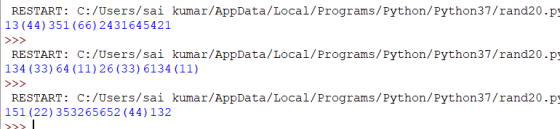
output:
Add Answer to:
. A run is a sequence of adjacent repeated values. Write a
program that generates a...
4 CS136: Computer Science II-Spring 2019 [10 points] Problem #4 A run is a sequence of...
 4 CS136: Computer Science II-Spring 2019 [10 points] Problem #4 A run is a sequence of adjacent repeated values. write a Java class (RunsPrinter. java) with one main method that generates a sequence of 20 random die tosses in an array (and not an ArrayList) and then prints the die values, marking the runs by including them in parentheses, like this: 1 2 (5 5) 3 124 3 (2 2 2 2) 3 6 (5 5) 6 3 1 Examples...
Write a program that generates a sequence of 20 random die tosses and that prints the...
Write a program that generates a sequence of 20 random die tosses and that prints the die values, marking only the longest run, like this: 1 2 5 5 3 3 2 4 3 (2 2 2 2) 3 6 5 5 6 3 1 programming language: python
Write a program that generates a sequence of 20 random die tosses in an ArrayList and...
Write a program that generates a sequence of 20 random die tosses in an ArrayList and that prints the die values, marking only the longest run, like this: 1 2 5 5 3 1 2 4 3 (2 2 2 2) 3 6 5 5 6 3 1 If there is more than one run of maximum length, mark the first one. Must use ArrayList, not an array!
F a as a sequence of adjacent array elements such that each value in the run array was of size 10...
 f a as a sequence of adjacent array elements such that each value in the run array was of size 10 9. We define a "run" of elements o (except for the first) is one greater than the previous and looked like: value. For example, say the 3 2 16 9 7 8 9 2 a: position 0 3 We have three runs in this array: (1) between 9,10,1, 12) and, (3) between positions 7 and 8, (15, 16) positions...
C programming! Write a program that reads integers until 0 and prints the sum of values...
C programming! Write a program that reads integers until 0 and prints the sum of values on odd positions minus the sum of values on even positions. Let ?1, ?2, … , ??, 0 be the input sequence. Then the program prints the value of ?1 − ?2 + ?3 − ?4 + ⋯ ??. The input is a sequence of integers that always contains at least 0 and the output will be a single number. For example, for input...
write the solution of the program by python 3 language : I need the program using...
write the solution of the program by python 3 language : I need the program using list or string or loops (while and for) or if,elif,else : You are given a sequence of n non-zero integers a1,a2,…,an. Determine if the given sequence contains a pair of adjacent elements of the same sign (both negative or both positive). Two elements are called adjacent if they stand next to each other in the sequence. Input The first line contains an integer n...
write the solution of the program by python 3 language : I need the program using...
write the solution of the program by python 3 language : I need the program using list or string or loops (while and for) or if,elif,else : i have 15 min to submit the solution please help me You are given a sequence of n non-zero integers a1,a2,…,an. Determine if the given sequence contains a pair of adjacent elements of the same sign (both negative or both positive). Two elements are called adjacent if they stand next to each other...
Assume that L is a list of Boolean values, True and False. Write a function longestFalse(L)...
Assume that L is a list of Boolean values, True and False. Write a function longestFalse(L) which returns a tuple (start, end) representing the start and end indices of the longest run of False values in L. If there is a tie, then return the first such run. For example, if L is False False True False False False False True True False False 0 1 2 3 4 5 6 7 8 9 10 then the function would return...
1 [Run Lengths] Write a function (in Python and numpy) with the following specification def run_lenths(n,...
1 [Run Lengths] Write a function (in Python and numpy) with the following specification def run_lenths(n, p): """Return a list of the run lengths in n tosses of a coin whose heads probability is p. Arguments: n--Number of tosses (a positive int), p--The probability of observing heads for any given toss (float between 0 and 1). """ For example, if the simulated sequence of coin tosses is HTTHHTHHHTTHHTTTTH, then the list of run lengths the function returns will be [1,...
An arithmetic sequence is a sequence of values where successive values have a common difference. For...
An arithmetic sequence is a sequence of values where successive values have a common difference. For example, 2,5,8,11,... is an arithmetic sequence starting at 2 with a common difference of 3. We call the starting point s and the difference d. Write a recursive Python function called arithmetic that takes values for s, d, and n, and returns the nth term of the arithmetic sequence. Given the main function: def main(): for i in range(1,6): print(arithmetic(2,3,i)) the output will be:...
 4 CS136: Computer Science II-Spring 2019 [10 points] Problem #4 A run is a sequence of adjacent repeated values. write a Java class (RunsPrinter. java) with one main method that generates a sequence of 20 random die tosses in an array (and not an ArrayList) and then prints the die values, marking the runs by including them in parentheses, like this: 1 2 (5 5) 3 124 3 (2 2 2 2) 3 6 (5 5) 6 3 1 Examples...
 f a as a sequence of adjacent array elements such that each value in the run array was of size 10 9. We define a "run" of elements o (except for the first) is one greater than the previous and looked like: value. For example, say the 3 2 16 9 7 8 9 2 a: position 0 3 We have three runs in this array: (1) between 9,10,1, 12) and, (3) between positions 7 and 8, (15, 16) positions...
Most questions answered within 3 hours.
-
Where is the error in this code sequence?
String s1 = "Hello";
String s2 = "ello";...
asked 10 months ago -
Financial data for Joel de Paris, Inc., for last year
follow:
Joel de Paris, Inc.
Balance...
asked 10 months ago -
Consider this reaction:
Al2(SO4)3 (aq)+ BaCl3
(aq) Al2Cl6 (aq)- +
3BaSO4(s) . What is the...
asked 10 months ago -
Suppose that Savneet is considering increasing her
recent random sample from 20 car rentals to 40...
asked 10 months ago -
Trucks arrive at an unloading terminal at an average rate of 120
per hour.
Trucks arrive...
asked 10 months ago -
Why are methanol and ethanol completely soluble in water while
octanol is not very little soluble....
asked 10 months ago -
A facilities manager at a university reads in a research report
that the mean amount of...
asked 10 months ago -
When the CuSO4 is rehydrated by adding water to the anhydrous
compound, is this an endothermic...
asked 10 months ago -
A ray of sunlight is passing from diamond into crown glass; the
angle of incidence is...
asked 10 months ago -
A block of mass 0.249 kg is placed on top of a light, vertical
spring of...
asked 10 months ago -
how do the kidneys compensate in the presences of acidosis
a) trigger hyperventilate
b) reserve acid...
asked 10 months ago -
Question 501 pts
The rental rate of capital to the firm increases. Which of the
following...
asked 10 months ago