What proportion of the progeny resulting from the cross SsJjYyEe x SsjjyyEe will resemble the phenotype...
What proportion of the progeny resulting from the cross SsJjYyEe x SsjjyyEe will resemble the phenotype of whichever parent?
Homework Answers
Answer:
Since genotype of parents are SsJjYyEe and SsjjyyEe
Then Ss=1/2
Jj=1/2
jj=1/2
Similerly for Yy=1/2
yy=1/2
Ee=1/2
Hence,for SsJjYyEe=1/2*1/2*1/2*1/2=1/16
For SsjjyyEe=1/2*1/2*1/2*1/2=1/16
Hence,1/16 of progeny will resembles the phenotype of parent.
Add Answer to:
What proportion of the progeny resulting from the cross SsJjYyEe
x SsjjyyEe will resemble the phenotype...
Consider the cross (assume a capital allele is dominant to a small case allele): Aa Bb...
Consider the cross (assume a capital allele is dominant to a small case allele): Aa Bb Cc Dd Ee X aa Bb cc Dd ee a) What proportion of the progeny will resemble phenotypically: (1) the female parent? (2) the male parent? (3) either parent? (4) neither parent? b) What proportion of the progeny will resemble genotypically: (1) the female parent? (2) the male parent? (3) either parent? (4) neither parent?
Consider the following cross examining four unlinked genes. Identify what proportion of progeny will be phenotypically...
 Consider the following cross examining four unlinked genes. Identify what proportion of progeny will be phenotypically identical to parent 2? A/a; B/d; e/e times A/a; b/b; E/e
a monohybrid cross between two heterozygous individuals results in 48 progeny with the dominant phenotype and...
a monohybrid cross between two heterozygous individuals results in 48 progeny with the dominant phenotype and 12 progeny with the recessive phenotype. You would like to determine if these results are significantly different from the expected ratios and you conduct a chi-square-test. What is the chi-square value?
A monohybrid cross between two heterozygous individuals results in 48 progeny with the dominant phenotype and...
A monohybrid cross between two heterozygous individuals results in 48 progeny with the dominant phenotype and 12 progeny with the recessive phenotype. You would like to determine if these results are significantly different from the expected ratios and you conduct a chi-square test. What is the chi-square value? use 2 decimal points.
Consider the progeny data attached from a test cross. Using the expected number of progeny that...
Consider the progeny data attached from a test cross. Using the expected number of progeny that are double crossovers based on this data, and given an interference value of –0.18, how may double cross-over progeny should be observed? Enter a number rounded to the nearest integer. Phenotype # progeny {m,b,+} 496 {b,a,m} 27 {b,+,+} 555 {b,a,+} 1312 {+,a,+} 549 {+,+,+} 24 {+,m,+} 1296 {a,+,m} 504
2. Consider the cross Aa Bb Cc Dd X aa Bb cc dd. All of the...
 2. Consider the cross Aa Bb Cc Dd X aa Bb cc dd. All of the genes are on mes. What proportion of progeny will phenotypically resemble the second parent (i.e. the parent listed second in the cross)? Show each individual cross AS OUTLINED IN CLASS. Punnett squares are NOT allowed. Also, show the final calculation to get your answer. In other words, show all of your work. (5 marks) SEDOT a slobo Question 10 (1 point) For the peptide:...
4. The principles that govern the inheritance of two independently assorting genes hold for more than...
 4. The principles that govern the inheritance of two independently assorting genes hold for more than two independently assorting genes. Consider the following cross: TIGgSsDDEE * TTGgSsDdEe → a. What proportion of the progeny will phenotypically resemble (1) the first parent, (2) the second parent, (3) either parent, and (4) neither parent? (4 pts.) b. What proportion of the progeny will genotypically resemble (1) the first parent, (2) the second parent, (3) either parent, and (4) neither parent? (4 pts.)
From this Punnette square, what proportion of the offspring have a phenotype that is DIFFERENT from...
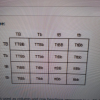 From this Punnette square, what proportion of the
offspring have a phenotype that is DIFFERENT from the phenotype of
either parent?
a. 3/16
b. 6/16
c. 7/16
d. 9/16
e. 1/16
re ТВ Tb тв TTBB ТТвь TIBB TIeb е тТВЫ Тbb тво е тівв TIBb IIBB tb TIBD tBb при і митні
From this Punnette square, what proportion of the
offspring have a phenotype that is DIFFERENT from the phenotype of
either parent?
a. 3/16
b. 6/16
c. 7/16
d. 9/16
e. 1/16
re ТВ Tb тв TTBB ТТвь TIBB TIeb е тТВЫ Тbb тво е тівв TIBb IIBB tb TIBD tBb при і митні
7. Plants of the following genotypes were crossed: (8 points) aaBbccDdEE x AaBbCcDdEe Calculate the proportion...
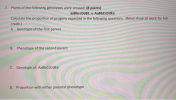 7. Plants of the following genotypes were crossed: (8 points) aaBbccDdEE x AaBbCcDdEe Calculate the proportion of progeny expected in the following questions. (Must show all work for full credit.) A. Genotype of the first parent B. Phenotype of the second parent C. Genotype of: AaBb CcDdEe ( centre de D. Proportion with either parental phenotype
When considering a single character, the progeny of a test cross have a 1:1 ratio of...
When considering a single character, the progeny of a test cross have a 1:1 ratio of dominant to recessive phenotypes. 1) the phenotype of the non-tester parent is a) recessive b) dominant c) homozygous d) heterozygous e) not enough information to solve this problem 2) The genotype of the non-tester parent is a) homozygous dominant b) heterozygous c) homozygous recessive d) hemizygous e) not enough information to solve this problem
 Consider the following cross examining four unlinked genes. Identify what proportion of progeny will be phenotypically identical to parent 2? A/a; B/d; e/e times A/a; b/b; E/e
 2. Consider the cross Aa Bb Cc Dd X aa Bb cc dd. All of the genes are on mes. What proportion of progeny will phenotypically resemble the second parent (i.e. the parent listed second in the cross)? Show each individual cross AS OUTLINED IN CLASS. Punnett squares are NOT allowed. Also, show the final calculation to get your answer. In other words, show all of your work. (5 marks) SEDOT a slobo Question 10 (1 point) For the peptide:...
 4. The principles that govern the inheritance of two independently assorting genes hold for more than two independently assorting genes. Consider the following cross: TIGgSsDDEE * TTGgSsDdEe → a. What proportion of the progeny will phenotypically resemble (1) the first parent, (2) the second parent, (3) either parent, and (4) neither parent? (4 pts.) b. What proportion of the progeny will genotypically resemble (1) the first parent, (2) the second parent, (3) either parent, and (4) neither parent? (4 pts.)
 From this Punnette square, what proportion of the
offspring have a phenotype that is DIFFERENT from the phenotype of
either parent?
a. 3/16
b. 6/16
c. 7/16
d. 9/16
e. 1/16
re ТВ Tb тв TTBB ТТвь TIBB TIeb е тТВЫ Тbb тво е тівв TIBb IIBB tb TIBD tBb при і митні
From this Punnette square, what proportion of the
offspring have a phenotype that is DIFFERENT from the phenotype of
either parent?
a. 3/16
b. 6/16
c. 7/16
d. 9/16
e. 1/16
re ТВ Tb тв TTBB ТТвь TIBB TIeb е тТВЫ Тbb тво е тівв TIBb IIBB tb TIBD tBb при і митні
 7. Plants of the following genotypes were crossed: (8 points) aaBbccDdEE x AaBbCcDdEe Calculate the proportion of progeny expected in the following questions. (Must show all work for full credit.) A. Genotype of the first parent B. Phenotype of the second parent C. Genotype of: AaBb CcDdEe ( centre de D. Proportion with either parental phenotype
Most questions answered within 3 hours.
-
Where is the error in this code sequence?
String s1 = "Hello";
String s2 = "ello";...
asked 11 months ago -
Financial data for Joel de Paris, Inc., for last year
follow:
Joel de Paris, Inc.
Balance...
asked 11 months ago -
Consider this reaction:
Al2(SO4)3 (aq)+ BaCl3
(aq) Al2Cl6 (aq)- +
3BaSO4(s) . What is the...
asked 11 months ago -
Suppose that Savneet is considering increasing her
recent random sample from 20 car rentals to 40...
asked 11 months ago -
Trucks arrive at an unloading terminal at an average rate of 120
per hour.
Trucks arrive...
asked 11 months ago -
Why are methanol and ethanol completely soluble in water while
octanol is not very little soluble....
asked 11 months ago -
A facilities manager at a university reads in a research report
that the mean amount of...
asked 11 months ago -
When the CuSO4 is rehydrated by adding water to the anhydrous
compound, is this an endothermic...
asked 11 months ago -
A ray of sunlight is passing from diamond into crown glass; the
angle of incidence is...
asked 11 months ago -
A block of mass 0.249 kg is placed on top of a light, vertical
spring of...
asked 11 months ago -
how do the kidneys compensate in the presences of acidosis
a) trigger hyperventilate
b) reserve acid...
asked 11 months ago -
Question 501 pts
The rental rate of capital to the firm increases. Which of the
following...
asked 11 months ago