A sine wave signal is displayed on the screen of an oscilloscope. 6 peak-to-peak divisions are...
A sine wave signal is displayed on the screen of an oscilloscope. 6 peak-to-peak divisions are measured vertically and 8 peak-to-peak divisions horizontally. The voltage control is on the 1 volts / div scale and the sweep control is on the 4 ms scale. The frequency of the signal is:
a.31.3 Hz
b.23.3 Hz
c.33.3 Hz
d.43.3 Hz
Homework Answers
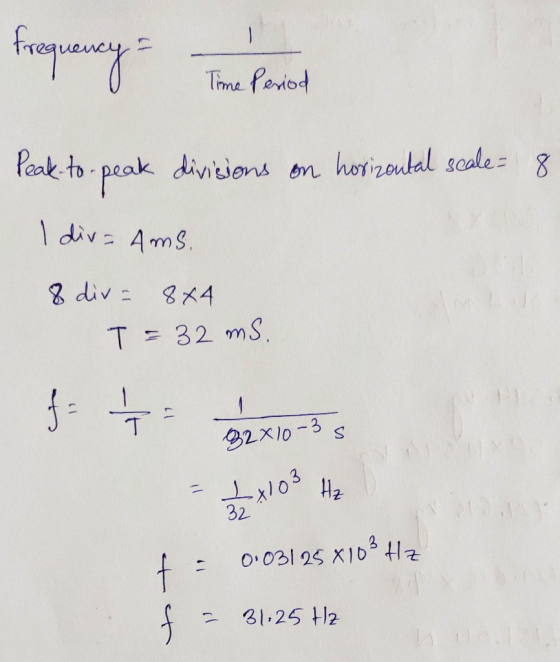
f=31.25 Hz can be approximately written as 31.3 Hz and hence option (a) is the correct option.
Add Answer to:
A sine wave signal is displayed on the screen of an
oscilloscope. 6 peak-to-peak divisions are...
A sine wave signal is displayed on the screen of an oscilloscope. 6 peak-to-peak divisions are...
A sine wave signal is displayed on the screen of an oscilloscope. 6 peak-to-peak divisions are measured vertically and 8 peak-to-peak divisions horizontally. The voltage control is on the 2 volts / div scale and the sweep control is on the 5ms scale. The signal period is: a. 0.03 seconds b. 0.04 seconds c. 4 seconds d. 0.005 seconds
The oscilloscope display below is connected to a sine wave of 100 Hz frequency and 4...
 The oscilloscope display below is connected to a sine wave of 100 Hz frequency and 4 volt amplitude, 100 us seconds/div, and 2 volts/div. What control(s) on the oscilloscope need to be adjusted to bring this signal into focus so that it displays a sine wave? The oscilloscope display below is connected to a sine wave of 150 Hz frequency , 2 ms seconds/div, and 1 volts/div. What control(s) on the oscilloscope need to be adjusted to bring this signal...
You place an AC voltage signal of amplitude 1.4 V and with a frequency of 1100.0...
You place an AC voltage signal of amplitude 1.4 V and with a frequency of 1100.0 Hz, into the input of an oscilloscope. (Note, you will not include units in your answers.) (a) Find the distance displayed on the screen of the oscilloscope for a full wave, if the sweep speed is adjusted to 182 µsec/DIV. divisions (b) If the vertical gain is set to 0.47 V/DIV, how many divisions will the wave span from peak-to-peak of the wave? divisions
On an oscilloscope you count 4 cycles across 55 minor time divisions on an oscilloscope screen. The time...
On an oscilloscope you count 4 cycles across 55 minor time divisions on an oscilloscope screen. The time sweep is set to 20 milli seconds. The voltage peak is measured to be 22 volts. What is the frequency?
Analog Oscilloscope Setup: 1. Turn on the power to the oscilloscope. 2. Connect the function gene...
 Analog Oscilloscope Setup: 1. Turn on the power to the oscilloscope. 2. Connect the function generator to the Channel 1 input on the oscilloscope 3. In the Vertical Control Group, set the Channel 1 AC/GND/DC switch to AC. 4. Set the Volts-per-Division knob 5. Intensity knob: adjust the signal intensity and focus to a comfortable level by using the intensity and focus knobs, respectively Set the seconds-per-division knob 6. Assignment Procedures: 1. Using the settings completed above, answer the following...
1. You count 12 cycles across 8.5 time divisions on an oscilloscope screen. The time sweep...
1. You count 12 cycles across 8.5 time divisions on an oscilloscope screen. The time sweep is set to 45 micro seconds. The voltage peak is measured to be 22 volts. What is the frequency in HZ? (Use three significant figures or N/A if no answer.) 2. You plot some data of Real Frequency versus HP Dial Frequency and get a linear trend of y = 1.31 x + 230. To what must you set the HP Dial Frequency in...
Sine wave measurement: Images 6.9 – 6.12 show a sine wave. Note that Image 6.9 is...
 Sine wave measurement:
Images 6.9 – 6.12 show a sine wave. Note that Image 6.9 is a
close up of the function generator’s frequency display.
Using images 6.10 – 6.12, determine the amplitude of the sine
wave. Be sure to include proper units:
# of vertical divisions
VOLT/DIV
Amplitude
Determine the period and calculate the frequency:
# of horizontal divisions
TIME/DIV
Period
Frequency
Assuming that the frequency displayed in Image 6.9 is more
accurate than the oscilloscope, what is the...
Sine wave measurement:
Images 6.9 – 6.12 show a sine wave. Note that Image 6.9 is a
close up of the function generator’s frequency display.
Using images 6.10 – 6.12, determine the amplitude of the sine
wave. Be sure to include proper units:
# of vertical divisions
VOLT/DIV
Amplitude
Determine the period and calculate the frequency:
# of horizontal divisions
TIME/DIV
Period
Frequency
Assuming that the frequency displayed in Image 6.9 is more
accurate than the oscilloscope, what is the...
Choose the incorrect statements about the experiment of the use of oscilloscope. A. A sine wave...
 Choose the incorrect statements about the experiment of the use of oscilloscope. A. A sine wave is shown on the screen. There are six divisions from peak to pee Therefore, we can conclude that the peak-to-peak voltage is six volts. B. For 5 MHz, the shape of the wave which is shown on the screen is inconsistent with the one we observe in lower frequency. Therefore, we must make some mistakes during the experiment. c. In the experiment, the ratio...
Draw the correct waveforms in the aranhs below for questions 10: 8. With the oscilloscope AC...
 Draw the correct waveforms in the aranhs below for questions 10: 8. With the oscilloscope AC coupled, draw the signal display you would expect to see on the screen of the oscilloscope on the graph provided below. SWITCH SETTINGS TIME/DIV 50 us VOLTS/DIV → 2 V SIGNAL PARAMETERS TH 12 Vdc 9. With the oscilloscope DC coupled, draw the signal display you would expect to see on the screen of the oscilloscope on the graph provided below. SWITCH SETTINGS TIME/DIV...
*USE Multisim( Provide Pictures of work on Multisim for each step) and Fill the Tables Below...
 *USE Multisim( Provide Pictures of work on Multisim for each
step) and Fill the Tables Below
PROCEDURE: Review the front panel controls in each of the major groups. Then turn on the oscilloscope, select Chl, set the SEC/DIV to 0.1 ms/div, select AUTO triggering, and obtain a line across the face of the CRT. Although many of the measurements described in this experiment are automated in newer scopes, it is useful to learn to make these measurements manually. Turn on...
*USE Multisim( Provide Pictures of work on Multisim for each
step) and Fill the Tables Below
PROCEDURE: Review the front panel controls in each of the major groups. Then turn on the oscilloscope, select Chl, set the SEC/DIV to 0.1 ms/div, select AUTO triggering, and obtain a line across the face of the CRT. Although many of the measurements described in this experiment are automated in newer scopes, it is useful to learn to make these measurements manually. Turn on...
 The oscilloscope display below is connected to a sine wave of 100 Hz frequency and 4 volt amplitude, 100 us seconds/div, and 2 volts/div. What control(s) on the oscilloscope need to be adjusted to bring this signal into focus so that it displays a sine wave? The oscilloscope display below is connected to a sine wave of 150 Hz frequency , 2 ms seconds/div, and 1 volts/div. What control(s) on the oscilloscope need to be adjusted to bring this signal...
 Analog Oscilloscope Setup: 1. Turn on the power to the oscilloscope. 2. Connect the function generator to the Channel 1 input on the oscilloscope 3. In the Vertical Control Group, set the Channel 1 AC/GND/DC switch to AC. 4. Set the Volts-per-Division knob 5. Intensity knob: adjust the signal intensity and focus to a comfortable level by using the intensity and focus knobs, respectively Set the seconds-per-division knob 6. Assignment Procedures: 1. Using the settings completed above, answer the following...
 Sine wave measurement:
Images 6.9 – 6.12 show a sine wave. Note that Image 6.9 is a
close up of the function generator’s frequency display.
Using images 6.10 – 6.12, determine the amplitude of the sine
wave. Be sure to include proper units:
# of vertical divisions
VOLT/DIV
Amplitude
Determine the period and calculate the frequency:
# of horizontal divisions
TIME/DIV
Period
Frequency
Assuming that the frequency displayed in Image 6.9 is more
accurate than the oscilloscope, what is the...
Sine wave measurement:
Images 6.9 – 6.12 show a sine wave. Note that Image 6.9 is a
close up of the function generator’s frequency display.
Using images 6.10 – 6.12, determine the amplitude of the sine
wave. Be sure to include proper units:
# of vertical divisions
VOLT/DIV
Amplitude
Determine the period and calculate the frequency:
# of horizontal divisions
TIME/DIV
Period
Frequency
Assuming that the frequency displayed in Image 6.9 is more
accurate than the oscilloscope, what is the...
 Choose the incorrect statements about the experiment of the use of oscilloscope. A. A sine wave is shown on the screen. There are six divisions from peak to pee Therefore, we can conclude that the peak-to-peak voltage is six volts. B. For 5 MHz, the shape of the wave which is shown on the screen is inconsistent with the one we observe in lower frequency. Therefore, we must make some mistakes during the experiment. c. In the experiment, the ratio...
 Draw the correct waveforms in the aranhs below for questions 10: 8. With the oscilloscope AC coupled, draw the signal display you would expect to see on the screen of the oscilloscope on the graph provided below. SWITCH SETTINGS TIME/DIV 50 us VOLTS/DIV → 2 V SIGNAL PARAMETERS TH 12 Vdc 9. With the oscilloscope DC coupled, draw the signal display you would expect to see on the screen of the oscilloscope on the graph provided below. SWITCH SETTINGS TIME/DIV...
 *USE Multisim( Provide Pictures of work on Multisim for each
step) and Fill the Tables Below
PROCEDURE: Review the front panel controls in each of the major groups. Then turn on the oscilloscope, select Chl, set the SEC/DIV to 0.1 ms/div, select AUTO triggering, and obtain a line across the face of the CRT. Although many of the measurements described in this experiment are automated in newer scopes, it is useful to learn to make these measurements manually. Turn on...
*USE Multisim( Provide Pictures of work on Multisim for each
step) and Fill the Tables Below
PROCEDURE: Review the front panel controls in each of the major groups. Then turn on the oscilloscope, select Chl, set the SEC/DIV to 0.1 ms/div, select AUTO triggering, and obtain a line across the face of the CRT. Although many of the measurements described in this experiment are automated in newer scopes, it is useful to learn to make these measurements manually. Turn on...
Most questions answered within 3 hours.
-
Where is the error in this code sequence?
String s1 = "Hello";
String s2 = "ello";...
asked 11 months ago -
Financial data for Joel de Paris, Inc., for last year
follow:
Joel de Paris, Inc.
Balance...
asked 11 months ago -
Consider this reaction:
Al2(SO4)3 (aq)+ BaCl3
(aq) Al2Cl6 (aq)- +
3BaSO4(s) . What is the...
asked 11 months ago -
Suppose that Savneet is considering increasing her
recent random sample from 20 car rentals to 40...
asked 11 months ago -
Trucks arrive at an unloading terminal at an average rate of 120
per hour.
Trucks arrive...
asked 11 months ago -
Why are methanol and ethanol completely soluble in water while
octanol is not very little soluble....
asked 11 months ago -
A facilities manager at a university reads in a research report
that the mean amount of...
asked 11 months ago -
When the CuSO4 is rehydrated by adding water to the anhydrous
compound, is this an endothermic...
asked 11 months ago -
A ray of sunlight is passing from diamond into crown glass; the
angle of incidence is...
asked 11 months ago -
A block of mass 0.249 kg is placed on top of a light, vertical
spring of...
asked 11 months ago -
how do the kidneys compensate in the presences of acidosis
a) trigger hyperventilate
b) reserve acid...
asked 11 months ago -
Question 501 pts
The rental rate of capital to the firm increases. Which of the
following...
asked 11 months ago