(9) For each of the following languages L, give a simple English description. Show two strings...
(9) For each of the following languages L, give a simple English
description. Show two strings that are in L and two that are not
(unless there are fewer than two strings in L or two not in L, in
which case show as many as possible).
• L = {ω ∈ {a,b}∗| exactly one prefix of ω ends in a }.
• L = {ω ∈ {a,b}∗| all prefixes of ω end in a }.
• L = {ω ∈ {a,b}∗|ω = axa,x ∈ {a,b}+}.
Homework Answers
1. Only one a is in the language
In language
-> a
-> bba
Not in language
-> aa
-> baba
2. Strings having only a's
In language
-> a
-> aa
Not in language
-> ab
-> baba
3. Strings that start and end with a
In language
-> aaa
-> aba
Not in language
-> ab
-> baba
--------------------------------------
Hit the thumbs up if you are fine with the answer. Happy
Learning!
Add Answer to:
(9) For each of the following languages L, give a simple English
description. Show two strings...
2. Give the first five strings in L-ordering for each of the following languages over 2...
 2. Give the first five strings in L-ordering for each of the following languages over 2 - {0,1}. If there are fewer than five strings, give the entire language instead: Let L1= {0, 11, 101) Let L2 = {€, 0,10 a) LUL b) L2-L2 c) L L2 d) L22
Give English descriptions of the languages represented by the following regular expressions. The descriptions should be...
Give English descriptions of the languages represented by the following regular expressions. The descriptions should be simple, similar to how we have been defining languages in class(e.g., “languages of binary strings containing 0 in even positions. . .”). Note: While describing your language, you don’t want to simply spell out the conditions in your regular expressions. E.g., if the regular expression is 0(0 + 1)∗, an answer of the sort “language of all binary strings that start with a 0”...
4) For the alphabet S={a, b}, construct an FA that accepts the following languages. Show all...
4) For the alphabet S={a, b}, construct an FA that accepts the following languages. Show all of your work. (a) L = {all strings with exactly one b}. (b) L = {all strings with at least one a}. (c) L = {all strings with no more than three b's}.
4) (9 pts) Give regular expressions for the following languages on (la, b) a) L1 =...
 4) (9 pts) Give regular expressions for the following languages on (la, b) a) L1 = { w : na(w) mod 3 = 1). b) L2w w ends in aa) c) L3 = all strings containing no more than three a's.
3) Construct a regular expression defining each of the following languages over the alphabet {a, b}....
3) Construct a regular expression defining each of the following languages over the alphabet {a, b}. (a) L = {aab, ba, bb, baab}; (b) The language of all strings containing exactly two b's. (c) The language of all strings containing at least one a and at least one b. (d) The language of all strings that do not end with ba. (e) The language of all strings that do not containing the substring bb. (f) The language of all strings...
Give regular expressions for the following languages: (a) The language of all strings over {a,b} except...
Give regular expressions for the following languages: (a) The language of all strings over {a,b} except the empty string. (b) The language of all strings over {a,b} that contain both bab and bba as substrings. (c)L k = {w ∈ {a,b} * | w contains a substring having 3 more b’s than a’s}. (d) The language of all strings over {a,b} that have a b in every odd position (first symbol is considered position 1; empty string should be accepted)...
4) For the alphabet S={a, b}, construct an FA that accepts the following languages. (d) L=...
4) For the alphabet S={a, b}, construct an FA that accepts the following languages. (d) L= {all strings with at least one a and exactly two b's} (e) L= {all strings with b as the third letter} (f) L={w, |w| mod 4 = 0} // the cardinality of the word is a multiple of 4
For context the class is about Automata, Computability, and Formal Languages I just need parts b...
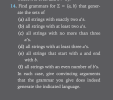 For context the class is about Automata, Computability, and
Formal Languages
I just need parts b & e done
14. Find grammars for E = {a, b} that gener- ate the sets of (a) all strings with exactly two a's. (b) all strings with at least two a’s. (c) all strings with no more than three a's. (d) all strings with at least three a’s. (e) all strings that start with a and end with b. (f) all strings with...
For context the class is about Automata, Computability, and
Formal Languages
I just need parts b & e done
14. Find grammars for E = {a, b} that gener- ate the sets of (a) all strings with exactly two a's. (b) all strings with at least two a’s. (c) all strings with no more than three a's. (d) all strings with at least three a’s. (e) all strings that start with a and end with b. (f) all strings with...
(9 pts 3 pts each) For each of the following languages, name the least powerful type of machine that will accept it...
 (9 pts 3 pts each) For each of the following languages, name the least powerful type of machine that will accept it, and prove your answer. (Hint: a finite state automata is less powerful than a pushdown automata, which in turn is less powerful than a Turing Machine.) For example, to prove a language needs a PDA to accept it, you would use the Pumping Lemma to show it is not regular, and then build the PDA or CFG that...
 2. Give the first five strings in L-ordering for each of the following languages over 2 - {0,1}. If there are fewer than five strings, give the entire language instead: Let L1= {0, 11, 101) Let L2 = {€, 0,10 a) LUL b) L2-L2 c) L L2 d) L22
 4) (9 pts) Give regular expressions for the following languages on (la, b) a) L1 = { w : na(w) mod 3 = 1). b) L2w w ends in aa) c) L3 = all strings containing no more than three a's.
 For context the class is about Automata, Computability, and
Formal Languages
I just need parts b & e done
14. Find grammars for E = {a, b} that gener- ate the sets of (a) all strings with exactly two a's. (b) all strings with at least two a’s. (c) all strings with no more than three a's. (d) all strings with at least three a’s. (e) all strings that start with a and end with b. (f) all strings with...
For context the class is about Automata, Computability, and
Formal Languages
I just need parts b & e done
14. Find grammars for E = {a, b} that gener- ate the sets of (a) all strings with exactly two a's. (b) all strings with at least two a’s. (c) all strings with no more than three a's. (d) all strings with at least three a’s. (e) all strings that start with a and end with b. (f) all strings with...
 (9 pts 3 pts each) For each of the following languages, name the least powerful type of machine that will accept it, and prove your answer. (Hint: a finite state automata is less powerful than a pushdown automata, which in turn is less powerful than a Turing Machine.) For example, to prove a language needs a PDA to accept it, you would use the Pumping Lemma to show it is not regular, and then build the PDA or CFG that...
Most questions answered within 3 hours.
-
Where is the error in this code sequence?
String s1 = "Hello";
String s2 = "ello";...
asked 11 months ago -
Financial data for Joel de Paris, Inc., for last year
follow:
Joel de Paris, Inc.
Balance...
asked 11 months ago -
Consider this reaction:
Al2(SO4)3 (aq)+ BaCl3
(aq) Al2Cl6 (aq)- +
3BaSO4(s) . What is the...
asked 11 months ago -
Suppose that Savneet is considering increasing her
recent random sample from 20 car rentals to 40...
asked 11 months ago -
Trucks arrive at an unloading terminal at an average rate of 120
per hour.
Trucks arrive...
asked 11 months ago -
Why are methanol and ethanol completely soluble in water while
octanol is not very little soluble....
asked 11 months ago -
A facilities manager at a university reads in a research report
that the mean amount of...
asked 11 months ago -
When the CuSO4 is rehydrated by adding water to the anhydrous
compound, is this an endothermic...
asked 11 months ago -
A ray of sunlight is passing from diamond into crown glass; the
angle of incidence is...
asked 11 months ago -
A block of mass 0.249 kg is placed on top of a light, vertical
spring of...
asked 11 months ago -
how do the kidneys compensate in the presences of acidosis
a) trigger hyperventilate
b) reserve acid...
asked 11 months ago -
Question 501 pts
The rental rate of capital to the firm increases. Which of the
following...
asked 11 months ago