A particle of spin 1/2 and a particle of spin 1 are in configuration with total...
A particle of spin 1/2 and a particle of spin 1 are in configuration with total spin equal to 3/2 and with the z-component of the total spin equal to 1/2 (state | 3/2 , 1/2 >). If you could measure the z-component of the spin of the spin-1 particle, what values would you get and what are the probabilities associated with each one of those values?
Homework Answers
Spin of particle 1 is 1/2, hence it's z component will be -1/2 and 1/2.
Spin of particle 2 is 1, hence it's z component will be -1, 0 and 1
Note that the z components are a interval of 1 i.e. 1/2 - (-1/2) =1 and 0 - (- 1) =1 similarly for other values of z components.
The total spin can be S1+S2 or |S1-S2| , in this case since total spin is 1/2, it is S2+S1 = 1 + 1/2 = 3/2
St=3/2 thus z component can be -3/2, -1/2, 1/2, 3/2, however in this case it is 1/2.
If z component of particle with spin 1 is measured, probability is there of obtaining, -1, 0 and 1 as z components of spin.
Probability associated with each is 1/3 since each state is equally probable.
Add Answer to:
A particle of spin 1/2 and a particle of spin 1 are in
configuration with total...
2. Addition of Angular Momentum a) (8pts) Given two spin 1/2 particles, what are the four possibilities for their spin configuration? Put your answer in terms of states such as | 11). where the f...
 2. Addition of Angular Momentum a) (8pts) Given two spin 1/2 particles, what are the four possibilities for their spin configuration? Put your answer in terms of states such as | 11). where the first arrow denotes the z-component of the particle's spin. Identify the m values for each state. b)(7pts) If you apply the lowering operator to a state you get Apply the two-state lowering operator S--S(,) +S(), where sti) acts on the first state and S acts on...
Two particle state
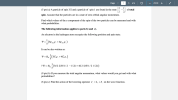 Two Particle State problem, measurement of total angular momentum, finding probabilities, action of lowering operatora) A particle of spin \(3 / 2\) and a particle of spin 1 are found in the state \(\left|\frac{3}{2}-\frac{1}{2}\right\rangle\) of total spin. Assume that the particles are in a state of zero orbital angular momentum.Find which values of the z-component of the spin of the two particles can be measured and with what probabilities.The following information applies to parts \(\mathbf{b}\) ) and \(\mathbf{c}\) ).An electron...
2. Consider a spin-1/2 particle. The physical quantity K is represented by the operator (written in...
 2. Consider a spin-1/2 particle. The physical quantity K is represented by the operator (written in the S-basis): k=ko –2i) * +2i 0 where k is a real number with the appropriate dimensions. (a) What are the eigenvalues and normalized eigenstates of K? (b) What value(s) of K could you measure? (c) What state(s) could the particle be in immediately after you measured K? (d) For a single particle, could you simultaneously know both the z-component of spin and the...
[3] A spin-1/2 particle is in the state IW) 1/311) +i2/3|). (a) A measurement is made of the x component of the spi...
 [3] A spin-1/2 particle is in the state IW) 1/311) +i2/3|). (a) A measurement is made of the x component of the spin. What is the probability that the spin will be in the +z direction? (b) Suppose a measurement is made of the spin in the z direction and it is found that the particle has m,#1/2. what is the state after the measurement? (c) Now a second measurement is made immediately after to determine the spin in the...
For the Li atom ground state (configuration (1s) (2s)'1, for the z-component of the total spin...
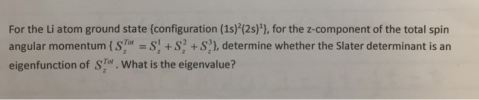 For the Li atom ground state (configuration (1s) (2s)'1, for the z-component of the total spin angular momentumt STo-S +S? +S), determine whether the Slater determinant is an eigenfunction of STod. What is the eigenvalue?
Consider a system with spin 1 and spin 1/2 particle. What are the possible total spin...
Consider a system with spin 1 and spin 1/2 particle. What are the possible total spin values and coefficients?
3. (a) A particle orbits a fixed point in space. Given that L-=-ih- , find the...
 3. (a) A particle orbits a fixed point in space. Given that L-=-ih- , find the eigenvalues аф and normalised eigenfunctions of the z-component of the particle's angular momentum. (5 marks) Explain clearly your reasoning at each important step An electron is in the spin state x)-A G) Normalise x) and hence determine the constant A (ii) If you measured the z-component of the electron's spin, s, . what values could (b) in the usual s basis you get and...
4. Spin (10 marks) Suppose an electron is in a state such that its spin can...
 4. Spin (10 marks) Suppose an electron is in a state such that its spin can be described by a linear superposition of the eigenspinors of S +A 32 2/22 (a) Normalise the state. (b) What are the possible outcomes of a measurement of the z-component of the spin? What is the probability of each possible result? (c) What are the expectation value and uncertainty of the z-component of the spin? (d) What are the possible results of measuring the...
A spin-1 particle interacts with an external magnetic field B = B. The interaction Hamiltonian for the system is H = gB-S, where S-Si + Sỳ + SE is the spin operator. (Ignore all degrees of freedom ot...
 A spin-1 particle interacts with an external magnetic field B = B. The interaction Hamiltonian for the system is H = gB-S, where S-Si + Sỳ + SE is the spin operator. (Ignore all degrees of freedom other than spin.) (a) Find the spin matrices in the basis of the S. S eigenstates, |s, m)) . (Hint: Use the ladder operators, S -S, iS, and S_-S-iS,, and show first that s_ | 1,0-ћ /2 | 1.-1)) . Then use these...
b 2. Suppose a spin-2 particle is in the state that particle. 2,0) + 2,1) Find...
 b 2. Suppose a spin-2 particle is in the state that particle. 2,0) + 2,1) Find the expectation value of S, for D 3. In the t spin-1/2 basis, consider the two operators 2 1 12d B- (2 i A= ni 2 (a) Find the commutator [A, B (b) Suppose we measure a number of particles in state |t), using A and B. Find the average values (A) and (B) from these measurements. (c) Use the uncertainty principle to find...
 2. Addition of Angular Momentum a) (8pts) Given two spin 1/2 particles, what are the four possibilities for their spin configuration? Put your answer in terms of states such as | 11). where the first arrow denotes the z-component of the particle's spin. Identify the m values for each state. b)(7pts) If you apply the lowering operator to a state you get Apply the two-state lowering operator S--S(,) +S(), where sti) acts on the first state and S acts on...
 2. Consider a spin-1/2 particle. The physical quantity K is represented by the operator (written in the S-basis): k=ko –2i) * +2i 0 where k is a real number with the appropriate dimensions. (a) What are the eigenvalues and normalized eigenstates of K? (b) What value(s) of K could you measure? (c) What state(s) could the particle be in immediately after you measured K? (d) For a single particle, could you simultaneously know both the z-component of spin and the...
 [3] A spin-1/2 particle is in the state IW) 1/311) +i2/3|). (a) A measurement is made of the x component of the spin. What is the probability that the spin will be in the +z direction? (b) Suppose a measurement is made of the spin in the z direction and it is found that the particle has m,#1/2. what is the state after the measurement? (c) Now a second measurement is made immediately after to determine the spin in the...
 For the Li atom ground state (configuration (1s) (2s)'1, for the z-component of the total spin angular momentumt STo-S +S? +S), determine whether the Slater determinant is an eigenfunction of STod. What is the eigenvalue?
 3. (a) A particle orbits a fixed point in space. Given that L-=-ih- , find the eigenvalues аф and normalised eigenfunctions of the z-component of the particle's angular momentum. (5 marks) Explain clearly your reasoning at each important step An electron is in the spin state x)-A G) Normalise x) and hence determine the constant A (ii) If you measured the z-component of the electron's spin, s, . what values could (b) in the usual s basis you get and...
 4. Spin (10 marks) Suppose an electron is in a state such that its spin can be described by a linear superposition of the eigenspinors of S +A 32 2/22 (a) Normalise the state. (b) What are the possible outcomes of a measurement of the z-component of the spin? What is the probability of each possible result? (c) What are the expectation value and uncertainty of the z-component of the spin? (d) What are the possible results of measuring the...
 A spin-1 particle interacts with an external magnetic field B = B. The interaction Hamiltonian for the system is H = gB-S, where S-Si + Sỳ + SE is the spin operator. (Ignore all degrees of freedom other than spin.) (a) Find the spin matrices in the basis of the S. S eigenstates, |s, m)) . (Hint: Use the ladder operators, S -S, iS, and S_-S-iS,, and show first that s_ | 1,0-ћ /2 | 1.-1)) . Then use these...
 b 2. Suppose a spin-2 particle is in the state that particle. 2,0) + 2,1) Find the expectation value of S, for D 3. In the t spin-1/2 basis, consider the two operators 2 1 12d B- (2 i A= ni 2 (a) Find the commutator [A, B (b) Suppose we measure a number of particles in state |t), using A and B. Find the average values (A) and (B) from these measurements. (c) Use the uncertainty principle to find...
Most questions answered within 3 hours.
-
Where is the error in this code sequence?
String s1 = "Hello";
String s2 = "ello";...
asked 11 months ago -
Financial data for Joel de Paris, Inc., for last year
follow:
Joel de Paris, Inc.
Balance...
asked 11 months ago -
Consider this reaction:
Al2(SO4)3 (aq)+ BaCl3
(aq) Al2Cl6 (aq)- +
3BaSO4(s) . What is the...
asked 11 months ago -
Suppose that Savneet is considering increasing her
recent random sample from 20 car rentals to 40...
asked 11 months ago -
Trucks arrive at an unloading terminal at an average rate of 120
per hour.
Trucks arrive...
asked 11 months ago -
Why are methanol and ethanol completely soluble in water while
octanol is not very little soluble....
asked 11 months ago -
A facilities manager at a university reads in a research report
that the mean amount of...
asked 11 months ago -
When the CuSO4 is rehydrated by adding water to the anhydrous
compound, is this an endothermic...
asked 11 months ago -
A ray of sunlight is passing from diamond into crown glass; the
angle of incidence is...
asked 11 months ago -
A block of mass 0.249 kg is placed on top of a light, vertical
spring of...
asked 11 months ago -
how do the kidneys compensate in the presences of acidosis
a) trigger hyperventilate
b) reserve acid...
asked 11 months ago -
Question 501 pts
The rental rate of capital to the firm increases. Which of the
following...
asked 11 months ago