Compare and contrast microbial growth control mechanisms 1.Physical 2.Chemical 3.Mechanical
Compare and contrast microbial growth control mechanisms
1.Physical
2.Chemical
3.Mechanical
Homework Answers


 6. Sonication: Exposure to
ultra sonic waves kills the growth of microbes.
6. Sonication: Exposure to
ultra sonic waves kills the growth of microbes.


Add Answer to:
Compare and contrast microbial growth control mechanisms
1.Physical
2.Chemical
3.Mechanical
Compare and contrast microbial growth control mechanisms Physical Chemical Mechanical
Compare and contrast microbial growth control mechanisms Physical Chemical Mechanical
Questions 1. Compare and contrast the processes of mechanical and chemical digestion in relation to the...
 Questions 1. Compare and contrast the processes of mechanical and chemical digestion in relation to the breakdown of polysaccharides. Where in the GI tract do each of these processes occur and what is involved in these processes?
Chemical method of microbial growth control: gaseous agents freezing gamma radiation desiccation
Chemical method of microbial growth control: gaseous agents freezing gamma radiation desiccation
In this experiment we are testing the effect of different chemical concentrations on microbial growth. Let’s...
In this experiment we are testing the effect of different chemical concentrations on microbial growth. Let’s say instead we used a 1.0% solution of Bleach against a low, medium, and high amount of microbes. How would you expect the growth numbers to look in this experiment? In restaurants, most food contact surfaces are smooth and lack cavities/pores in their surface. What is the advantage of that for microbial control? If soaps are not powerful at killing microbes, why are they used...
Compare and contrast 2 tools/ techniques of the control quality process.
Compare and contrast 2 tools/ techniques of the control quality process.
2. Compare and contrast the general sites and mechanisms of action of reserpine, clonidine, and methyldopa...
2. Compare and contrast the general sites and mechanisms of action of reserpine, clonidine, and methyldopa with those of drugs that block adrenergic receptors (for example, propranolol and phentolamine). 3. Explain the factors that lead to and the characteristics of the “rebound” phenomenon associated with sudden discontinuation of clonidine. 4. How responses to the main classes of adrenergic agonists would be affected.
Define economic growth? Discuss how economic growth is measure? Compare and contrast 2 countries and their...
Define economic growth? Discuss how economic growth is measure? Compare and contrast 2 countries and their economic growth over the last 50 years?
Please help! :~) Compare and contrast these mechanisms. Match the items to their respective spots. A:...
Please help! :~) Compare and contrast these mechanisms. Match the items to their respective spots. A: The process is controlled by genes of extrachromosomal elements B: DNA is released after the "donor" cell lyses. C: The process is characterized by infection of the donor cell by a bacteriophage D: DNA enters the "recipient" cell via DNA transporters E: Transforming elements absorb across the cell membrane F: The process rrquires genetic information for transfer which is found in the F plasmid...
Compare and contrast both the reaction scheme presented Figure 3 for the chain growth and step...
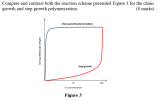 Compare and contrast both the reaction scheme presented Figure 3 for the chain growth and step growth polymerization. (8 marks) Chain-growth polymerization Average Molecular Weight Step-growth 100 50 % Concentration Figure 3
2. a) Compare and contrast various synthetic polymers used for manufacturing rubber based on the mechanical...
2. a) Compare and contrast various synthetic polymers used for manufacturing rubber based on the mechanical properties and weathering resistance; b) Illustrate the mechanism of curing or vulcanization for rubber induced by sulfur; c) What are the roles of carbon black and clay in rubber used for automobile tires?
 Questions 1. Compare and contrast the processes of mechanical and chemical digestion in relation to the breakdown of polysaccharides. Where in the GI tract do each of these processes occur and what is involved in these processes?
 Compare and contrast both the reaction scheme presented Figure 3 for the chain growth and step growth polymerization. (8 marks) Chain-growth polymerization Average Molecular Weight Step-growth 100 50 % Concentration Figure 3
Most questions answered within 3 hours.
-
Where is the error in this code sequence?
String s1 = "Hello";
String s2 = "ello";...
asked 10 months ago -
Financial data for Joel de Paris, Inc., for last year
follow:
Joel de Paris, Inc.
Balance...
asked 10 months ago -
Consider this reaction:
Al2(SO4)3 (aq)+ BaCl3
(aq) Al2Cl6 (aq)- +
3BaSO4(s) . What is the...
asked 10 months ago -
Suppose that Savneet is considering increasing her
recent random sample from 20 car rentals to 40...
asked 10 months ago -
Trucks arrive at an unloading terminal at an average rate of 120
per hour.
Trucks arrive...
asked 10 months ago -
Why are methanol and ethanol completely soluble in water while
octanol is not very little soluble....
asked 10 months ago -
A facilities manager at a university reads in a research report
that the mean amount of...
asked 10 months ago -
When the CuSO4 is rehydrated by adding water to the anhydrous
compound, is this an endothermic...
asked 10 months ago -
A ray of sunlight is passing from diamond into crown glass; the
angle of incidence is...
asked 10 months ago -
A block of mass 0.249 kg is placed on top of a light, vertical
spring of...
asked 10 months ago -
how do the kidneys compensate in the presences of acidosis
a) trigger hyperventilate
b) reserve acid...
asked 10 months ago -
Question 501 pts
The rental rate of capital to the firm increases. Which of the
following...
asked 10 months ago