Write balanced net ionic equations that explain the following observations. a) When solutions of BaCl2 and...
Write balanced net ionic equations that explain the following observations. a) When solutions of BaCl2 and K2CrO4 are mixed, a bright yellow precipitate forms. b) When solutions of NaC12H22O2 and Ca(NO3)2 are mixed, a white precipitate forms
Homework Answers

Add Answer to:
Write balanced net ionic equations that explain the following
observations. a) When solutions of BaCl2 and...
Write Balanced Ionic Equations and Balanced Net Ionic Equations for the following combinations (including states ex.(s)...
Write Balanced Ionic Equations and Balanced Net Ionic Equations for the following combinations (including states ex.(s) or (aq)): BaCl2 and AgNO3, KBr and AgNO3, K2CrO4 and AgNO3, NaOH and AgNO3, Na2CO3 and BaCl2, (NH4)2SO4 and BaCl2, Pb(NO3)2 and Na2CO3, Zn(NO3)2 and Na2CO3, FeCl3 and Na2CO3, Cu(NO3)2 and Na2CO3, K2CrO4 and Pb(NO3)2, NaOH and Pb(NO3)2, NaOH and FeCl3, NaCH3COO and FeCl3, MgCl2 and NaOH, Cu(NO3)2 and NaOH.
Writing Balanced Molecular, Ionic, And Net Ionic Equations Write Balanced Net-Ionic Equations for the following Reactions...
Writing Balanced Molecular, Ionic, And Net Ionic Equations Write Balanced Net-Ionic Equations for the following Reactions in Aqueous Solution: 1. Copper metal (Cu(s)) is immersed in an aqueous solution of silver nitrate (AgNO3). The solution turns light blue and a silver coating appears on the copper. 2. Dilute solutions of antimony(III) chloride and sodium sulfide are mixed to give a precipitate. 3. Dilute solutions of silver nitrate and potassium iodide are combined and give a yellow precipitate. 4. Dilute solutions...
Write the balanced complete ionic equations and net ionic equations for the reactions that occur when...
Write the balanced complete ionic equations and net ionic equations for the reactions that occur when each of the following solutions are mixed. (Type your answers using the format [NH4]+ for NH4+ or Ca3(PO4)2 for Ca3(PO4)2. Use the lowest possible coefficients.) (a) Pb(NO3)2(aq) and Na2S(aq) complete ionic equation? net ionic equation? (b) Al2(SO4)3(aq) and K3PO4(aq) complete ionic equation? net ionic equation? (c) (NH4)3PO4(aq) and CaCl2(aq) complete ionic equation? net ionic equation?
Write the balanced complete ionic equations and net ionic equations for the reactions that occur when...
Write the balanced complete ionic equations and net ionic equations for the reactions that occur when each of the following solutions are mixed. (Type your answers using the format [NH4]+ for NH4+ or Ca3(PO4)2 for Ca3(PO4)2. Use the lowest possible coefficients.) a)AgNO3(aq) and K2SO4(aq) b)Pb(NO3)2(aq) and Al2(SO4)3(aq) c)Fe2(SO4)3(aq) and CaCl2(aq)
3. Write balanced net ionic equations for the following reactions from the spot tests in Part...
 3. Write balanced net ionic equations for the following reactions from the spot tests in Part A. Include the states of components (e.g. (aq) if aqueous, (s) if solid) and the final colour of the solution or precipitate, if any. a) AgNO3+ HCI b) Pb(NO3)2+ K2CrO c) Fe(NO3)3 KSCN d) Ni(NOs)2 + H-DMG e) Ba(NO3)2 K2CrO4
1. Write balanced net ionic equations to explain the observations in the options assigned. (All reactions...
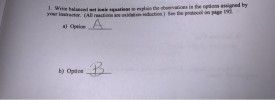 1. Write balanced net ionic equations to explain the
observations in the options assigned. (All reactions are
oxidation-reduction)
White balanced net ionic equations to explain the observations in the options assigned by Your instructor. (All reactions are oxidation-reduction.) See the protocol on page 192. a) Option A b) Option B 1. A. Some aqueous iron(II) sulfate is treated with granulated (solid) zinc. B. A piece of aluminum metal appears to dissolve in hydrochloric acid solution with evolution of gas bubbles
1. Write balanced net ionic equations to explain the
observations in the options assigned. (All reactions are
oxidation-reduction)
White balanced net ionic equations to explain the observations in the options assigned by Your instructor. (All reactions are oxidation-reduction.) See the protocol on page 192. a) Option A b) Option B 1. A. Some aqueous iron(II) sulfate is treated with granulated (solid) zinc. B. A piece of aluminum metal appears to dissolve in hydrochloric acid solution with evolution of gas bubbles
Use the Solubility Rules to write net ionic equations for the reactions that occur when solutions...
Use the Solubility Rules to write net ionic equations for the reactions that occur when solutions of the following are mixed. (Use the lowest possible coefficients. Include states-of-matter under the given conditions in your answer.) a) K2S + ZnSO4 b) K2CrO4 + NiCl2 c) CsOH + FeCl3 d) CuSO4 + Pb(ClO4)2 e) FeSO4 + K3PO4 f) FeCl2 + TlNO3 g) (NH4)2CO3 + Ca(ClO4)2
Write the balanced net ionic equation for the reactions that occur when the given aqueous solutions...
Write the balanced net ionic equation for the reactions that occur when the given aqueous solutions are mixed. Include the physical states. A. nitric acid, HNO3, and calcium hydroxide, Ca(OH)2 B. lead (II) nitrate, Pb(NO3)2, and potassium iodide, KI
write out the molecular, complete ionic, and net ionic equations for the reaction that occurs when...
 write out the molecular, complete ionic, and net ionic
equations for the reaction that occurs when solutions Cas and
Fe(NO3)2 are mixed
6. Write out the molecular, complete ionic, and net ionic equations for the reaction that occurs when solutions of Cas and Fe(NO3)2 are mixed (9 points) (a) molecular: (b) complete ionic: (c) net ionic:
write out the molecular, complete ionic, and net ionic
equations for the reaction that occurs when solutions Cas and
Fe(NO3)2 are mixed
6. Write out the molecular, complete ionic, and net ionic equations for the reaction that occurs when solutions of Cas and Fe(NO3)2 are mixed (9 points) (a) molecular: (b) complete ionic: (c) net ionic:
Please Help! Both compounds are aqueous solutions. Write the balanced net-ionic equations for the following compounds...
Please Help! Both compounds are aqueous solutions. Write the balanced net-ionic equations for the following compounds when HCl is added: Hg2(NO3)2 and Hg(NO3)2
 3. Write balanced net ionic equations for the following reactions from the spot tests in Part A. Include the states of components (e.g. (aq) if aqueous, (s) if solid) and the final colour of the solution or precipitate, if any. a) AgNO3+ HCI b) Pb(NO3)2+ K2CrO c) Fe(NO3)3 KSCN d) Ni(NOs)2 + H-DMG e) Ba(NO3)2 K2CrO4
 1. Write balanced net ionic equations to explain the
observations in the options assigned. (All reactions are
oxidation-reduction)
White balanced net ionic equations to explain the observations in the options assigned by Your instructor. (All reactions are oxidation-reduction.) See the protocol on page 192. a) Option A b) Option B 1. A. Some aqueous iron(II) sulfate is treated with granulated (solid) zinc. B. A piece of aluminum metal appears to dissolve in hydrochloric acid solution with evolution of gas bubbles
1. Write balanced net ionic equations to explain the
observations in the options assigned. (All reactions are
oxidation-reduction)
White balanced net ionic equations to explain the observations in the options assigned by Your instructor. (All reactions are oxidation-reduction.) See the protocol on page 192. a) Option A b) Option B 1. A. Some aqueous iron(II) sulfate is treated with granulated (solid) zinc. B. A piece of aluminum metal appears to dissolve in hydrochloric acid solution with evolution of gas bubbles
 write out the molecular, complete ionic, and net ionic
equations for the reaction that occurs when solutions Cas and
Fe(NO3)2 are mixed
6. Write out the molecular, complete ionic, and net ionic equations for the reaction that occurs when solutions of Cas and Fe(NO3)2 are mixed (9 points) (a) molecular: (b) complete ionic: (c) net ionic:
write out the molecular, complete ionic, and net ionic
equations for the reaction that occurs when solutions Cas and
Fe(NO3)2 are mixed
6. Write out the molecular, complete ionic, and net ionic equations for the reaction that occurs when solutions of Cas and Fe(NO3)2 are mixed (9 points) (a) molecular: (b) complete ionic: (c) net ionic:
Most questions answered within 3 hours.
-
Where is the error in this code sequence?
String s1 = "Hello";
String s2 = "ello";...
asked 11 months ago -
Financial data for Joel de Paris, Inc., for last year
follow:
Joel de Paris, Inc.
Balance...
asked 11 months ago -
Consider this reaction:
Al2(SO4)3 (aq)+ BaCl3
(aq) Al2Cl6 (aq)- +
3BaSO4(s) . What is the...
asked 11 months ago -
Suppose that Savneet is considering increasing her
recent random sample from 20 car rentals to 40...
asked 11 months ago -
Trucks arrive at an unloading terminal at an average rate of 120
per hour.
Trucks arrive...
asked 11 months ago -
Why are methanol and ethanol completely soluble in water while
octanol is not very little soluble....
asked 11 months ago -
A facilities manager at a university reads in a research report
that the mean amount of...
asked 11 months ago -
When the CuSO4 is rehydrated by adding water to the anhydrous
compound, is this an endothermic...
asked 11 months ago -
A ray of sunlight is passing from diamond into crown glass; the
angle of incidence is...
asked 11 months ago -
A block of mass 0.249 kg is placed on top of a light, vertical
spring of...
asked 11 months ago -
how do the kidneys compensate in the presences of acidosis
a) trigger hyperventilate
b) reserve acid...
asked 11 months ago -
Question 501 pts
The rental rate of capital to the firm increases. Which of the
following...
asked 11 months ago