a 2.0 kg water balloon is propelled by a water balloon launcher. You pull back on...
a 2.0 kg water balloon is propelled by a water balloon launcher. You pull back on the water balloon launcher at a distance of 0.48 meters in order to shoot the balloon. The spring constant of the elastic in the launcher is 2150 N/m. A. calculate how much work do you perform by stretching the launcher?
Homework Answers

Add Answer to:
a 2.0 kg water balloon is propelled by a water balloon launcher.
You pull back on...
A spring-loaded launcher is used to shoot a ball of mass 1.50 kg straight up in...
 A spring-loaded launcher is used to shoot a ball of mass 1.50 kg straight up in the air, as shown in (Figure 1). The spring has spring constant k 667 N/m. If the spring is compressed a distance of 25.0 centimeters from its equilibrium position y = 0 and then released, the ball reaches a maximum height hmax (measured from the equilibrium position of the spring). There is no air resistance, and the ball never touches the inside of the...
Using surgical tubing and ingenuity, you have constructed a water- balloon launcher in a window 22...
Using surgical tubing and ingenuity, you have constructed a water- balloon launcher in a window 22 m above the ground. Your device launches a water balloon at a speed of 19 m/s, and at an elevation of 0.25 radians above the horizontal. At what horizontal distance from the building will the water balloon strike the ground?
If flying from a water balloon launcher safe altitude of 1,000 ft (305 m), calculate how...
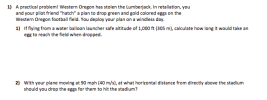 If flying from a water balloon launcher safe altitude of 1,000
ft (305 m), calculate how long it would take an egg to....
1) A practical problem! Western Oregon has stolen the Lumberjack. In retaliation, you and your pilot friend "hatch" a plan to drop green and gold colored eggs on the Western Oregon football field. You deploy your plan on a windless day. If flying from a water balloon launcher safe altitude of 1,000 ft (305 m), calculate how...
If flying from a water balloon launcher safe altitude of 1,000
ft (305 m), calculate how long it would take an egg to....
1) A practical problem! Western Oregon has stolen the Lumberjack. In retaliation, you and your pilot friend "hatch" a plan to drop green and gold colored eggs on the Western Oregon football field. You deploy your plan on a windless day. If flying from a water balloon launcher safe altitude of 1,000 ft (305 m), calculate how...
5) Surgical hose makes an excellent catapult for water balloons. Assume that the stretching of the...
 5) Surgical hose makes an excellent catapult for water balloons. Assume that the stretching of the hose obeys Hooke's law with a spring constant of 100 N/m. If the hose is stretched by 5.0 m and then released, how much work does the force from the hose do on the balloon in the pouch by the time the hose reaches its relaxed length?
A brick of mass m=0.49 kg is set against a spring with a spring constant of k1 = 639 N/m which has been compressed by a distance of 0.1 m
 A brick of mass m=0.49 kg is set against a spring with a spring constant of k1 = 639 N/m which has been compressed by a distance of 0.1 m. Some distance in front of it, along a frictionless surface, is another spring with a spring constant of k2 = 261 N/m. Part (a) How far, d2 in meters, will the second spring compress when the brick runs into it? Part (b) How fast, v in meters per second, will the brick...
2. You hang a 2 kg mass on a spring, and find that it takes 1...
2. You hang a 2 kg mass on a spring, and find that it takes 1 second to go through one cycle of its motion. What is the spring’s spring constant? 3. You have a pendulum of length 0.5 meters and mass m. If you pull it back just a little bit, how long does it take to swing back and forth 4 times?
HI, I need these answered ASAP. Please do not answer if you are not going to...
 HI, I need these answered ASAP. Please do not answer if you are
not going to complete both. I will give a good rate. Thank you.
Question 1 10 pts A spring has a spring constant of 96 N/m. How much work is done when the spring stretches a distance of 6 cm? You must show work to earn credit for your answer. Question 2 10 pts A rocket launcher has a spring constant of 214 N/m. What force is...
HI, I need these answered ASAP. Please do not answer if you are
not going to complete both. I will give a good rate. Thank you.
Question 1 10 pts A spring has a spring constant of 96 N/m. How much work is done when the spring stretches a distance of 6 cm? You must show work to earn credit for your answer. Question 2 10 pts A rocket launcher has a spring constant of 214 N/m. What force is...
A glider with mass m = 0.200 kg sits on a frictionless horizontal air track, connected...
A glider with mass m = 0.200 kg sits on a frictionless horizontal air track, connected to a spring with force constant k = 5.20 N/m . You pull on the glider, stretching the spring 0.130 m , and then release it with no initial velocity. The glider begins to move back toward its equilibrium position ( x=0 ). Part A What is the speed of the glider when it returns to x=0 ? Part B What must the initial...
After gluing two 0.70-kg blocks together, you determine that you can pull the blocks apart with...
After gluing two 0.70-kg blocks together, you determine that you can pull the blocks apart with a force of 25 N . You attach the top block to a vertical spring for which the spring constant is 500 N/m . What is the maximum possible amplitude of oscillation for which the glue can keep the blocks together?
1. An object of mass 10 kg is released at point A, slides to the bottom...
 1. An object of mass 10 kg is released at point A, slides to the bottom of the 30° incline, then collides with a horizontal massless spring, compressing it a maximum distance of 0.75 m. The spring constant is 500 N/m, the height of the incline is 2.0 m, and the horizontal surface is frictionless. (a) What is the speed of the object at the bottom of the incline? (b) What is the work of friction on the object while...
 A spring-loaded launcher is used to shoot a ball of mass 1.50 kg straight up in the air, as shown in (Figure 1). The spring has spring constant k 667 N/m. If the spring is compressed a distance of 25.0 centimeters from its equilibrium position y = 0 and then released, the ball reaches a maximum height hmax (measured from the equilibrium position of the spring). There is no air resistance, and the ball never touches the inside of the...
 If flying from a water balloon launcher safe altitude of 1,000
ft (305 m), calculate how long it would take an egg to....
1) A practical problem! Western Oregon has stolen the Lumberjack. In retaliation, you and your pilot friend "hatch" a plan to drop green and gold colored eggs on the Western Oregon football field. You deploy your plan on a windless day. If flying from a water balloon launcher safe altitude of 1,000 ft (305 m), calculate how...
If flying from a water balloon launcher safe altitude of 1,000
ft (305 m), calculate how long it would take an egg to....
1) A practical problem! Western Oregon has stolen the Lumberjack. In retaliation, you and your pilot friend "hatch" a plan to drop green and gold colored eggs on the Western Oregon football field. You deploy your plan on a windless day. If flying from a water balloon launcher safe altitude of 1,000 ft (305 m), calculate how...
 5) Surgical hose makes an excellent catapult for water balloons. Assume that the stretching of the hose obeys Hooke's law with a spring constant of 100 N/m. If the hose is stretched by 5.0 m and then released, how much work does the force from the hose do on the balloon in the pouch by the time the hose reaches its relaxed length?
 HI, I need these answered ASAP. Please do not answer if you are
not going to complete both. I will give a good rate. Thank you.
Question 1 10 pts A spring has a spring constant of 96 N/m. How much work is done when the spring stretches a distance of 6 cm? You must show work to earn credit for your answer. Question 2 10 pts A rocket launcher has a spring constant of 214 N/m. What force is...
HI, I need these answered ASAP. Please do not answer if you are
not going to complete both. I will give a good rate. Thank you.
Question 1 10 pts A spring has a spring constant of 96 N/m. How much work is done when the spring stretches a distance of 6 cm? You must show work to earn credit for your answer. Question 2 10 pts A rocket launcher has a spring constant of 214 N/m. What force is...
 1. An object of mass 10 kg is released at point A, slides to the bottom of the 30° incline, then collides with a horizontal massless spring, compressing it a maximum distance of 0.75 m. The spring constant is 500 N/m, the height of the incline is 2.0 m, and the horizontal surface is frictionless. (a) What is the speed of the object at the bottom of the incline? (b) What is the work of friction on the object while...
Most questions answered within 3 hours.
-
Where is the error in this code sequence?
String s1 = "Hello";
String s2 = "ello";...
asked 11 months ago -
Financial data for Joel de Paris, Inc., for last year
follow:
Joel de Paris, Inc.
Balance...
asked 11 months ago -
Consider this reaction:
Al2(SO4)3 (aq)+ BaCl3
(aq) Al2Cl6 (aq)- +
3BaSO4(s) . What is the...
asked 11 months ago -
Suppose that Savneet is considering increasing her
recent random sample from 20 car rentals to 40...
asked 11 months ago -
Trucks arrive at an unloading terminal at an average rate of 120
per hour.
Trucks arrive...
asked 11 months ago -
Why are methanol and ethanol completely soluble in water while
octanol is not very little soluble....
asked 11 months ago -
A facilities manager at a university reads in a research report
that the mean amount of...
asked 11 months ago -
When the CuSO4 is rehydrated by adding water to the anhydrous
compound, is this an endothermic...
asked 11 months ago -
A ray of sunlight is passing from diamond into crown glass; the
angle of incidence is...
asked 11 months ago -
A block of mass 0.249 kg is placed on top of a light, vertical
spring of...
asked 11 months ago -
how do the kidneys compensate in the presences of acidosis
a) trigger hyperventilate
b) reserve acid...
asked 11 months ago -
Question 501 pts
The rental rate of capital to the firm increases. Which of the
following...
asked 11 months ago