A beam of particles, each with a charge of 11.2 x 10⁻¹⁹ C, moves at [...
A beam of particles, each with a charge of 11.2 x 10⁻¹⁹ C, moves at [ (-8.13)i + (-7.69)j + (-1.24)k ] x 105 m/s through a uniform magnetic field of [ (4.97)i + (1.01)j + (-1.61)k ] T. Let F represent the force vector on each particle.
Small number entry: use 1.24e-14 N to enter 1.24x10⁻¹⁴ N
What is the i component of F?
What is the j component of F?
What is the k component of F?
What is the magnitude of F?
A uniform electric field of [ (5.49)i + (-2.75)j + (-5.35)k ] x 105 N/C is added to the system. What is the new magnitude of F?
Homework Answers

Add Answer to:
A beam of particles, each with a charge of 11.2 x
10-19 C, moves at [...
Need help with both please A charged particle (with q = 1.0 x 10⁻² C) that...
 Need help with both please
A charged particle (with q = 1.0 x 10⁻² C) that is moving through a uniform magnetic field has a velocity (6.0 x 10⁵ m/s) i + (4.0 x 10⁵ m/s) k when it experiences a force F due to the magnetic field. If B = (-3.0 x 10⁻³T) i +(4.0 x 10⁻³T)j +(5.0 x 10⁻³ T) k , calculate the force, in N (in terms of unit vectors). Equation: F=qvxB F=-(3.0 N) i -(6.0...
Need help with both please
A charged particle (with q = 1.0 x 10⁻² C) that is moving through a uniform magnetic field has a velocity (6.0 x 10⁵ m/s) i + (4.0 x 10⁵ m/s) k when it experiences a force F due to the magnetic field. If B = (-3.0 x 10⁻³T) i +(4.0 x 10⁻³T)j +(5.0 x 10⁻³ T) k , calculate the force, in N (in terms of unit vectors). Equation: F=qvxB F=-(3.0 N) i -(6.0...
5.A particle of charge +2.00 x 10³ C is moving with velocity v (1000 m/s)j through...
 5.A particle of charge +2.00 x 10³ C is moving with velocity v (1000 m/s)j through a uniform magnetic field. The magnetic force on the particle is F = (4.00 N)i-(6.00 N)k. What is B, the z component of the magnetic field (in T)? (A) 1.00 (B) 1.50 (C) 4.00 (D) 2.00 (E) 3.00 (F) 5.00
An electron (charge -1.6 x 10^-19 C) moves on a path perpendicular to the direction of...
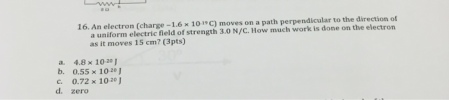 An electron (charge -1.6 x 10^-19 C) moves on a path perpendicular to the direction of a uniform electric field of strength 3.0 N/C. How much work is done on the electron as it moves 15 cm? 4.8 x 10^20 J 0.55 x 10^20 J 0.72 x 10^-20 J
7. An electron with a charge of -1.60 x 10⁻¹⁹ C and a mass of 9.10...
 7. An electron with a charge of -1.60 x 10⁻¹⁹ C and a mass of 9.10 x 10⁻³¹ kg passes between two charged metal plates. The electric field in the region between the plates is directed downward with a magnitude of 100. N/C (see figure below). The electron enters the uniform electric field region between the plates with an initial horizontal velocity of 3.00 x 10⁶ m/s, and traverses a horizontal distance of 4.00 cm before exiting the plates. (a)...
X 107 kg) 27.25 A proton (q 1.60 x 10¹⁹ C, m 1.67 moves in a...
 X 107 kg) 27.25 A proton (q 1.60 x 10¹⁹ C, m 1.67 moves in a uniform magnetic field B (0.500 T)1. At t = 0 the proton has velocity components ux-1.50 × 10⁵ m/s, vy=0, and vz = 2.00 × 10⁵ m/s (see Example 27.4) (a) what are the magnitude and direction of the magnetic force acting on the proton? In addition to the magnetic field there is a uniform electric field in the +x-direction, E (+2.00 x 10⁴...
A point charge of +7.45 PC (7.45 x 10⁻¹² C) is fixed at the origin. Another...
 A point charge of +7.45 PC (7.45 x 10⁻¹² C) is fixed at the origin. Another point charge of -4.28 PC is fixed on the y-axis, 279 mm from the origin. If you placed a proton at point P, which is on the x-axis, 9.83 mm from the origin, what would be the magnitude of the electric force on that proton? 0 353 N 0 1.69 x 10⁻¹⁶ N 0 1050 N O 5.66 x 10⁻¹⁷ N A uniform magnetic...
A proton with charge 1.602 x 10^-19 C moves at a speed of 300 m/s in...
A proton with charge 1.602 x 10^-19 C moves at a speed of 300 m/s in a magnetic field at an angle of 65 degrees. If the strength of the magnetic field is 19 T, what would be the magnitude of the force the charge experiences? 8.28 x 10^-16 N 13.78 x 10^-15 N 5.09 x 10^-14 N 7.75 x 10^-17 N An alpha particle travelling at 2155 m/s enters a magnetic field of strength 12.2 T. The particle is...
A particle with mass 1.81 x 10^-3 kg and a charge of 1.22 x 10^-8 C...
A particle with mass 1.81 x 10^-3 kg and a charge of 1.22 x 10^-8 C has, at a given instant, a velocity v = (3.00 x 10^4 ms^-1) j. What is the acceleration produced by a uniform magnetic field B = (1.63 T)i + (0.980 T)j ? a) (-0.330m^-2)j b) (-0.330m^-2)k c) (-0.330m^-2)j + (-0.330m^-2)k d) (-0.330m^-2)i + (-0.330m^-2)k
solve these 3 question step by step plz Q1. A beam of protons (q 1.6 x...
 solve these 3 question step by step plz
Q1. A beam of protons (q 1.6 x 10⁻¹⁹ C) moves at 3.0 x 10⁵ m/s through a uniform 201 alongthe postive z-axis, as shown in the figure. The velocity of each proton lies in the xz-plane and is directed at 30° to the +z-axis. Find the force on a proton. Q2. The figure is a perspective view of a flat surface with area 3.0 cm2 in a uniform magnetic field B....
solve these 3 question step by step plz
Q1. A beam of protons (q 1.6 x 10⁻¹⁹ C) moves at 3.0 x 10⁵ m/s through a uniform 201 alongthe postive z-axis, as shown in the figure. The velocity of each proton lies in the xz-plane and is directed at 30° to the +z-axis. Find the force on a proton. Q2. The figure is a perspective view of a flat surface with area 3.0 cm2 in a uniform magnetic field B....
A 1.2-C charge moves with a velocity of (1.8i-3.2j+6.4 k) m/s and experiences a magnetic force...
 A 1.2-C charge moves with a velocity of (1.8i-3.2j+6.4 k) m/s and experiences a magnetic force of (3.6 i-27.0 j+11.0K) N. The x-component of the magnetic field equalis zero. Determine the y-component of the magnetic field. Submit Answer
 Need help with both please
A charged particle (with q = 1.0 x 10⁻² C) that is moving through a uniform magnetic field has a velocity (6.0 x 10⁵ m/s) i + (4.0 x 10⁵ m/s) k when it experiences a force F due to the magnetic field. If B = (-3.0 x 10⁻³T) i +(4.0 x 10⁻³T)j +(5.0 x 10⁻³ T) k , calculate the force, in N (in terms of unit vectors). Equation: F=qvxB F=-(3.0 N) i -(6.0...
Need help with both please
A charged particle (with q = 1.0 x 10⁻² C) that is moving through a uniform magnetic field has a velocity (6.0 x 10⁵ m/s) i + (4.0 x 10⁵ m/s) k when it experiences a force F due to the magnetic field. If B = (-3.0 x 10⁻³T) i +(4.0 x 10⁻³T)j +(5.0 x 10⁻³ T) k , calculate the force, in N (in terms of unit vectors). Equation: F=qvxB F=-(3.0 N) i -(6.0...
 5.A particle of charge +2.00 x 10³ C is moving with velocity v (1000 m/s)j through a uniform magnetic field. The magnetic force on the particle is F = (4.00 N)i-(6.00 N)k. What is B, the z component of the magnetic field (in T)? (A) 1.00 (B) 1.50 (C) 4.00 (D) 2.00 (E) 3.00 (F) 5.00
 An electron (charge -1.6 x 10^-19 C) moves on a path perpendicular to the direction of a uniform electric field of strength 3.0 N/C. How much work is done on the electron as it moves 15 cm? 4.8 x 10^20 J 0.55 x 10^20 J 0.72 x 10^-20 J
 7. An electron with a charge of -1.60 x 10⁻¹⁹ C and a mass of 9.10 x 10⁻³¹ kg passes between two charged metal plates. The electric field in the region between the plates is directed downward with a magnitude of 100. N/C (see figure below). The electron enters the uniform electric field region between the plates with an initial horizontal velocity of 3.00 x 10⁶ m/s, and traverses a horizontal distance of 4.00 cm before exiting the plates. (a)...
 X 107 kg) 27.25 A proton (q 1.60 x 10¹⁹ C, m 1.67 moves in a uniform magnetic field B (0.500 T)1. At t = 0 the proton has velocity components ux-1.50 × 10⁵ m/s, vy=0, and vz = 2.00 × 10⁵ m/s (see Example 27.4) (a) what are the magnitude and direction of the magnetic force acting on the proton? In addition to the magnetic field there is a uniform electric field in the +x-direction, E (+2.00 x 10⁴...
 A point charge of +7.45 PC (7.45 x 10⁻¹² C) is fixed at the origin. Another point charge of -4.28 PC is fixed on the y-axis, 279 mm from the origin. If you placed a proton at point P, which is on the x-axis, 9.83 mm from the origin, what would be the magnitude of the electric force on that proton? 0 353 N 0 1.69 x 10⁻¹⁶ N 0 1050 N O 5.66 x 10⁻¹⁷ N A uniform magnetic...
 solve these 3 question step by step plz
Q1. A beam of protons (q 1.6 x 10⁻¹⁹ C) moves at 3.0 x 10⁵ m/s through a uniform 201 alongthe postive z-axis, as shown in the figure. The velocity of each proton lies in the xz-plane and is directed at 30° to the +z-axis. Find the force on a proton. Q2. The figure is a perspective view of a flat surface with area 3.0 cm2 in a uniform magnetic field B....
solve these 3 question step by step plz
Q1. A beam of protons (q 1.6 x 10⁻¹⁹ C) moves at 3.0 x 10⁵ m/s through a uniform 201 alongthe postive z-axis, as shown in the figure. The velocity of each proton lies in the xz-plane and is directed at 30° to the +z-axis. Find the force on a proton. Q2. The figure is a perspective view of a flat surface with area 3.0 cm2 in a uniform magnetic field B....
 A 1.2-C charge moves with a velocity of (1.8i-3.2j+6.4 k) m/s and experiences a magnetic force of (3.6 i-27.0 j+11.0K) N. The x-component of the magnetic field equalis zero. Determine the y-component of the magnetic field. Submit Answer
Most questions answered within 3 hours.
-
Where is the error in this code sequence?
String s1 = "Hello";
String s2 = "ello";...
asked 11 months ago -
Financial data for Joel de Paris, Inc., for last year
follow:
Joel de Paris, Inc.
Balance...
asked 11 months ago -
Consider this reaction:
Al2(SO4)3 (aq)+ BaCl3
(aq) Al2Cl6 (aq)- +
3BaSO4(s) . What is the...
asked 11 months ago -
Suppose that Savneet is considering increasing her
recent random sample from 20 car rentals to 40...
asked 11 months ago -
Trucks arrive at an unloading terminal at an average rate of 120
per hour.
Trucks arrive...
asked 11 months ago -
Why are methanol and ethanol completely soluble in water while
octanol is not very little soluble....
asked 11 months ago -
A facilities manager at a university reads in a research report
that the mean amount of...
asked 11 months ago -
When the CuSO4 is rehydrated by adding water to the anhydrous
compound, is this an endothermic...
asked 11 months ago -
A ray of sunlight is passing from diamond into crown glass; the
angle of incidence is...
asked 11 months ago -
A block of mass 0.249 kg is placed on top of a light, vertical
spring of...
asked 11 months ago -
how do the kidneys compensate in the presences of acidosis
a) trigger hyperventilate
b) reserve acid...
asked 11 months ago -
Question 501 pts
The rental rate of capital to the firm increases. Which of the
following...
asked 11 months ago