1. (a) The potential difference between the plates of a 4.90-µF capacitor is 130 V. How...
1. (a) The potential difference between the plates of a 4.90-µF
capacitor is 130 V. How much energy is stored in the capacitor?How
much additional energy is required to increase the potential
difference between the plates from 130 V to 260 V?
b)The charges on the plates of a 9-µF capacitor are ± 4.3 µC.How
much energy is stored in the capacitor? If the charge is
transferred until the charges on the plates are equal to ±1.9 µC,
how much stored energy remains?
Homework Answers
Dear student,
Find this solution, and RATE IT ,If you find it is helpful .your rating is very important to me.If any incorrectness ,kindly let me know I will rectify them soon.
Thanks for asking ..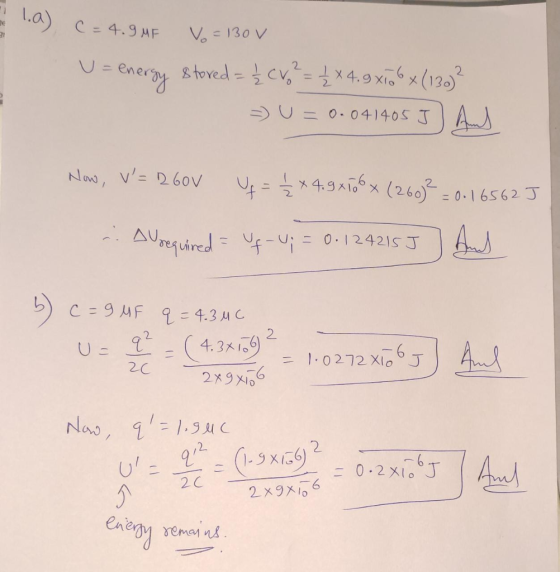
Add Answer to:
1. (a) The potential difference between the plates of a 4.90-µF
capacitor is 130 V. How...
A parallel-plate capacitor has a capacitance of 1.9 µF and a plate separation of 1.9 mm....
A parallel-plate capacitor has a capacitance of 1.9 µF and a plate separation of 1.9 mm. (a) What is the maximum potential difference between the plates such that dielectric breakdown of the air between the plates does not occur? (Use Emax = 3 MV/m.) ________________kV (b) How much charge is stored at this maximum potential difference? ___________________mC
1. (a) When a battery is connected to the plates of a 6.00-µF capacitor, it stores...
1. (a) When a battery is connected to the plates of a 6.00-µF capacitor, it stores a charge of 144.0 µC. What is the voltage of the battery? V (b) If the same capacitor is connected to another battery and 18.0 µC of charge is stored on the capacitor, what is the voltage of the battery? V
a.) A lab technician connects a 4.50 V battery to the plates of a capacitor. After...
a.) A lab technician connects a 4.50 V battery to the plates of a capacitor. After waiting a while, the capacitor reaches a maximum amount of 21.0 µC of stored charge. What is the value of the capacitance (in µF)? b.) The capacitor is disconnected from the battery, discharged, and then connected to a 15.0 V battery. Again, a long enough time is waited for the capacitor to fully charge. How much charge (in µC) is stored now? (Assume the...
A parallel-plate capacitor has charge of magnitude 8.40 µC on each plate and capacitance 3.60 µF when there is air between the plates.
A parallel-plate capacitor has charge of magnitude 8.40 µC on each plate and capacitance 3.60 µF when there is air between the plates. The plates are separated by 2.10 mm. With the charge on the plates kept constant, a dielectric withκ = 6is inserted between the plates, completely filling the volume between the plates. (Enter the magnitudes.)(a)What is the potential difference between the plates of the capacitor (in V) before and after the dielectric has been inserted?before Vafter V(b)What is...
In the figure a potential difference of V = 120 V is applied across a capacitor...
 In the figure a potential difference of V = 120 V is
applied across a capacitor arrangement with capacitances
C1 = 12.3 µF, C2 = 7.39 µF,
and C3 = 14.1 µF. What are (a)
charge q3, (b) potential
difference V3, and (c) stored
energy U3 for capacitor 3, (d)
q1, (e)
V1, and (f)
U1 for capacitor 1, and (g)
q2, (h)
V2, and (i)
U2 for capacitor 2
C2 CL C3
In the figure a potential difference of V = 120 V is
applied across a capacitor arrangement with capacitances
C1 = 12.3 µF, C2 = 7.39 µF,
and C3 = 14.1 µF. What are (a)
charge q3, (b) potential
difference V3, and (c) stored
energy U3 for capacitor 3, (d)
q1, (e)
V1, and (f)
U1 for capacitor 1, and (g)
q2, (h)
V2, and (i)
U2 for capacitor 2
C2 CL C3
In the figure a potential difference V = 80.0 V is applied across a capacitor arrangement...
 In the figure a potential difference V = 80.0 V is applied
across a capacitor arrangement with capacitances C1 = 14.7 µF, C2 =
3.82 µF, and C3 = 3.72 µF. What are (a) charge q3, (b) potential
difference V3, and (c) stored energy U3 for capacitor 3, (d) q1,
(e) V1, and (f) U1 for capacitor 1, and (g) q2, (h) V2, and (i) U2
for capacitor 2?
In the figure a potential difference V = 80.0 V is applied
across a capacitor arrangement with capacitances C1 = 14.7 µF, C2 =
3.82 µF, and C3 = 3.72 µF. What are (a) charge q3, (b) potential
difference V3, and (c) stored energy U3 for capacitor 3, (d) q1,
(e) V1, and (f) U1 for capacitor 1, and (g) q2, (h) V2, and (i) U2
for capacitor 2?
A 1.9-µF capacitor is charged to a potential difference of 18.0 V and then connected across...
A 1.9-µF capacitor is charged to a potential difference of 18.0 V and then connected across a 0.39-mH inductor. What is the current in the circuit when the potential difference across the capacitor is 9.0 V? (Give the magnitude.)
(a) How much charge is on each plate of a 4.00 µF capacitor when it is...
(a) How much charge is on each plate of a 4.00 µF capacitor when it is connected to a 9.00 V battery? 1 µC (b) If this same capacitor is connected to a 12.0 V battery, what charge is stored? 2 µC
In the figure a potential difference V = 120 V is applied across a capacitor arrangement...
 In
the figure a potential difference V = 120 V is applied across a
capacitor arrangement with capacitances C1 = 14.3 µF, C2 = 4.40 µF,
and C3 = 4.43 µF. What are (a) charge q3, (b) potential difference
V3, and (c) stored energy U3 for capacitor 3, (d) q1, (e) V1, and
(f) U1 for capacitor 1, and (g) q2, (h) V2, and (i) U2 for
capacitor 2?
Chapter 25, Problem 034 In the figure a potential difference V...
In
the figure a potential difference V = 120 V is applied across a
capacitor arrangement with capacitances C1 = 14.3 µF, C2 = 4.40 µF,
and C3 = 4.43 µF. What are (a) charge q3, (b) potential difference
V3, and (c) stored energy U3 for capacitor 3, (d) q1, (e) V1, and
(f) U1 for capacitor 1, and (g) q2, (h) V2, and (i) U2 for
capacitor 2?
Chapter 25, Problem 034 In the figure a potential difference V...
A 12.5μF capacitor is connected to a power supply that keeps a constant potential difference of...
A 12.5μF capacitor is connected to a power supply that keeps a constant potential difference of 24.0 V across the plates. A piece of material having a dielectric constant of 3.75 is placed between the plates, completely filling the space between them. a.) How much energy is stored in the capacitor before the dielectric is inserted? b.) How much energy is stored in the capacitor after the dielectric is inserted? c.) By how much did the energy change during the...
 In the figure a potential difference of V = 120 V is
applied across a capacitor arrangement with capacitances
C1 = 12.3 µF, C2 = 7.39 µF,
and C3 = 14.1 µF. What are (a)
charge q3, (b) potential
difference V3, and (c) stored
energy U3 for capacitor 3, (d)
q1, (e)
V1, and (f)
U1 for capacitor 1, and (g)
q2, (h)
V2, and (i)
U2 for capacitor 2
C2 CL C3
In the figure a potential difference of V = 120 V is
applied across a capacitor arrangement with capacitances
C1 = 12.3 µF, C2 = 7.39 µF,
and C3 = 14.1 µF. What are (a)
charge q3, (b) potential
difference V3, and (c) stored
energy U3 for capacitor 3, (d)
q1, (e)
V1, and (f)
U1 for capacitor 1, and (g)
q2, (h)
V2, and (i)
U2 for capacitor 2
C2 CL C3
 In the figure a potential difference V = 80.0 V is applied
across a capacitor arrangement with capacitances C1 = 14.7 µF, C2 =
3.82 µF, and C3 = 3.72 µF. What are (a) charge q3, (b) potential
difference V3, and (c) stored energy U3 for capacitor 3, (d) q1,
(e) V1, and (f) U1 for capacitor 1, and (g) q2, (h) V2, and (i) U2
for capacitor 2?
In the figure a potential difference V = 80.0 V is applied
across a capacitor arrangement with capacitances C1 = 14.7 µF, C2 =
3.82 µF, and C3 = 3.72 µF. What are (a) charge q3, (b) potential
difference V3, and (c) stored energy U3 for capacitor 3, (d) q1,
(e) V1, and (f) U1 for capacitor 1, and (g) q2, (h) V2, and (i) U2
for capacitor 2?
 In
the figure a potential difference V = 120 V is applied across a
capacitor arrangement with capacitances C1 = 14.3 µF, C2 = 4.40 µF,
and C3 = 4.43 µF. What are (a) charge q3, (b) potential difference
V3, and (c) stored energy U3 for capacitor 3, (d) q1, (e) V1, and
(f) U1 for capacitor 1, and (g) q2, (h) V2, and (i) U2 for
capacitor 2?
Chapter 25, Problem 034 In the figure a potential difference V...
In
the figure a potential difference V = 120 V is applied across a
capacitor arrangement with capacitances C1 = 14.3 µF, C2 = 4.40 µF,
and C3 = 4.43 µF. What are (a) charge q3, (b) potential difference
V3, and (c) stored energy U3 for capacitor 3, (d) q1, (e) V1, and
(f) U1 for capacitor 1, and (g) q2, (h) V2, and (i) U2 for
capacitor 2?
Chapter 25, Problem 034 In the figure a potential difference V...
Most questions answered within 3 hours.
-
Where is the error in this code sequence?
String s1 = "Hello";
String s2 = "ello";...
asked 10 months ago -
Financial data for Joel de Paris, Inc., for last year
follow:
Joel de Paris, Inc.
Balance...
asked 10 months ago -
Consider this reaction:
Al2(SO4)3 (aq)+ BaCl3
(aq) Al2Cl6 (aq)- +
3BaSO4(s) . What is the...
asked 10 months ago -
Suppose that Savneet is considering increasing her
recent random sample from 20 car rentals to 40...
asked 10 months ago -
Trucks arrive at an unloading terminal at an average rate of 120
per hour.
Trucks arrive...
asked 10 months ago -
Why are methanol and ethanol completely soluble in water while
octanol is not very little soluble....
asked 10 months ago -
A facilities manager at a university reads in a research report
that the mean amount of...
asked 10 months ago -
When the CuSO4 is rehydrated by adding water to the anhydrous
compound, is this an endothermic...
asked 10 months ago -
A ray of sunlight is passing from diamond into crown glass; the
angle of incidence is...
asked 10 months ago -
A block of mass 0.249 kg is placed on top of a light, vertical
spring of...
asked 10 months ago -
how do the kidneys compensate in the presences of acidosis
a) trigger hyperventilate
b) reserve acid...
asked 10 months ago -
Question 501 pts
The rental rate of capital to the firm increases. Which of the
following...
asked 10 months ago