hello, please can you please help with these questions, i will give a thumb for sure,...
hello, please can you please help with these questions, i will give a thumb for sure, thanks!
(x) When Iron (Fe) is added to a solution of CuSO4 no reaction occurs. What can you deduce about the standard electrode potentials of Fe/Fe2+ and Cu/Cu2+ from this fact?
-
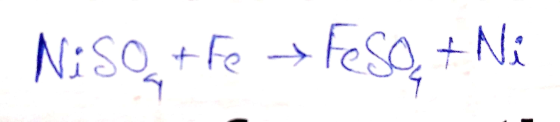
(xi) A plastic container of nickel sulfate (NiSO4) solution develops a leak and the solution comes into contact with a steel machine part. What would happen?
Fe2+ Ι Fe = -0.44V; Ni2+ Ι Ni = -0.25V
-
(xii) Calculate the mass of Zn deposited at the cathode after a current of 0.5 A was passed for 6 min through an electrolytic cell containing zinc sulfate (ZnSO4 ≡ Zn2+ SO42-)
-
Some ionic solids such as AgCl are very insoluble in water whereas some a very soluble (KCl) explain the different behaviour.
Homework Answers
x) From this fact, it can be concluded that the reduction potential of Fe2+/Fe couple is definitely greater than the Reduction Potential of the Cu2+/Cu couple. That's why, Fe isn't Oxidized and Cu2+ isn't reduced.
xi) Since, the Reduction Potential of Ni2+/Ni couple is greater than that of Fe2+/Fe couple, Ni2+ will oxidise Fe to Fe2+, and itself get reduced to Ni.
xii)


Add Answer to:
hello, please can you please help with these questions, i will
give a thumb for sure,...
Please help with solving Question 1 (A-C) Thank you! Unless otherwise specified in the problem, you...
 Please help with solving Question 1 (A-C) Thank you!
Unless otherwise specified in the problem, you may assume that all solutions are at 25°C. 1. 50.0 mL of a pH 6.00 carbonic acid buffer is titrated with 0.2857 M NaOH, requiring 17.47 mL to reach the second equivalence point. a. Calculate the molarity of carbonic acid and bicarbonate in the original buffer. Carbonic acid: Bicarbonate: b. Calculate the pH of the solution after a total of 100.0 mL of 0.2857...
Please help with solving Question 1 (A-C) Thank you!
Unless otherwise specified in the problem, you may assume that all solutions are at 25°C. 1. 50.0 mL of a pH 6.00 carbonic acid buffer is titrated with 0.2857 M NaOH, requiring 17.47 mL to reach the second equivalence point. a. Calculate the molarity of carbonic acid and bicarbonate in the original buffer. Carbonic acid: Bicarbonate: b. Calculate the pH of the solution after a total of 100.0 mL of 0.2857...
Hi please can you answer 4 questions .. thanks for help Factoes hich Infuence The Rates...
 Hi
please can you answer 4 questions .. thanks for help
Factoes hich Infuence The Rates Of Resction Name Date Prelab Question Lab Instructor Lab Section a. List the potential ehemical hazards in this experiment and tell how you wi handle them in order to make this experiment safe for you and others in the laboratory b. List the potential procedural hazards in this experiment and tell how you will handle them in order to make this experiment safe for...
Hi
please can you answer 4 questions .. thanks for help
Factoes hich Infuence The Rates Of Resction Name Date Prelab Question Lab Instructor Lab Section a. List the potential ehemical hazards in this experiment and tell how you wi handle them in order to make this experiment safe for you and others in the laboratory b. List the potential procedural hazards in this experiment and tell how you will handle them in order to make this experiment safe for...
 Please help with solving Question 1 (A-C) Thank you!
Unless otherwise specified in the problem, you may assume that all solutions are at 25°C. 1. 50.0 mL of a pH 6.00 carbonic acid buffer is titrated with 0.2857 M NaOH, requiring 17.47 mL to reach the second equivalence point. a. Calculate the molarity of carbonic acid and bicarbonate in the original buffer. Carbonic acid: Bicarbonate: b. Calculate the pH of the solution after a total of 100.0 mL of 0.2857...
Please help with solving Question 1 (A-C) Thank you!
Unless otherwise specified in the problem, you may assume that all solutions are at 25°C. 1. 50.0 mL of a pH 6.00 carbonic acid buffer is titrated with 0.2857 M NaOH, requiring 17.47 mL to reach the second equivalence point. a. Calculate the molarity of carbonic acid and bicarbonate in the original buffer. Carbonic acid: Bicarbonate: b. Calculate the pH of the solution after a total of 100.0 mL of 0.2857...
 Hi
please can you answer 4 questions .. thanks for help
Factoes hich Infuence The Rates Of Resction Name Date Prelab Question Lab Instructor Lab Section a. List the potential ehemical hazards in this experiment and tell how you wi handle them in order to make this experiment safe for you and others in the laboratory b. List the potential procedural hazards in this experiment and tell how you will handle them in order to make this experiment safe for...
Hi
please can you answer 4 questions .. thanks for help
Factoes hich Infuence The Rates Of Resction Name Date Prelab Question Lab Instructor Lab Section a. List the potential ehemical hazards in this experiment and tell how you wi handle them in order to make this experiment safe for you and others in the laboratory b. List the potential procedural hazards in this experiment and tell how you will handle them in order to make this experiment safe for...
Most questions answered within 3 hours.
-
Where is the error in this code sequence?
String s1 = "Hello";
String s2 = "ello";...
asked 10 months ago -
Financial data for Joel de Paris, Inc., for last year
follow:
Joel de Paris, Inc.
Balance...
asked 10 months ago -
Consider this reaction:
Al2(SO4)3 (aq)+ BaCl3
(aq) Al2Cl6 (aq)- +
3BaSO4(s) . What is the...
asked 10 months ago -
Suppose that Savneet is considering increasing her
recent random sample from 20 car rentals to 40...
asked 10 months ago -
Trucks arrive at an unloading terminal at an average rate of 120
per hour.
Trucks arrive...
asked 10 months ago -
Why are methanol and ethanol completely soluble in water while
octanol is not very little soluble....
asked 10 months ago -
A facilities manager at a university reads in a research report
that the mean amount of...
asked 10 months ago -
When the CuSO4 is rehydrated by adding water to the anhydrous
compound, is this an endothermic...
asked 10 months ago -
A ray of sunlight is passing from diamond into crown glass; the
angle of incidence is...
asked 10 months ago -
A block of mass 0.249 kg is placed on top of a light, vertical
spring of...
asked 10 months ago -
how do the kidneys compensate in the presences of acidosis
a) trigger hyperventilate
b) reserve acid...
asked 10 months ago -
Question 501 pts
The rental rate of capital to the firm increases. Which of the
following...
asked 10 months ago