Consider a capacitor made of two very large perpendicular plates. let the positive x and y-axis...
Consider a capacitor made of two very large perpendicular plates. let the positive x and y-axis represent the cross-section of the capacitor. let one plate be held at v=0 (x-axis) and the other plate v=100(y-axis).Find the potential v(x,y) for x>0 and y>0 and the equations of the equipotentials.
Homework Answers

Add Answer to:
Consider a capacitor made of two very large perpendicular
plates. let the positive x and y-axis...
A parallel plate capacitor is made using two rectangular plates with dimension 1.1mX0.6m containing two dielectrics between the conducting plates. One plate is at x-0m plane and the other plate i...
 A parallel plate capacitor is made using two rectangular plates with dimension 1.1mX0.6m containing two dielectrics between the conducting plates. One plate is at x-0m plane and the other plate is at x -3m plane. Let -2.0 for 0 < z < 0.5 m, and ε,2 = 4.5 for 0.5m< z < 0.6m. Draw this capacitor and find the capacitance.
A parallel plate capacitor is made using two rectangular plates with dimension 1.1mX0.6m containing two dielectrics between the conducting plates....
A parallel plate capacitor is made using two rectangular plates with dimension 1.1mX0.6m containing two dielectrics between the conducting plates. One plate is at x-0m plane and the other plate is at x -3m plane. Let -2.0 for 0 < z < 0.5 m, and ε,2 = 4.5 for 0.5m< z < 0.6m. Draw this capacitor and find the capacitance.
A parallel plate capacitor is made using two rectangular plates with dimension 1.1mX0.6m containing two dielectrics between the conducting plates....
. A large parallel plate capacitor is made out of two circular plates that are 20.0...
. A large parallel plate capacitor is made out of two circular plates that are 20.0 cm in diameter. They are arranged so that one is a short distance above the other. A small glass bead has a mass of 0.100 g and carries a charge of +5.00 nC. The glass bead hovers between the two plates of the parallel plate capacitor. (a) Which plate, upper or lower, is positively charged? (b) What is the charge on the positive plate?
In the picture Consider a parallel plate capacitor with plates of area A and With separation...
 In the picture
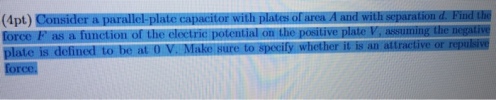
Consider a parallel plate capacitor with plates of area A and With separation d. Find the force F as a function of the electric potential on the positive plate V, assuming the negative plate is defined to be at 0 V. Make sure to specify whether is an attractive or repulsive force.
In the picture
Consider a parallel plate capacitor with plates of area A and With separation d. Find the force F as a function of the electric potential on the positive plate V, assuming the negative plate is defined to be at 0 V. Make sure to specify whether is an attractive or repulsive force.
(a) Consider a parallel plate capacitor with static charge density σ and no medium between the disk and the capacitor. Suppose the capacitor is placed in such a way that the xy plane bisects...
 (a) Consider a parallel plate capacitor with static charge density σ and no medium between the disk and the capacitor. Suppose the capacitor is placed in such a way that the xy plane bisects its interior and the z axis is perpendicular to the plate Assume that the "home" frame is stationary relative to the capacitance, but the "other" frame is moving in the positive x direction at the speed of v. Find the electric field Cartesian com ponents in...
Let R be the region bounded by the y-axis and the graphs and as shown in...
 Let R be the region bounded by the y-axis and the
graphs and as shown in the figure to the
right.
The region R is the base of a solid.
Find the volume of this solid, assuming that each cross section
perpendicular to the x-axis is:
a) a square.
b) an equilateral
triangle.
Let R be the region bounded by the y-axis 4. and the graphs y = 1+x2 and y 4-2x 2x y = 4 as shown in the...
Let R be the region bounded by the y-axis and the
graphs and as shown in the figure to the
right.
The region R is the base of a solid.
Find the volume of this solid, assuming that each cross section
perpendicular to the x-axis is:
a) a square.
b) an equilateral
triangle.
Let R be the region bounded by the y-axis 4. and the graphs y = 1+x2 and y 4-2x 2x y = 4 as shown in the...
A parallel plate capacitor is made of two square plates of side "l" separated by a...
 A parallel plate capacitor is made of two square plates of side "l" separated by a distance "d". Each plate lies parallel to the x-z plane. (see picture below) The capacitance of the parallel plate capacitor is Cpp = One of the plates is now tilted at a SMALL angle as shown Note that the separation between the plates, d(z) now varies with "z". Consider this capacitor as an infinite number of parallel plate capacitors connected to each other in...
A parallel plate capacitor is formed with two plates separated by 5.00 mm as shown in...
A parallel plate capacitor is formed with two plates separated by 5.00 mm as shown in Figure 1. Each plate is a 10.0 cm X 10.0 cm square. We do not know the charge on the plates. An electron beam is shot in from one edge of the capacitor. It enters the capacitor very close (call it 0 mm) from the top plate and travelling parallel to the plates. The electrons in the beam are moving at 1.50 × 10⁷...
3. A capacitor made up of two square 2 cm x 2 cm parallel plates spaced...
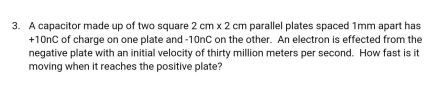 3. A capacitor made up of two square 2 cm x 2 cm parallel plates spaced 1mm apart has +10nC of charge on one plate and -10nC on the other. An electron is effected from the negative plate with an initial velocity of thirty million meters per second. How fast is it moving when it reaches the positive plate?
A parallel plate capacitor is formed with two plates separated by 5.00 mm as shown in...
 A parallel plate capacitor is formed with two plates separated
by 5.00 mm as shown in Figure 1. Each plate is a 10.0 cm X 10.0 cm
square. We do not know the charge on the plates. An electron beam
is shot in from one edge of the capacitor. It enters the capacitor
very close (call it 0 mm) from the top plate and travelling
parallel to the plates. The electrons in the beam are moving at
1.50 × 10⁷...
A parallel plate capacitor is formed with two plates separated
by 5.00 mm as shown in Figure 1. Each plate is a 10.0 cm X 10.0 cm
square. We do not know the charge on the plates. An electron beam
is shot in from one edge of the capacitor. It enters the capacitor
very close (call it 0 mm) from the top plate and travelling
parallel to the plates. The electrons in the beam are moving at
1.50 × 10⁷...
2) Consider two large, metal plates with equal and opposite charges as shown below: OV 300...
 2) Consider two large, metal plates with equal and opposite charges as shown below: OV 300 V 3.0 mm 100 V 200 v a) Which plate, left or right, is the positively charged plate? How do you know? (1 pt) b) What is the magnitude and direction of the electric field at point A located halfway between the plates: y=0 m, x= 1.5mm? (2 pts) c) What is the magnitude and direction of the electric force felt by an electron...
 A parallel plate capacitor is made using two rectangular plates with dimension 1.1mX0.6m containing two dielectrics between the conducting plates. One plate is at x-0m plane and the other plate is at x -3m plane. Let -2.0 for 0 < z < 0.5 m, and ε,2 = 4.5 for 0.5m< z < 0.6m. Draw this capacitor and find the capacitance.
A parallel plate capacitor is made using two rectangular plates with dimension 1.1mX0.6m containing two dielectrics between the conducting plates....
A parallel plate capacitor is made using two rectangular plates with dimension 1.1mX0.6m containing two dielectrics between the conducting plates. One plate is at x-0m plane and the other plate is at x -3m plane. Let -2.0 for 0 < z < 0.5 m, and ε,2 = 4.5 for 0.5m< z < 0.6m. Draw this capacitor and find the capacitance.
A parallel plate capacitor is made using two rectangular plates with dimension 1.1mX0.6m containing two dielectrics between the conducting plates....
 In the picture
Consider a parallel plate capacitor with plates of area A and With separation d. Find the force F as a function of the electric potential on the positive plate V, assuming the negative plate is defined to be at 0 V. Make sure to specify whether is an attractive or repulsive force.
In the picture
Consider a parallel plate capacitor with plates of area A and With separation d. Find the force F as a function of the electric potential on the positive plate V, assuming the negative plate is defined to be at 0 V. Make sure to specify whether is an attractive or repulsive force.
 (a) Consider a parallel plate capacitor with static charge density σ and no medium between the disk and the capacitor. Suppose the capacitor is placed in such a way that the xy plane bisects its interior and the z axis is perpendicular to the plate Assume that the "home" frame is stationary relative to the capacitance, but the "other" frame is moving in the positive x direction at the speed of v. Find the electric field Cartesian com ponents in...
 Let R be the region bounded by the y-axis and the
graphs and as shown in the figure to the
right.
The region R is the base of a solid.
Find the volume of this solid, assuming that each cross section
perpendicular to the x-axis is:
a) a square.
b) an equilateral
triangle.
Let R be the region bounded by the y-axis 4. and the graphs y = 1+x2 and y 4-2x 2x y = 4 as shown in the...
Let R be the region bounded by the y-axis and the
graphs and as shown in the figure to the
right.
The region R is the base of a solid.
Find the volume of this solid, assuming that each cross section
perpendicular to the x-axis is:
a) a square.
b) an equilateral
triangle.
Let R be the region bounded by the y-axis 4. and the graphs y = 1+x2 and y 4-2x 2x y = 4 as shown in the...
 A parallel plate capacitor is made of two square plates of side "l" separated by a distance "d". Each plate lies parallel to the x-z plane. (see picture below) The capacitance of the parallel plate capacitor is Cpp = One of the plates is now tilted at a SMALL angle as shown Note that the separation between the plates, d(z) now varies with "z". Consider this capacitor as an infinite number of parallel plate capacitors connected to each other in...
 3. A capacitor made up of two square 2 cm x 2 cm parallel plates spaced 1mm apart has +10nC of charge on one plate and -10nC on the other. An electron is effected from the negative plate with an initial velocity of thirty million meters per second. How fast is it moving when it reaches the positive plate?
 A parallel plate capacitor is formed with two plates separated
by 5.00 mm as shown in Figure 1. Each plate is a 10.0 cm X 10.0 cm
square. We do not know the charge on the plates. An electron beam
is shot in from one edge of the capacitor. It enters the capacitor
very close (call it 0 mm) from the top plate and travelling
parallel to the plates. The electrons in the beam are moving at
1.50 × 10⁷...
A parallel plate capacitor is formed with two plates separated
by 5.00 mm as shown in Figure 1. Each plate is a 10.0 cm X 10.0 cm
square. We do not know the charge on the plates. An electron beam
is shot in from one edge of the capacitor. It enters the capacitor
very close (call it 0 mm) from the top plate and travelling
parallel to the plates. The electrons in the beam are moving at
1.50 × 10⁷...
 2) Consider two large, metal plates with equal and opposite charges as shown below: OV 300 V 3.0 mm 100 V 200 v a) Which plate, left or right, is the positively charged plate? How do you know? (1 pt) b) What is the magnitude and direction of the electric field at point A located halfway between the plates: y=0 m, x= 1.5mm? (2 pts) c) What is the magnitude and direction of the electric force felt by an electron...
Most questions answered within 3 hours.
-
Where is the error in this code sequence?
String s1 = "Hello";
String s2 = "ello";...
asked 10 months ago -
Financial data for Joel de Paris, Inc., for last year
follow:
Joel de Paris, Inc.
Balance...
asked 10 months ago -
Consider this reaction:
Al2(SO4)3 (aq)+ BaCl3
(aq) Al2Cl6 (aq)- +
3BaSO4(s) . What is the...
asked 10 months ago -
Suppose that Savneet is considering increasing her
recent random sample from 20 car rentals to 40...
asked 10 months ago -
Trucks arrive at an unloading terminal at an average rate of 120
per hour.
Trucks arrive...
asked 10 months ago -
Why are methanol and ethanol completely soluble in water while
octanol is not very little soluble....
asked 10 months ago -
A facilities manager at a university reads in a research report
that the mean amount of...
asked 10 months ago -
When the CuSO4 is rehydrated by adding water to the anhydrous
compound, is this an endothermic...
asked 10 months ago -
A ray of sunlight is passing from diamond into crown glass; the
angle of incidence is...
asked 10 months ago -
A block of mass 0.249 kg is placed on top of a light, vertical
spring of...
asked 10 months ago -
how do the kidneys compensate in the presences of acidosis
a) trigger hyperventilate
b) reserve acid...
asked 10 months ago -
Question 501 pts
The rental rate of capital to the firm increases. Which of the
following...
asked 10 months ago