If the concentration of Na on side a is 7mMs and side B of the membrane...
If the concentration of Na on side a is 7mMs and side B of the membrane the sodium concentration is 175mM what direction will sodium want to move. If In the Na is at equilibrium, what is na contribution to the membrane potential? Which side of the membrane has the more positive charge on it?
Homework Answers
Answer :)
Under the only influence of concentration of ion, Sodium will move from side B to A i.e. down to its concentration gradient.
If Na is at equilibrium:
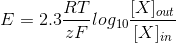
Here R is gas constant = 8.314 J.K−1.mol−1
T is the absolute temperature in Kelvin. Here we consider the body temperature (370C).
T = 37 + 273 K
T = 310 K
The z is the valence of ions, which is +1 for Na+.
F = Faraday’s constant= 96,485 C.mol−1
[X]out = outside of the membrane concentration of the ion
[X]out = 175 mM
[X]in = inside the concentration of the ion.
[X]in = 7 mM
By putting all values in the above formula:


E = 0.061 x 1.4
E = 0.085 V or
E = 0.085 x 1000 mV
E = +85 mV
The side B would be more positive becuase due to the high concentraiton of sodium ions, the charge on side B is +85 mV.

Add Answer to:
If the concentration of Na on side a is 7mMs and side B of the
membrane...
(OHow does the relative permeability of the membrane to Na and K throughout the course of...
 (OHow does the relative permeability of the membrane to Na and K throughout the course of the action potential change compared with that at the resting membrane potential? From the following, select the statement(s) which are CORRECT: Select one or more: a. The number of potassium voltage-gated channels that open determine the amplitude of the action potential b. During the peak of an action potential, there is a 500x increase in the concentration of Na+ that move into the cell....
If the membrane shown in the beakers is permeable only to Na^+, and the beaker on...
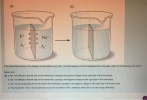 If the membrane shown in the beakers is permeable only to Na^+, and the beaker on the left represents the initial state, which of the following will occur? Select one: a. Na^+ will diffuse to the left side of the membrane, causing a net positive charge on the right tide of the membrane. b. Na^+ will diffuse to the left side of the membrane, causing a not negative charge on the right side of the membrane. c. Na^+ will be...
Calculate the equilibrium membrane potentials to be expected across a membrane at 37 ∘C, with a...
Calculate the equilibrium membrane potentials to be expected across a membrane at 37 ∘C, with a NaCl concentration of 0.10 M on the right and 0.01 M on the left, given the following conditions. Consider the process is spontaneous. Part A Membrane permeable only to Na+. Express your answer to three significant figures and include the appropriate units. Δψ = Part B State which side is positive (+) Part C Membrane permeable only to Cl−. Express your answer to three...
Quiz 3 Bios 240 1. Two solutions are separated by a semipermeable membrane that is permeable...
 Quiz 3 Bios 240 1. Two solutions are separated by a semipermeable membrane that is permeable to sodium but not chloride or potassium ions. Solution A on the left contains a solution that is 100 mM NaCI, while Solution B on the right has a concentration of sodium chloride of 1 mM. There is an electrode in both solutions, and a comparative assessment of voltages between the two compartments is being made. The investigator doing the study decides to call...
How does facilitated diffusion differ from simple diffusion? Facilitated diffusion requires ATP Facilitated diffusion requires a...
How does facilitated diffusion differ from simple diffusion? Facilitated diffusion requires ATP Facilitated diffusion requires a solute-specific protein carrier Facilitated diffusion transports solute against its’ concentration gradient Which of the following is TRUE about primary active cell membrane transport? It is a form of transport that requires a protein “pump” It is a form of transport that transports ions and/or solute against their concentration gradient It is a transport mechanism that requires energy released from the splitting of ATP by...
Complete each sentence to demonstrate your understanding of the resting membrane potential. Thank you!! Complete each...
 Complete each sentence to demonstrate your understanding of the
resting membrane potential.
Thank you!!
Complete each sentence to demonstrate your understanding of the resting membrane potential. opposite The resting membrane potential of a typical neuron is mv. equilibrium potential At rest, the establishes and maintains the concentration gradients for these ions across the plasma membrane When the membrane potential is at the equilibrium potential for a particular ion, there is of the ion through open ion channels, but no Na...
Complete each sentence to demonstrate your understanding of the
resting membrane potential.
Thank you!!
Complete each sentence to demonstrate your understanding of the resting membrane potential. opposite The resting membrane potential of a typical neuron is mv. equilibrium potential At rest, the establishes and maintains the concentration gradients for these ions across the plasma membrane When the membrane potential is at the equilibrium potential for a particular ion, there is of the ion through open ion channels, but no Na...
34. Side A of a Beaker contains 500 mOsmols/liter. Side B of the beaker contains 100...
 34. Side A of a Beaker contains 500 mOsmols/liter. Side B of the beaker contains 100 m/Osmols/liter. A membrane permeable only to water is placed between Side A and B. Describe what will happen. a. Water will move by osmosis from side A to B b. Water will move by osmosis from side B to A c. Water will move from the hypertonic side to the hypotonic side d. Solute will move from side A to side B 35. The...
Shown is a phospholipid bilayer with Na+ on each side. What direction will the Na+ move?...
 Shown is a phospholipid bilayer with Na+ on each side. What
direction will the Na+ move?
A. A to B
B. B to A
C. Both directions
D. It can't move across the bilayer
Shown is a phospholipid bilayer with Na+ on each side. What
direction will the Na+ move?
A. A to B
B. B to A
C. Both directions
D. It can't move across the bilayer
What is the current in amperes if 1500 Na+ ions flow across a cell membrane in...
What is the current in amperes if 1500 Na+ ions flow across a cell membrane in 3.6 μs ? The charge on the sodium is the same as on an electron, but positive. Express your answer to two significant figures and include the appropriate units.
What is the main function of the sodium potassium pump in the neuron? a. Establish concentration...
What is the main function of the sodium potassium pump in the neuron? a. Establish concentration gradients for sodium and potassium ions. b. Depolarize the membrane to threshold. c. Make the inside of the cell more negative than the outside. d. Make the inside of the cell more positive than the outside. e. Pump ions down their concentration gradients during an action potential. A patient of yours has been poisoned by a toxin which prevents fast repolarization of the membrane...
 (OHow does the relative permeability of the membrane to Na and K throughout the course of the action potential change compared with that at the resting membrane potential? From the following, select the statement(s) which are CORRECT: Select one or more: a. The number of potassium voltage-gated channels that open determine the amplitude of the action potential b. During the peak of an action potential, there is a 500x increase in the concentration of Na+ that move into the cell....
 If the membrane shown in the beakers is permeable only to Na^+, and the beaker on the left represents the initial state, which of the following will occur? Select one: a. Na^+ will diffuse to the left side of the membrane, causing a net positive charge on the right tide of the membrane. b. Na^+ will diffuse to the left side of the membrane, causing a not negative charge on the right side of the membrane. c. Na^+ will be...
 Quiz 3 Bios 240 1. Two solutions are separated by a semipermeable membrane that is permeable to sodium but not chloride or potassium ions. Solution A on the left contains a solution that is 100 mM NaCI, while Solution B on the right has a concentration of sodium chloride of 1 mM. There is an electrode in both solutions, and a comparative assessment of voltages between the two compartments is being made. The investigator doing the study decides to call...
 Complete each sentence to demonstrate your understanding of the
resting membrane potential.
Thank you!!
Complete each sentence to demonstrate your understanding of the resting membrane potential. opposite The resting membrane potential of a typical neuron is mv. equilibrium potential At rest, the establishes and maintains the concentration gradients for these ions across the plasma membrane When the membrane potential is at the equilibrium potential for a particular ion, there is of the ion through open ion channels, but no Na...
Complete each sentence to demonstrate your understanding of the
resting membrane potential.
Thank you!!
Complete each sentence to demonstrate your understanding of the resting membrane potential. opposite The resting membrane potential of a typical neuron is mv. equilibrium potential At rest, the establishes and maintains the concentration gradients for these ions across the plasma membrane When the membrane potential is at the equilibrium potential for a particular ion, there is of the ion through open ion channels, but no Na...
 34. Side A of a Beaker contains 500 mOsmols/liter. Side B of the beaker contains 100 m/Osmols/liter. A membrane permeable only to water is placed between Side A and B. Describe what will happen. a. Water will move by osmosis from side A to B b. Water will move by osmosis from side B to A c. Water will move from the hypertonic side to the hypotonic side d. Solute will move from side A to side B 35. The...
 Shown is a phospholipid bilayer with Na+ on each side. What
direction will the Na+ move?
A. A to B
B. B to A
C. Both directions
D. It can't move across the bilayer
Shown is a phospholipid bilayer with Na+ on each side. What
direction will the Na+ move?
A. A to B
B. B to A
C. Both directions
D. It can't move across the bilayer
Most questions answered within 3 hours.
-
Where is the error in this code sequence?
String s1 = "Hello";
String s2 = "ello";...
asked 11 months ago -
Financial data for Joel de Paris, Inc., for last year
follow:
Joel de Paris, Inc.
Balance...
asked 11 months ago -
Consider this reaction:
Al2(SO4)3 (aq)+ BaCl3
(aq) Al2Cl6 (aq)- +
3BaSO4(s) . What is the...
asked 11 months ago -
Suppose that Savneet is considering increasing her
recent random sample from 20 car rentals to 40...
asked 11 months ago -
Trucks arrive at an unloading terminal at an average rate of 120
per hour.
Trucks arrive...
asked 11 months ago -
Why are methanol and ethanol completely soluble in water while
octanol is not very little soluble....
asked 11 months ago -
A facilities manager at a university reads in a research report
that the mean amount of...
asked 11 months ago -
When the CuSO4 is rehydrated by adding water to the anhydrous
compound, is this an endothermic...
asked 11 months ago -
A ray of sunlight is passing from diamond into crown glass; the
angle of incidence is...
asked 11 months ago -
A block of mass 0.249 kg is placed on top of a light, vertical
spring of...
asked 11 months ago -
how do the kidneys compensate in the presences of acidosis
a) trigger hyperventilate
b) reserve acid...
asked 11 months ago -
Question 501 pts
The rental rate of capital to the firm increases. Which of the
following...
asked 11 months ago