A particle is initially at rest and begins to accelerate to the right as 13t-t^2 m/s....
-
A particle is initially at rest and begins to accelerate to the right as 13t-t^2 m/s. How far does the particle move in 3 seconds?
Homework Answers
Acceleration = 
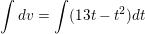
Then 

Integrating both sides we get:
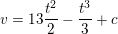
At t = 0, v = 0 ( starts from rest) ---> c = 0
SO 
Now 
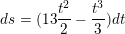
Integrating both sides we get:
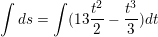
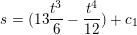
At t = 0, s = 0 ----> c1 = 0
So
Now at t= 3 s, 
Add Answer to:
A particle is initially at rest and begins to accelerate to the
right as 13t-t^2 m/s....
At t = 0.00 seconds,a car begins to accelerate uniformly (i.e. with a constant acceleration) from...
At t = 0.00 seconds,a car begins to accelerate uniformly (i.e. with a constant acceleration) from rest. At t = 3.00 seconds the car has traveled a distance d3. How far will the car have traveled from it's starting point at t = 6 seconds?
A) Starting from rest, you accelerate at 6.0 m/s/s for 5 seconds. You then travel at...
A) Starting from rest, you accelerate at 6.0 m/s/s for 5 seconds. You then travel at constant speed for 10 seconds. What is the constant velocity you are moving at after 5 seconds? B) Starting from rest, you accelerate at 6.0 m/s/s for 5 seconds. You then travel at constant speed for 10 seconds. How far did you travel over the 15 seconds?
A cyclist is initially at rest at the origin. At t=0 she starts to accelerate at...
A cyclist is initially at rest at the origin. At t=0 she starts to accelerate at a constant rate, along a straight road reaching a velocity of 2.60 m/s after 12.0 seconds. 12.0 seconds after starting a prairie dog runs across her path and the cyclist hits the brakes, producing a new constant acceleration. 13.0 seconds after starting, the cyclist has a velocity of 1.50 m/s . C. What is her average acceleration in this 13-s interval? D. What is...
Starting at rest, a particle has an acceleration given by a(t) = 6t+1, with a in...
Starting at rest, a particle has an acceleration given by a(t) = 6t+1, with a in m/s and t in seconds. How far, in meters, does it travel in the first two seconds?
A bus travels at a constant speed of 32m/s for 5 seconds. It begins to accelerate at a rate of 3m/s^2 for 7 seconds and then maintains that speed for another 18 seconds. Finally, it slows down to rest in 22 seconds. How far did the bus travel during the c
A bus travels at a constant speed of 32m/s for 5 seconds. It begins to accelerate at a rate of 3m/s^2 for 7 seconds and then maintains that speed for another 18 seconds. Finally, it slows down to rest in 22 seconds. How far did the bus travel during the course of this entire problem?
2. A 5g particle moving 60m/s East collides with a 2g particle initially at rest. After...
 2. A 5g particle moving 60m/s East collides with a 2g particle initially at rest. After the collision the particles move such that the 5g particle is moving 30° North of East and the 2g particle is moving 30° South of East. What is the speed of the 2g particle after the collision? [87 m/s]
A car sitting at a red light begins to accelerate at 2 m/s2 when the light...
A car sitting at a red light begins to accelerate at 2 m/s2 when the light turns green. It continues with this acceleration until it reaches a speed of 20 m/s. It then travels at this speed for another few minutes. How far does the car travel in the first 45 s after the light changes to green?
the motion of a particle is given by x(t)=(25cm)cos(13t) where t is in s
The motion of a particle is given by x(t)=(25cm)cos(13t), where t is in s. At what time is the kinetic energy equal to twice the potential energy for the first time?
8) A particle initially at rest accelerates at 5.0 m/s2. How fast is it moving after...
 8) A particle initially at rest accelerates at 5.0 m/s2. How fast is it moving after 3.2 s? How far 9) A car is moving at 12.0 m/s and then accelerates at 1.5 m/s2 for 10 seconds. What is the 10) A bal is dropped from height H and accelerates downward with acceleration g. In terms of H 11) A rock is thrown straight up in the air at 6.2 m/s and it is released 1.8 m above the ground....
A car sitting at a red light begins to accelerate at 2 m/s2 when the light...
A car sitting at a red light begins to accelerate at 2 m/s2 when the light turns green. It continues with this acceleration until it reaches a speed of 20 m/s. It then travels at this speed for another few minutes. How far does the car travel in the first 35 s after the light changes to green? Express your answer in meters to one significant figure.
 2. A 5g particle moving 60m/s East collides with a 2g particle initially at rest. After the collision the particles move such that the 5g particle is moving 30° North of East and the 2g particle is moving 30° South of East. What is the speed of the 2g particle after the collision? [87 m/s]
 8) A particle initially at rest accelerates at 5.0 m/s2. How fast is it moving after 3.2 s? How far 9) A car is moving at 12.0 m/s and then accelerates at 1.5 m/s2 for 10 seconds. What is the 10) A bal is dropped from height H and accelerates downward with acceleration g. In terms of H 11) A rock is thrown straight up in the air at 6.2 m/s and it is released 1.8 m above the ground....
Most questions answered within 3 hours.
-
Where is the error in this code sequence?
String s1 = "Hello";
String s2 = "ello";...
asked 10 months ago -
Financial data for Joel de Paris, Inc., for last year
follow:
Joel de Paris, Inc.
Balance...
asked 10 months ago -
Consider this reaction:
Al2(SO4)3 (aq)+ BaCl3
(aq) Al2Cl6 (aq)- +
3BaSO4(s) . What is the...
asked 10 months ago -
Suppose that Savneet is considering increasing her
recent random sample from 20 car rentals to 40...
asked 10 months ago -
Trucks arrive at an unloading terminal at an average rate of 120
per hour.
Trucks arrive...
asked 10 months ago -
Why are methanol and ethanol completely soluble in water while
octanol is not very little soluble....
asked 10 months ago -
A facilities manager at a university reads in a research report
that the mean amount of...
asked 10 months ago -
When the CuSO4 is rehydrated by adding water to the anhydrous
compound, is this an endothermic...
asked 10 months ago -
A ray of sunlight is passing from diamond into crown glass; the
angle of incidence is...
asked 10 months ago -
A block of mass 0.249 kg is placed on top of a light, vertical
spring of...
asked 10 months ago -
how do the kidneys compensate in the presences of acidosis
a) trigger hyperventilate
b) reserve acid...
asked 10 months ago -
Question 501 pts
The rental rate of capital to the firm increases. Which of the
following...
asked 10 months ago