Thin-layer chromatography can be used to follow the progress of a reaction. Speculate on how this...
Thin-layer chromatography can be used to follow the progress of a reaction. Speculate on how this can be accomplished.
Homework Answers

Add Answer to:
Thin-layer chromatography can be used to follow the progress of
a reaction. Speculate on how this...
Wanting to monitor the reaction progress you decide to use normal phase thin-layer chromatography, but do...
Wanting to monitor the reaction progress you decide to use normal phase thin-layer chromatography, but do not know what the best conditions are to use. If you had the standards for all potential products and your starting materials, outline how would you go about determining the best TLC conditions for monitoring the reaction progress. Provide drawings of an ideal TLC plate with the number of theoretical products you would expect and their relative positions. How do you know when the...
1.a IR spectroscopy and Thin Layer Chromatography (TLC) is very convenient in tracking reactions. Explain How...
1.a IR spectroscopy and Thin Layer Chromatography (TLC) is very convenient in tracking reactions. Explain How you used both IR and TLC to track your reaction. Was your reaction complete when you did your initial TLC check? If so, how can you tell? 1.b Discuss how yield can be correlated to the efficacy of a reaction? Why are yields never 100%?
Why is thin layer chromatography used to determine the purity of a sample when you could...
Why is thin layer chromatography used to determine the purity of a sample when you could use an IR spectrum? How does TLC confirm the purity?
11. Why should you use pencil instead of pen when marking on a thin layer chromatography...
11. Why should you use pencil instead of pen when marking on a thin layer chromatography plate? a. Pencil lead isn't as dark. b. The components of pen ink will separate along with your sample, while pencil lead will not. c. Pen ink will not mark on a TLC plate. d. Pen ink will undergo a chemical reaction with the solvent. 12. Which of the following is not a reason to use thin-layer chromatography? a. To determine the number of...
Which of the following statements regarding thin layer chromatography are TRUE? Partition chromatography separates compounds based...
Which of the following statements regarding thin layer chromatography are TRUE? Partition chromatography separates compounds based on how they distribute themselves between the stationary and mobile phases. In thin layer chromatography, a polar organic compound will be attracted to the adsorbent and therefore travel further up the plate than a non-polar compound The Rf value is independent of the adsorbent material used. In thin layer chromatography, a polar organic compound will be repelled by the adsorbent and therefore travel not...
With reference to the principles of thin-layer chromatography (TLC), explain how silica flash chromatography allows for...
With reference to the principles of thin-layer chromatography (TLC), explain how silica flash chromatography allows for the purification of organic compounds. What was the purpose of performing TLC analysis to optimise the eluent, and how does changing eluent affect this?
Thin layer chromatography is used for (select all that apply) 1. following the course of a...
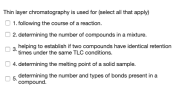 Thin layer chromatography is used for (select all that apply) 1. following the course of a reaction. 2. determining the number of compounds in a mixture. , helping to establish if two compounds have identical retention times under the same TLC conditions. 4. determining the melting point of a solid sample. determining the number and types of bonds present in a compound.
why would you perform purification via recrystallization and column chromatography, and what is thin layer chromatography...
why would you perform purification via recrystallization and column chromatography, and what is thin layer chromatography used for?
you can use thin layer chromatography to separate the hydrocarbons in gasoline? true or false
you can use thin layer chromatography to separate the hydrocarbons in gasoline? true or false
Explain how Thin Layer Chromatograpy (TLC) was used to monitor the progress of the second step...
Explain how Thin Layer Chromatograpy (TLC) was used to monitor the progress of the second step of the diantilis synthesis ( the conversion of the benzyl alcohol into the diantilis product). Illustrate your answer by drawing representative TLC plates.
 Thin layer chromatography is used for (select all that apply) 1. following the course of a reaction. 2. determining the number of compounds in a mixture. , helping to establish if two compounds have identical retention times under the same TLC conditions. 4. determining the melting point of a solid sample. determining the number and types of bonds present in a compound.
Most questions answered within 3 hours.
-
Where is the error in this code sequence?
String s1 = "Hello";
String s2 = "ello";...
asked 10 months ago -
Financial data for Joel de Paris, Inc., for last year
follow:
Joel de Paris, Inc.
Balance...
asked 10 months ago -
Consider this reaction:
Al2(SO4)3 (aq)+ BaCl3
(aq) Al2Cl6 (aq)- +
3BaSO4(s) . What is the...
asked 10 months ago -
Suppose that Savneet is considering increasing her
recent random sample from 20 car rentals to 40...
asked 10 months ago -
Trucks arrive at an unloading terminal at an average rate of 120
per hour.
Trucks arrive...
asked 10 months ago -
Why are methanol and ethanol completely soluble in water while
octanol is not very little soluble....
asked 10 months ago -
A facilities manager at a university reads in a research report
that the mean amount of...
asked 10 months ago -
When the CuSO4 is rehydrated by adding water to the anhydrous
compound, is this an endothermic...
asked 10 months ago -
A ray of sunlight is passing from diamond into crown glass; the
angle of incidence is...
asked 10 months ago -
A block of mass 0.249 kg is placed on top of a light, vertical
spring of...
asked 10 months ago -
how do the kidneys compensate in the presences of acidosis
a) trigger hyperventilate
b) reserve acid...
asked 10 months ago -
Question 501 pts
The rental rate of capital to the firm increases. Which of the
following...
asked 10 months ago