Which of the following is not an essential function of ribosomes in all domains of life?...
Which of the following is not an essential function of ribosomes in all domains of life?
| A. |
Catalyze peptide bond formation between amino acids during polypeptide formation. |
|
| B. |
Bind messenger RNA and identify the start codon where translation begins. |
|
| C. |
Facilitate the complementary base pairing of mRNA codons and tRNA anticodons that determines amino acid order in the polypeptide. |
|
| D. |
Align the Shine Delgarno sequence in the mRNA with a complementary sequence in the 16S rRNA of the small ribosomal subunit. |
Homework Answers
Ribosome is a cellular organelle, found in all living organisms. It is found either in cytoplasm or attached with endoplasmic reticulum. Ribosomes made up of two subunits, one large subunit and one small subunit. In bacteria 70s ribosomes are found , small subunit 30s and large subunit 50s. In eukaryotes it is 80s, small subunit 40s, large subunit 60s.
The main function of the ribosome is assembly of amino acids during protein synthesis. The ribosome has 3 binding sites, A,P and E. At the A site, an aminoacyle-tRNA complementary with mRNA binds. At P site, t-RNA binds with the synthesized peptide chain. From E site the t-RNA exists. During translation of mRNA tRNA brings amino acids attached with it . There are several tRNAs present in the cell. These tRNA contains complementary anti codon of mRNA at its anti codon loop.
Translation begins with the recognition of start codon on mRNA by the ribosome. Ribosomes recognizes the start codon by using a constant region on mRNA located upstream of the start codon. In prokaryotes this region known as Shine-dalgarno sequence and In eukaryotes this region known as Kozak sequence.
So , the non essential function of ribosome is (option D) Align shine-Dalgarno sequence in the mRNA with a complementary sequences in the 16s rRNA of the small ribosomal subunit.
Add Answer to:
Which of the following is not an essential function of ribosomes
in all domains of life?...
Match the following choices to the questions below. UUU catalyzes translocation of the ribosome involved in...
 Match the following choices to the questions below. UUU catalyzes translocation of the ribosome involved in transcription associated with the binding of mRNA in the ribosome binds to Shine-Dalgarno sequence involved in replication contains information in the form of anticodons catalyzes the formation of amino acid-AMP AUG UAG binds to pribnow box catalyzes formation of peptide bonds catalyzes disassembly of the translation complex associated with the binding of tRNA in the ribosome catalyzes disassembly of the transcription complex start codon...
Place the following steps of TRANSLATION in the correct order for EUKARYOTES. The ribosome reaches a...
 Place the following steps of TRANSLATION in the correct order for EUKARYOTES. The ribosome reaches a stop codon. A release factor binds and causes the release of the new polypeptide, along with the mRNA. The ribosome dissociates. v Acharged tRNA with a matching anticodon binds the mRNA codon in the A site. ✓ The ribosome moves exactly 3 nucleotides toward the 3* end of the mRNA. The small ribosomal subunit uses rRNA to bind to the Kozak sequence, which places...
In Bacteria, translation of nascent RNA transcripts is often initiated before transcription is terminated. When this...
 In Bacteria, translation of nascent RNA transcripts is often initiated before transcription is terminated. When this occurs: Select one: a. RNA is transcribed 3'=>5' and amino acids are added to the carboxy terminus of the growing polypeptide as the ribosome moves 5' => 3' along the mRNA b. RNA is transcribed 5'->3' and amino acids are added to the amino terminus of the growing polypeptide as the ribosome moves 3'=> 5' along the mRNA c. RNA is transcribed 3'=> 5'...
Table 1B: Protein Synthesis with 2nd DNA Template Strand DNA Codons in the 2nd Template Strand...
 Table 1B: Protein Synthesis with 2nd DNA Template Strand DNA Codons in the 2nd Template Strand mRNA Sequence (List codons) Amino Acids in the Protein **Use the Genetic Code Chart on page 217 to determine the amino acids that will be placed in the protein Questions: 19. The three letter "code words of DNA and RNA that specify amino acids are called: A. codons B. promoters C. Introns D. anticodons 20. Proteins are composed of building blocks called: A. fatty...
BIOLOGY QUESTION Ribosomes are important complexes during translation. Choose all the answers below that are associated...
 BIOLOGY QUESTION
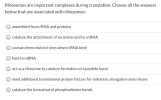
Ribosomes are important complexes during translation. Choose all the answers below that are associated with ribosomes: assembled from rRNA and proteins catalyze the attachment of an amino acid to a tRNA contain three distinct sites where tRNA bind bind to mRNA O act as a ribozyme to catalyze formation of a peptide bond need additional translational protein factors for initiation, elongation and release catalyze the formation of phosphodiester bonds
BIOLOGY QUESTION
Ribosomes are important complexes during translation. Choose all the answers below that are associated with ribosomes: assembled from rRNA and proteins catalyze the attachment of an amino acid to a tRNA contain three distinct sites where tRNA bind bind to mRNA O act as a ribozyme to catalyze formation of a peptide bond need additional translational protein factors for initiation, elongation and release catalyze the formation of phosphodiester bonds
Question 9: The genetic code is read in groups of three nucleotides, called codons, in mRNA...
 Question 9:
The genetic code is read in groups of three nucleotides, called
codons, in mRNA that specifies for a particular amino acid.
tRNA molecules act as the amino acid carriers that by correctly
pairing with the codon on mRNA can deliver the correct amino acid
to the ribosome during translation. At the tip of each tRNA
molecule is a group of three nucleotides called an anticodon and at
the other end is where the corresponding amino acid is attached...
Question 9:
The genetic code is read in groups of three nucleotides, called
codons, in mRNA that specifies for a particular amino acid.
tRNA molecules act as the amino acid carriers that by correctly
pairing with the codon on mRNA can deliver the correct amino acid
to the ribosome during translation. At the tip of each tRNA
molecule is a group of three nucleotides called an anticodon and at
the other end is where the corresponding amino acid is attached...
there are multiple answers correct MS Which of the following events occur during prokaryotic translation termination?...
 there are multiple answers correct
MS Which of the following events occur during prokaryotic translation termination? The small ribosomal subunit binds with a specific tRNA to the mRNA and scans for a start codon. A tRNA recognizes the stop codon and the ribosome dissociates from the mRNA A protein recognizes the stop codon and the ribosome dissociates from the mRNA. A tRNA binds a codon and the ribosome adds amino acids from each tRNA to the polypeptide chain. Codons in...
there are multiple answers correct
MS Which of the following events occur during prokaryotic translation termination? The small ribosomal subunit binds with a specific tRNA to the mRNA and scans for a start codon. A tRNA recognizes the stop codon and the ribosome dissociates from the mRNA A protein recognizes the stop codon and the ribosome dissociates from the mRNA. A tRNA binds a codon and the ribosome adds amino acids from each tRNA to the polypeptide chain. Codons in...
4.(10) Match the following terms for translation in prokaryotes: All of the letters will be used...
 4.(10) Match the following terms for translation in prokaryotes: All of the letters will be used once. One of the items on the left will be left blank. - IRNA - mRNA a. Catalyzes attachment of amino acids to tRNAS 16S rRNA in the 30S subunit Attaches to 30S ribosome to prevent premature formation of 70S ribosome 23S rRNA in the 50S subunit b_IFI, IF3 y Delivers initial I Met-tRNA to initiation complex That which is translated into protein 21F2...
22. What are the roles of Dicer and RISC in the function of miRNAs? Dicer RISC...
 22. What are the roles of Dicer and RISC in the function of miRNAs? Dicer RISC 23. Describe the concepts of primary, secondary, tertiary and quaternary protein structure 24. Here is a short sequence of codons. AUG CAU UGU UUU Write out the amino acids this sequence of codons encodes. Now add an insertion mutation of your choosing in the first codon and write out the new mutant sequence. What are the first four amino acids encoded by this mutant...
Question 18 Which of the following will most likely be observed if the spliceosome were to...
 Question 18 Which of the following will most likely be observed if the spliceosome were to be inactivated? A decrease in the formation of 2 to 5 phosphodiester bonds. An increase in the formation of RNA lariats. An increase in the number of RNAs produced by alternative splicing. O A decrease in 7mGppp formation Question 19 Which of the following is NOT true of typical aminoacyl tRNA synthetases? They catalyze the formation of a larger molecule. They are capable of...
 Match the following choices to the questions below. UUU catalyzes translocation of the ribosome involved in transcription associated with the binding of mRNA in the ribosome binds to Shine-Dalgarno sequence involved in replication contains information in the form of anticodons catalyzes the formation of amino acid-AMP AUG UAG binds to pribnow box catalyzes formation of peptide bonds catalyzes disassembly of the translation complex associated with the binding of tRNA in the ribosome catalyzes disassembly of the transcription complex start codon...
 Place the following steps of TRANSLATION in the correct order for EUKARYOTES. The ribosome reaches a stop codon. A release factor binds and causes the release of the new polypeptide, along with the mRNA. The ribosome dissociates. v Acharged tRNA with a matching anticodon binds the mRNA codon in the A site. ✓ The ribosome moves exactly 3 nucleotides toward the 3* end of the mRNA. The small ribosomal subunit uses rRNA to bind to the Kozak sequence, which places...
 In Bacteria, translation of nascent RNA transcripts is often initiated before transcription is terminated. When this occurs: Select one: a. RNA is transcribed 3'=>5' and amino acids are added to the carboxy terminus of the growing polypeptide as the ribosome moves 5' => 3' along the mRNA b. RNA is transcribed 5'->3' and amino acids are added to the amino terminus of the growing polypeptide as the ribosome moves 3'=> 5' along the mRNA c. RNA is transcribed 3'=> 5'...
 Table 1B: Protein Synthesis with 2nd DNA Template Strand DNA Codons in the 2nd Template Strand mRNA Sequence (List codons) Amino Acids in the Protein **Use the Genetic Code Chart on page 217 to determine the amino acids that will be placed in the protein Questions: 19. The three letter "code words of DNA and RNA that specify amino acids are called: A. codons B. promoters C. Introns D. anticodons 20. Proteins are composed of building blocks called: A. fatty...
 BIOLOGY QUESTION
Ribosomes are important complexes during translation. Choose all the answers below that are associated with ribosomes: assembled from rRNA and proteins catalyze the attachment of an amino acid to a tRNA contain three distinct sites where tRNA bind bind to mRNA O act as a ribozyme to catalyze formation of a peptide bond need additional translational protein factors for initiation, elongation and release catalyze the formation of phosphodiester bonds
BIOLOGY QUESTION
Ribosomes are important complexes during translation. Choose all the answers below that are associated with ribosomes: assembled from rRNA and proteins catalyze the attachment of an amino acid to a tRNA contain three distinct sites where tRNA bind bind to mRNA O act as a ribozyme to catalyze formation of a peptide bond need additional translational protein factors for initiation, elongation and release catalyze the formation of phosphodiester bonds
 Question 9:
The genetic code is read in groups of three nucleotides, called
codons, in mRNA that specifies for a particular amino acid.
tRNA molecules act as the amino acid carriers that by correctly
pairing with the codon on mRNA can deliver the correct amino acid
to the ribosome during translation. At the tip of each tRNA
molecule is a group of three nucleotides called an anticodon and at
the other end is where the corresponding amino acid is attached...
Question 9:
The genetic code is read in groups of three nucleotides, called
codons, in mRNA that specifies for a particular amino acid.
tRNA molecules act as the amino acid carriers that by correctly
pairing with the codon on mRNA can deliver the correct amino acid
to the ribosome during translation. At the tip of each tRNA
molecule is a group of three nucleotides called an anticodon and at
the other end is where the corresponding amino acid is attached...
 there are multiple answers correct
MS Which of the following events occur during prokaryotic translation termination? The small ribosomal subunit binds with a specific tRNA to the mRNA and scans for a start codon. A tRNA recognizes the stop codon and the ribosome dissociates from the mRNA A protein recognizes the stop codon and the ribosome dissociates from the mRNA. A tRNA binds a codon and the ribosome adds amino acids from each tRNA to the polypeptide chain. Codons in...
there are multiple answers correct
MS Which of the following events occur during prokaryotic translation termination? The small ribosomal subunit binds with a specific tRNA to the mRNA and scans for a start codon. A tRNA recognizes the stop codon and the ribosome dissociates from the mRNA A protein recognizes the stop codon and the ribosome dissociates from the mRNA. A tRNA binds a codon and the ribosome adds amino acids from each tRNA to the polypeptide chain. Codons in...
 4.(10) Match the following terms for translation in prokaryotes: All of the letters will be used once. One of the items on the left will be left blank. - IRNA - mRNA a. Catalyzes attachment of amino acids to tRNAS 16S rRNA in the 30S subunit Attaches to 30S ribosome to prevent premature formation of 70S ribosome 23S rRNA in the 50S subunit b_IFI, IF3 y Delivers initial I Met-tRNA to initiation complex That which is translated into protein 21F2...
 22. What are the roles of Dicer and RISC in the function of miRNAs? Dicer RISC 23. Describe the concepts of primary, secondary, tertiary and quaternary protein structure 24. Here is a short sequence of codons. AUG CAU UGU UUU Write out the amino acids this sequence of codons encodes. Now add an insertion mutation of your choosing in the first codon and write out the new mutant sequence. What are the first four amino acids encoded by this mutant...
 Question 18 Which of the following will most likely be observed if the spliceosome were to be inactivated? A decrease in the formation of 2 to 5 phosphodiester bonds. An increase in the formation of RNA lariats. An increase in the number of RNAs produced by alternative splicing. O A decrease in 7mGppp formation Question 19 Which of the following is NOT true of typical aminoacyl tRNA synthetases? They catalyze the formation of a larger molecule. They are capable of...
Most questions answered within 3 hours.
-
Where is the error in this code sequence?
String s1 = "Hello";
String s2 = "ello";...
asked 11 months ago -
Financial data for Joel de Paris, Inc., for last year
follow:
Joel de Paris, Inc.
Balance...
asked 11 months ago -
Consider this reaction:
Al2(SO4)3 (aq)+ BaCl3
(aq) Al2Cl6 (aq)- +
3BaSO4(s) . What is the...
asked 11 months ago -
Suppose that Savneet is considering increasing her
recent random sample from 20 car rentals to 40...
asked 11 months ago -
Trucks arrive at an unloading terminal at an average rate of 120
per hour.
Trucks arrive...
asked 11 months ago -
Why are methanol and ethanol completely soluble in water while
octanol is not very little soluble....
asked 11 months ago -
A facilities manager at a university reads in a research report
that the mean amount of...
asked 11 months ago -
When the CuSO4 is rehydrated by adding water to the anhydrous
compound, is this an endothermic...
asked 11 months ago -
A ray of sunlight is passing from diamond into crown glass; the
angle of incidence is...
asked 11 months ago -
A block of mass 0.249 kg is placed on top of a light, vertical
spring of...
asked 11 months ago -
how do the kidneys compensate in the presences of acidosis
a) trigger hyperventilate
b) reserve acid...
asked 11 months ago -
Question 501 pts
The rental rate of capital to the firm increases. Which of the
following...
asked 11 months ago