Provide a metabolic pathway showing all intermediates (in order)including those of glycoloysis and the TCAcycle. Label...
Provide a metabolic pathway showing all intermediates (in order)including those of glycoloysis and the TCAcycle. Label all the points in metabolism that produce or use ATP, NADH, and FADH2. Put * where yo would find MDH and explain how it might regulate chlorophyll synthesis.
Homework Answers
In glycolysis 2ATP and 1 NADH are formed from one glucose. When pyruvate is converted to acetyl-CoA, 1 NADH is formed. And in TCA cycle 1GTP, 3 NADH and 2FADH2 are formed.
One NADH can provide 3 ATP and one FADH2 can provide 2 ATP molecules. Altogether 30 ATP are formed from one TCA cycle of 2 pyruvate from one glucose.
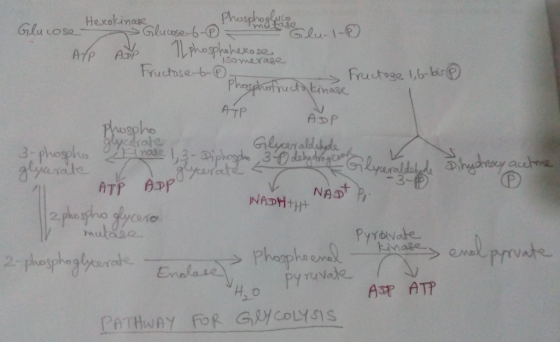
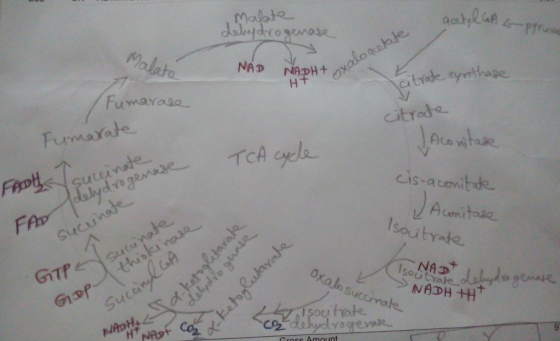
Oxalo acetate (OAA) is imported into the cytosol though the chloroplastic Mal-OAA (malate-oxaloacetate) shuttle. OAA in the cytosol participates in giving malate and citrate. Through the oxidation-reduction reactions of malate and oxaloacetate catalysed by malate dehydrogenase it regulates chlorophyll synthesis.
Add Answer to:
Provide a metabolic pathway showing all intermediates (in
order)including those of glycoloysis and the TCAcycle. Label...
2. (6 points) Provide a valid synthesis (including all intermediates and reagents required) for the following...
 2. (6 points) Provide a valid synthesis (including all intermediates and reagents required) for the following molecule from the given starting material. several steps
7. (True/false) Because glycolysis produces pyruvate, glycolysis is an anabolic pathway, • True • False 8....
 7. (True/false) Because glycolysis produces pyruvate, glycolysis is an anabolic pathway, • True • False 8. Which metabolism is better equipped to support chemotaxis? • Aerobic respiration • Anaerobic respiration • Aerobic chemolithotrophic metabolisms • Gycolysis alone • Tricarboxylic acid cycle alone 9. Comparing a Saccharomyces cerevisiae yeast cell to a Staphylococcus aureus bacterial cell, which one would have the higher S/V ratio? • Staphylococcus aureus • Saccharomyces cerevisiae 10. (True/false) Metabolic pathways represent a predictable linear set of reactions...
YOU MUST ANSWER THE FOLLOWING QUESTIONS ON YOUR OWN PRIOR TO CLASS REVIEW! 1. Label the...
 YOU MUST ANSWER THE FOLLOWING QUESTIONS ON YOUR OWN PRIOR TO CLASS REVIEW! 1. Label the path of electrons through the light reactions of photosynthesis using the illustration below. A. Include PSII and PSI and label all the complexes involved i. Which complex pushes H* across the membrane? ii. Where do these electrons end up? iii. What is the purpose of splitting H2O? iv. Where do the light reactions take place? 2H2D Ot ENR NAOD ADP photolyetemi photosyetemi wlochtone be-...
Create a metabolic pathway map that shows what happens to a glucose molecule that enters a muscle...
 Create a metabolic pathway map that shows what happens to a glucose molecule that enters a muscle cell and becomes metabolized to lactate (in Oz-depleted muscle). Follow the lactate through the Cori cycle, and show how it ultimately gets converted to a glucose molecule that can once again enter the muscle cell. In addition, show how the glucose may be stored as glycogen, and mobilized from glycogen in both liver and muscle. Also show how pyruvate gets converted to acetyl-CoA...
Metabolic Pathway Engineering Problem Set 5 Engineering a Fermentation System: Fermentation of plant matter to produce...
Metabolic Pathway Engineering Problem Set 5 Engineering a Fermentation System: Fermentation of plant matter to produce ethanol for fuel is one potential method for reducing the use of fossil fuels and thus the CO2 emissions that lead to global warming. Many microorganisms can break down cellulose then ferment the glucose to ethanol. However, many potential cellulose sources, including agricultural residues and switchgrass, also contain substantial amounts of arabinose, which is not as easily fermented. Escherichia coli is capable of fermenting...
For the following questions answer with as much detail as possible. If a metabolic pathway is involved draw a name all molecular structures and name all enzymes. Indicate cell type and location within...
For the following questions answer with as much detail as possible. If a metabolic pathway is involved draw a name all molecular structures and name all enzymes. Indicate cell type and location within the cell as well as any transport mechanisms. Since the fatty acid pathways are serpentine, show one pass through the sequence and then you may simply state how many times a sequence is repeated until a new reaction is needed. If asked to synthesize a fatty acid,...
Cellular Metabolism Lab We will walk through the steps of Cellular Respiration in this activity. Please...
Cellular Metabolism Lab We will walk through the steps of Cellular Respiration in this activity. Please do not skip ahead or leave out steps. Fully taking the time to cut out, arrange the shapes, and answer the attached questions will help you to gain a deeper understanding of cellular respiration (the process of making energy, ATP, the major contributor to our overall metabolism). Pages 941-948 in you TEXTBOOK should help you answer the questions. Grading Notes: You can either 1)...
Do expect the cell to produce more ATP from one glucose molecule or from one fatty...
 Do expect the cell to produce more ATP from one glucose molecule or from one fatty acid molecule? Explain your answer. Indicate whether the following statements are true or false. If a statement is false, explain why it is false The proteins of the electron-transport chain remove a pair of high-energy electrons from the cofactors, NADH and FADH_2, after which the electrons move across the inner mitochondrial membrane to maintain the voltage gradient. Gluconeogenesis is a linear reaction pathway that...
N During the light reactions of photosynthesis, chlorophyll absorbs energy from sunlight. This energy is hused...
 N During the light reactions of photosynthesis, chlorophyll absorbs energy from sunlight. This energy is hused to Pe P Select one: O a split water to produce O2 and high-energy electrons O b. convert carbon dioxide to sugar O c. convert sugar to carbon dioxide and water O d. synthesize cell molecules like cellulose Question Not yet How do we derive energy from fats? Points ou Flag Select one: a. Fat can provide energy in the form of NADH and...
BIOL 221 A&P Exam 3 Please read each question carefully and provide a detailed answer using...
 BIOL 221 A&P Exam 3 Please read each question carefully and provide a detailed answer using complete sentences. You may r textbook and course resources All exams must be completed via computer- no hand written documents will be accepted. Save your completed exam using your last name (Exam3Moon.doc) and submit to drop box found within Blackboard under the Digestion tab Explain the difference between a catabolic and anabolic reaction. (4 points) 2. Identify the components of the alimentary canal.(6 points)...
 2. (6 points) Provide a valid synthesis (including all intermediates and reagents required) for the following molecule from the given starting material. several steps
 7. (True/false) Because glycolysis produces pyruvate, glycolysis is an anabolic pathway, • True • False 8. Which metabolism is better equipped to support chemotaxis? • Aerobic respiration • Anaerobic respiration • Aerobic chemolithotrophic metabolisms • Gycolysis alone • Tricarboxylic acid cycle alone 9. Comparing a Saccharomyces cerevisiae yeast cell to a Staphylococcus aureus bacterial cell, which one would have the higher S/V ratio? • Staphylococcus aureus • Saccharomyces cerevisiae 10. (True/false) Metabolic pathways represent a predictable linear set of reactions...
 YOU MUST ANSWER THE FOLLOWING QUESTIONS ON YOUR OWN PRIOR TO CLASS REVIEW! 1. Label the path of electrons through the light reactions of photosynthesis using the illustration below. A. Include PSII and PSI and label all the complexes involved i. Which complex pushes H* across the membrane? ii. Where do these electrons end up? iii. What is the purpose of splitting H2O? iv. Where do the light reactions take place? 2H2D Ot ENR NAOD ADP photolyetemi photosyetemi wlochtone be-...
 Create a metabolic pathway map that shows what happens to a glucose molecule that enters a muscle cell and becomes metabolized to lactate (in Oz-depleted muscle). Follow the lactate through the Cori cycle, and show how it ultimately gets converted to a glucose molecule that can once again enter the muscle cell. In addition, show how the glucose may be stored as glycogen, and mobilized from glycogen in both liver and muscle. Also show how pyruvate gets converted to acetyl-CoA...
 Do expect the cell to produce more ATP from one glucose molecule or from one fatty acid molecule? Explain your answer. Indicate whether the following statements are true or false. If a statement is false, explain why it is false The proteins of the electron-transport chain remove a pair of high-energy electrons from the cofactors, NADH and FADH_2, after which the electrons move across the inner mitochondrial membrane to maintain the voltage gradient. Gluconeogenesis is a linear reaction pathway that...
 N During the light reactions of photosynthesis, chlorophyll absorbs energy from sunlight. This energy is hused to Pe P Select one: O a split water to produce O2 and high-energy electrons O b. convert carbon dioxide to sugar O c. convert sugar to carbon dioxide and water O d. synthesize cell molecules like cellulose Question Not yet How do we derive energy from fats? Points ou Flag Select one: a. Fat can provide energy in the form of NADH and...
 BIOL 221 A&P Exam 3 Please read each question carefully and provide a detailed answer using complete sentences. You may r textbook and course resources All exams must be completed via computer- no hand written documents will be accepted. Save your completed exam using your last name (Exam3Moon.doc) and submit to drop box found within Blackboard under the Digestion tab Explain the difference between a catabolic and anabolic reaction. (4 points) 2. Identify the components of the alimentary canal.(6 points)...
Most questions answered within 3 hours.
-
Where is the error in this code sequence?
String s1 = "Hello";
String s2 = "ello";...
asked 11 months ago -
Financial data for Joel de Paris, Inc., for last year
follow:
Joel de Paris, Inc.
Balance...
asked 11 months ago -
Consider this reaction:
Al2(SO4)3 (aq)+ BaCl3
(aq) Al2Cl6 (aq)- +
3BaSO4(s) . What is the...
asked 11 months ago -
Suppose that Savneet is considering increasing her
recent random sample from 20 car rentals to 40...
asked 11 months ago -
Trucks arrive at an unloading terminal at an average rate of 120
per hour.
Trucks arrive...
asked 11 months ago -
Why are methanol and ethanol completely soluble in water while
octanol is not very little soluble....
asked 11 months ago -
A facilities manager at a university reads in a research report
that the mean amount of...
asked 11 months ago -
When the CuSO4 is rehydrated by adding water to the anhydrous
compound, is this an endothermic...
asked 11 months ago -
A ray of sunlight is passing from diamond into crown glass; the
angle of incidence is...
asked 11 months ago -
A block of mass 0.249 kg is placed on top of a light, vertical
spring of...
asked 11 months ago -
how do the kidneys compensate in the presences of acidosis
a) trigger hyperventilate
b) reserve acid...
asked 11 months ago -
Question 501 pts
The rental rate of capital to the firm increases. Which of the
following...
asked 11 months ago