List two shared derived characteristics of modern birds that separate them from other reptiles.
List two shared derived characteristics of modern birds that separate them from other reptiles.
Homework Answers
1.Birds lay eggs with hard shells. (eventhough both birds and reptiles have amniotic eggs)
2.In birds the fore limb devoloped into wings(pnematized in case of flying birds), and having feathers.
3.The single occipital condyle, which is at the base of the skull, joins the neck to the body and is present in reptiles as well. In case of birds, it allows them to rotate their necks as much as 270 degrees.
Also we can consider the four chambered heart in birds to provide more energy for their body temperature as well as flight.
Add Answer to:
List two shared derived characteristics of modern birds that
separate them from other reptiles.
Select all of the following characteristics that are unique to birds compared to other reptiles, making...
 Select all of the following characteristics that are unique to birds compared to other reptiles, making birds suited for flight Synapsid skulls Air sacs to lighten the body for flight Ability to instinctively migrate with the seasons Rigid skeleton due toll Presence of Jacobson's fusing of bones, especially organ for sensory the collarbone interpretation Lobular lungs connect to anterior and posterior sacs, allowing for continuous gas exchange Breast muscles are attached to sternum keel Specialized feathers to Il provide warmth,...
Do all reptiles look alike? Name at least four reptiles that different from each other and...
Do all reptiles look alike? Name at least four reptiles that different from each other and list the characteristics that makes them different.
List the four shared derived characteristics of chordates. Which invertebrate subphylum shows all four characters as...
List the four shared derived characteristics of chordates. Which invertebrate subphylum shows all four characters as intact, functioning structures in the adult? Which character is present, in intact, functioning form, in an adult human?
Explain please Ch. 34 N) Characteristics of Phylum Chordata. Closest invertebrate related phyla. O) Early chordate...
 Explain please
Ch. 34 N) Characteristics of Phylum Chordata. Closest invertebrate related phyla. O) Early chordate evolution in terms of Hox genes. P) Evolution of land based tetrapods in terms of Gnasthostomes that have limbs. Q) Ostiechthyans and land based tetrapods. R) Features making amphibians sensitive to environmental changes. S) Amniotic eggs with non amniotic eggs; Adult amniote and amphibian ventilation. T Derived characteristics that separate reptiles from other tetrapods. U) Derived characters of birds; factors related to their emergence...
Explain please
Ch. 34 N) Characteristics of Phylum Chordata. Closest invertebrate related phyla. O) Early chordate evolution in terms of Hox genes. P) Evolution of land based tetrapods in terms of Gnasthostomes that have limbs. Q) Ostiechthyans and land based tetrapods. R) Features making amphibians sensitive to environmental changes. S) Amniotic eggs with non amniotic eggs; Adult amniote and amphibian ventilation. T Derived characteristics that separate reptiles from other tetrapods. U) Derived characters of birds; factors related to their emergence...
1. Annelids exhibit two characteristics shared by all other bilateral animals except flatworms: 2. a body...
 1. Annelids exhibit two characteristics shared by all other bilateral animals except flatworms: 2. a body cavity
Answer all the questions please Name Check Your Understanding 9.2 Date Section 1 Cladistics or Evolutionary tax...
 Answer all the questions please
Name Check Your Understanding 9.2 Date Section 1 Cladistics or Evolutionary taxonomy? (Put a C or ET in the blanks.) Which school of systematics emphasizes: amount of change (evolution) of groups since the shared common ancestor. b recency of divergence from the common ancestor; branching patterns. 2 What are two characteristics that are primitive for mammals but derived for vertebrates? (Vertebrate groups are: fish, amphibians, reptiles, birds, and mammals.) (Hint: These would be features that...
Answer all the questions please
Name Check Your Understanding 9.2 Date Section 1 Cladistics or Evolutionary taxonomy? (Put a C or ET in the blanks.) Which school of systematics emphasizes: amount of change (evolution) of groups since the shared common ancestor. b recency of divergence from the common ancestor; branching patterns. 2 What are two characteristics that are primitive for mammals but derived for vertebrates? (Vertebrate groups are: fish, amphibians, reptiles, birds, and mammals.) (Hint: These would be features that...
Two characteristics shared by gymnosperms and angiosperms that are absent from earlier plant groups and represent...
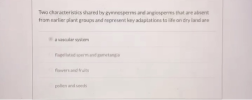 Two characteristics shared by gymnosperms and angiosperms that are absent from earlier plant groups and represent key adaptations to life on dry land are a vascular system Magellated sperm and gametangla flowers and fruits pollen and seeds
. Knightia fish specimens. Classify these animals. They were found in the Green River shale, and lived during the Eocene. Identify anatomical f animals that distinguish them from other kinds of f...
 . Knightia fish specimens. Classify these animals. They were found in the Green River shale, and lived during the Eocene. Identify anatomical f animals that distinguish them from other kinds of fish that you can see on these specimens. There is also a specimen of Diplomystus, another Green River shale fish in one of the exhibits near the Ordovician sea. You can compare this animal to the Knightia specimens. Distinguishing fossil birds from reptiles of similar body form is often...
Circular distribution •Suppose two birds are flying, one is flying from the north and the other...
Circular distribution •Suppose two birds are flying, one is flying from the north and the other is flying from the south. What are there directional average?
2. List two characters/traits you share with ALL animals that are NOT shared by ANY plants....
 2. List two characters/traits you share with ALL animals that are NOT shared by ANY plants. 2a. Consider the traits you listed in the previous question. Would any of them help you to distinguish an animal (e.g., you) from a plant (e.g., a pine tree)? Choose one: YES NO (highlight in color and bold) 2b. Consider the same animal traits. Would any of them, by themselves, help you to distinguish one species of animal from another species of animal? Choose...
 Select all of the following characteristics that are unique to birds compared to other reptiles, making birds suited for flight Synapsid skulls Air sacs to lighten the body for flight Ability to instinctively migrate with the seasons Rigid skeleton due toll Presence of Jacobson's fusing of bones, especially organ for sensory the collarbone interpretation Lobular lungs connect to anterior and posterior sacs, allowing for continuous gas exchange Breast muscles are attached to sternum keel Specialized feathers to Il provide warmth,...
 Explain please
Ch. 34 N) Characteristics of Phylum Chordata. Closest invertebrate related phyla. O) Early chordate evolution in terms of Hox genes. P) Evolution of land based tetrapods in terms of Gnasthostomes that have limbs. Q) Ostiechthyans and land based tetrapods. R) Features making amphibians sensitive to environmental changes. S) Amniotic eggs with non amniotic eggs; Adult amniote and amphibian ventilation. T Derived characteristics that separate reptiles from other tetrapods. U) Derived characters of birds; factors related to their emergence...
Explain please
Ch. 34 N) Characteristics of Phylum Chordata. Closest invertebrate related phyla. O) Early chordate evolution in terms of Hox genes. P) Evolution of land based tetrapods in terms of Gnasthostomes that have limbs. Q) Ostiechthyans and land based tetrapods. R) Features making amphibians sensitive to environmental changes. S) Amniotic eggs with non amniotic eggs; Adult amniote and amphibian ventilation. T Derived characteristics that separate reptiles from other tetrapods. U) Derived characters of birds; factors related to their emergence...
 1. Annelids exhibit two characteristics shared by all other bilateral animals except flatworms: 2. a body cavity
 Answer all the questions please
Name Check Your Understanding 9.2 Date Section 1 Cladistics or Evolutionary taxonomy? (Put a C or ET in the blanks.) Which school of systematics emphasizes: amount of change (evolution) of groups since the shared common ancestor. b recency of divergence from the common ancestor; branching patterns. 2 What are two characteristics that are primitive for mammals but derived for vertebrates? (Vertebrate groups are: fish, amphibians, reptiles, birds, and mammals.) (Hint: These would be features that...
Answer all the questions please
Name Check Your Understanding 9.2 Date Section 1 Cladistics or Evolutionary taxonomy? (Put a C or ET in the blanks.) Which school of systematics emphasizes: amount of change (evolution) of groups since the shared common ancestor. b recency of divergence from the common ancestor; branching patterns. 2 What are two characteristics that are primitive for mammals but derived for vertebrates? (Vertebrate groups are: fish, amphibians, reptiles, birds, and mammals.) (Hint: These would be features that...
 Two characteristics shared by gymnosperms and angiosperms that are absent from earlier plant groups and represent key adaptations to life on dry land are a vascular system Magellated sperm and gametangla flowers and fruits pollen and seeds
 . Knightia fish specimens. Classify these animals. They were found in the Green River shale, and lived during the Eocene. Identify anatomical f animals that distinguish them from other kinds of fish that you can see on these specimens. There is also a specimen of Diplomystus, another Green River shale fish in one of the exhibits near the Ordovician sea. You can compare this animal to the Knightia specimens. Distinguishing fossil birds from reptiles of similar body form is often...
 2. List two characters/traits you share with ALL animals that are NOT shared by ANY plants. 2a. Consider the traits you listed in the previous question. Would any of them help you to distinguish an animal (e.g., you) from a plant (e.g., a pine tree)? Choose one: YES NO (highlight in color and bold) 2b. Consider the same animal traits. Would any of them, by themselves, help you to distinguish one species of animal from another species of animal? Choose...
Most questions answered within 3 hours.
-
Where is the error in this code sequence?
String s1 = "Hello";
String s2 = "ello";...
asked 10 months ago -
Financial data for Joel de Paris, Inc., for last year
follow:
Joel de Paris, Inc.
Balance...
asked 10 months ago -
Consider this reaction:
Al2(SO4)3 (aq)+ BaCl3
(aq) Al2Cl6 (aq)- +
3BaSO4(s) . What is the...
asked 10 months ago -
Suppose that Savneet is considering increasing her
recent random sample from 20 car rentals to 40...
asked 10 months ago -
Trucks arrive at an unloading terminal at an average rate of 120
per hour.
Trucks arrive...
asked 10 months ago -
Why are methanol and ethanol completely soluble in water while
octanol is not very little soluble....
asked 10 months ago -
A facilities manager at a university reads in a research report
that the mean amount of...
asked 10 months ago -
When the CuSO4 is rehydrated by adding water to the anhydrous
compound, is this an endothermic...
asked 10 months ago -
A ray of sunlight is passing from diamond into crown glass; the
angle of incidence is...
asked 10 months ago -
A block of mass 0.249 kg is placed on top of a light, vertical
spring of...
asked 10 months ago -
how do the kidneys compensate in the presences of acidosis
a) trigger hyperventilate
b) reserve acid...
asked 10 months ago -
Question 501 pts
The rental rate of capital to the firm increases. Which of the
following...
asked 10 months ago