is Adderall related to the citric acid cycle/Krebs cycle? if so, how so?
Homework Answers
The citric acid cycle (also known as the Krebs Cycle) is actually a part of the much larger process called cellular respiration, the process where your body harvests energy from the food you eat. Yes, the citric acid cycle has the same citric acid found in oranges and other citrus fruits!
Where does the citric acid cycle fit into cellular respiration?
- Glycolysis, where the simple sugar glucose is broken down, occurs in the cytosol.
- Pyruvate, the product from glycolysis, is transformed into acetyl CoA in the mitochondria for the next step.
- The citric acid cycle, where acetyl CoA is modified in the mitochondria to produce energy precursors in preparation for the next step.
- Oxidative phosphorylation, the process where electron transport from the energy precursors from the citric acid cycle (step 3) leads to the phosphorylation of ADP, producing ATP. This also occurs in the mitochondria.
The citric acid cycle captures the energy stored in the chemical bonds of acetyl CoA (processed glucose) in a step-by-step process, trapping it in the form of high-energy intermediate molecules. The trapped energy from the citric acid cycle is then passed on to oxidative phosphorylation, where it is converted to a usable form of cellular energy, ATP (adenosine triphosphate). We can then use that energy to move, breathe, make our hearts beat, and think (among other things)
The citric acid cycle is called a cycle because the starting molecule, oxaloacetate (which has 4 carbons), is regenerated at the end of the cycle. Throughout the citric acid cycle, oxaloacetate is progressively transformed into several different molecules (as carbon atoms are added to and removed from it), but at the end of the cycle, it always turns back into oxaloacetate to be used again. Energy can be captured from this cycle because several of the steps are energetically favorable. When a step is favored, it means that the products of the reaction have lower energy than the reactants. The difference in energy between the products and the reactants is the energy that is released when the reaction takes place (see enzyme kinetics). The released energy is captured as the electron shuttles (NAD^\text{+}+start superscript, plus, end superscript, and FAD) are reduced to NADH and FADH_{2}2start subscript, 2, e
To start the cycle, an enzyme fuses acetyl CoA and oxaloacetate together so that citric acid is formed (a 2-carbon molecule + a 4-carbon molecule = a 6-carbon molecule!). This is the first molecule that is made in the cycle and is where the cycle gets its name. Enzymes then proceed to speed up (or “catalyze”) a sequence of rearrangements that convert the newly made citric acid molecule into a series of slightly different molecules. These enzymes only change the rate that these rearrangements occur, not the outcome.
Energy shuttles:
- NADH: An energy shuttle which delivers high energy electrons to the electron transport chain where they will eventually power the production of 2 to 3 ATP molecules. When this electron shuttle is not carrying high energy electrons, meaning it has been oxidized (lost its electrons), it is left with a positive charge and is called NAD^\text{+}+start superscript, plus, end superscript.
- FADH_{2}2start subscript, 2, end subscript: Another energy shuttle that carries high energy electrons to the electron transport chain, where they will ultimately drive production of 1 to 2 ATP molecules. The oxidized form of FADH_{2}2start subscript, 2, end subscript is FAD and happens just like in NADH.
High energy molecules:
- ATP: The basic energy currency of the cell. It’s a form of energy that cells can use right away.
- GTP: Similar to ATP, GTP can be easily converted to ATP in the cell.

Add Answer to:
is
Adderall related to the citric acid cycle/Krebs cycle? if so, how
so?
Which of the following processes occur in the cytoplasm? Citric acid cycle a. Oь. Glycolysis Krebs...
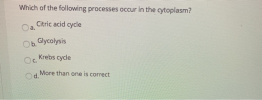 Which of the following processes occur in the cytoplasm? Citric acid cycle a. Oь. Glycolysis Krebs cycle C. d. More than one is correct
Draw the complete TCA cycle (Krebs or Citric acid cycle). Show the entry of acetyl- COA...
 Draw the complete TCA cycle (Krebs or Citric acid cycle). Show the entry of acetyl- COA and the eight intermediates. Draw the chemical structures of each compound. Show the control point(s) in the pathway. Show where all CO2 is released and label the reactions where oxidation of carbon occurs.
In 1937 Hans Krebs deduced the operation of the citric acid cycle from careful observations on...
 In 1937 Hans Krebs deduced the operation of the
citric acid cycle from careful observations on the oxidation of
carbon compounds in minced preparations of pigeon flight muscle.
(Pigeon breast is a rich source of mitochondria, but the function
of mitochondria was unknown at the time.) The consumption of O2 and
the production of CO2 were monitored with a manometer, which
measure changes in volume of a closed system at a constant pressure
and temperature. Standard chemical methods were used...
In 1937 Hans Krebs deduced the operation of the
citric acid cycle from careful observations on the oxidation of
carbon compounds in minced preparations of pigeon flight muscle.
(Pigeon breast is a rich source of mitochondria, but the function
of mitochondria was unknown at the time.) The consumption of O2 and
the production of CO2 were monitored with a manometer, which
measure changes in volume of a closed system at a constant pressure
and temperature. Standard chemical methods were used...
In 1937 Hans Krebs deduced the operation of the citric acid cycle from careful observations on...
 In 1937 Hans Krebs deduced the operation of the citric acid
cycle from careful observations on the oxidation of carbon
compounds in minced preparations of pigeon flight muscle. (Pigeon
breast is a rich source of mitochondria, but the function of
mitochondria was unknown at the time.) The consumption of O2 and
the production of CO2 were monitored with a manometer, which
measure changes in volume of a closed system at a constant pressure
and temperature. Standard chemical methods were used...
In 1937 Hans Krebs deduced the operation of the citric acid
cycle from careful observations on the oxidation of carbon
compounds in minced preparations of pigeon flight muscle. (Pigeon
breast is a rich source of mitochondria, but the function of
mitochondria was unknown at the time.) The consumption of O2 and
the production of CO2 were monitored with a manometer, which
measure changes in volume of a closed system at a constant pressure
and temperature. Standard chemical methods were used...
Question 2 (20 pts) In 1937 Hans Krebs deduced the operation of the citric acid cycle...
 Question 2 (20 pts)
In 1937 Hans Krebs deduced the operation of the citric acid
cycle from careful observations on the oxidation of carbon
compounds in minced preparations of pigeon flight muscle. (Pigeon
breast is a rich source of mitochondria, but the function of
mitochondria was unknown at the time.) The consumption of O2 and
the production of CO2 were monitored with a manometer, which
measure changes in volume of a closed system at a constant pressure
and temperature. Standard...
Question 2 (20 pts)
In 1937 Hans Krebs deduced the operation of the citric acid
cycle from careful observations on the oxidation of carbon
compounds in minced preparations of pigeon flight muscle. (Pigeon
breast is a rich source of mitochondria, but the function of
mitochondria was unknown at the time.) The consumption of O2 and
the production of CO2 were monitored with a manometer, which
measure changes in volume of a closed system at a constant pressure
and temperature. Standard...
Krebs cycle Starting with one molecule of pyruvate and ending with oxaloacetate, how many ATP molecules...
Krebs cycle Starting with one molecule of pyruvate and ending with oxaloacetate, how many ATP molecules and NADH and FADH2 are formed in citric acid cycle
6. Citric Acid Cycle Draw the complete Citric Acid Cycle pathway, include: (a) Total number of...
 6. Citric Acid Cycle Draw the complete Citric Acid Cycle pathway, include: (a) Total number of steps in Citric Acid Cycle? (b) Specify the type of reaction in each step? (c) Name the enzymes in each step? (d) How many redox reactions are present in Citric Acid Cycle?
Fill out the blankets. (Citric Acid Cycle: The Reactions) Citric Acid Cycle: The Reactions
 Fill out the blankets. (Citric Acid Cycle: The
Reactions)
Citric Acid Cycle: The Reactions
Fill out the blankets. (Citric Acid Cycle: The
Reactions)
Citric Acid Cycle: The Reactions
12. Explain how citric acid cycle Is connected to the electron transport chain. what is the...
12. Explain how citric acid cycle Is connected to the electron transport chain. what is the role of molecular oxygen (O2) for citric acid cycle? why will blocking the electron transport chain halt the citric acid cycle?
QUESTION 65 Free energy (delta G) is higher during the citric acid cycle than during glycolysis....
 QUESTION 65 Free energy (delta G) is higher during the citric acid cycle than during glycolysis. Despite this, only two molecules of ATP will be generated in the krebs cycle. Most of the remaining free energy that is released during the krebs cycle will be O a. Used to synthesize GTP O b. Converted into kinetic energy O c.Lost as heat d. Used to reduce pyruvate Oe. Used to reduce electron carriers such as NADH and FADH2
 Which of the following processes occur in the cytoplasm? Citric acid cycle a. Oь. Glycolysis Krebs cycle C. d. More than one is correct
 Draw the complete TCA cycle (Krebs or Citric acid cycle). Show the entry of acetyl- COA and the eight intermediates. Draw the chemical structures of each compound. Show the control point(s) in the pathway. Show where all CO2 is released and label the reactions where oxidation of carbon occurs.
 In 1937 Hans Krebs deduced the operation of the
citric acid cycle from careful observations on the oxidation of
carbon compounds in minced preparations of pigeon flight muscle.
(Pigeon breast is a rich source of mitochondria, but the function
of mitochondria was unknown at the time.) The consumption of O2 and
the production of CO2 were monitored with a manometer, which
measure changes in volume of a closed system at a constant pressure
and temperature. Standard chemical methods were used...
In 1937 Hans Krebs deduced the operation of the
citric acid cycle from careful observations on the oxidation of
carbon compounds in minced preparations of pigeon flight muscle.
(Pigeon breast is a rich source of mitochondria, but the function
of mitochondria was unknown at the time.) The consumption of O2 and
the production of CO2 were monitored with a manometer, which
measure changes in volume of a closed system at a constant pressure
and temperature. Standard chemical methods were used...
 In 1937 Hans Krebs deduced the operation of the citric acid
cycle from careful observations on the oxidation of carbon
compounds in minced preparations of pigeon flight muscle. (Pigeon
breast is a rich source of mitochondria, but the function of
mitochondria was unknown at the time.) The consumption of O2 and
the production of CO2 were monitored with a manometer, which
measure changes in volume of a closed system at a constant pressure
and temperature. Standard chemical methods were used...
In 1937 Hans Krebs deduced the operation of the citric acid
cycle from careful observations on the oxidation of carbon
compounds in minced preparations of pigeon flight muscle. (Pigeon
breast is a rich source of mitochondria, but the function of
mitochondria was unknown at the time.) The consumption of O2 and
the production of CO2 were monitored with a manometer, which
measure changes in volume of a closed system at a constant pressure
and temperature. Standard chemical methods were used...
 Question 2 (20 pts)
In 1937 Hans Krebs deduced the operation of the citric acid
cycle from careful observations on the oxidation of carbon
compounds in minced preparations of pigeon flight muscle. (Pigeon
breast is a rich source of mitochondria, but the function of
mitochondria was unknown at the time.) The consumption of O2 and
the production of CO2 were monitored with a manometer, which
measure changes in volume of a closed system at a constant pressure
and temperature. Standard...
Question 2 (20 pts)
In 1937 Hans Krebs deduced the operation of the citric acid
cycle from careful observations on the oxidation of carbon
compounds in minced preparations of pigeon flight muscle. (Pigeon
breast is a rich source of mitochondria, but the function of
mitochondria was unknown at the time.) The consumption of O2 and
the production of CO2 were monitored with a manometer, which
measure changes in volume of a closed system at a constant pressure
and temperature. Standard...
 6. Citric Acid Cycle Draw the complete Citric Acid Cycle pathway, include: (a) Total number of steps in Citric Acid Cycle? (b) Specify the type of reaction in each step? (c) Name the enzymes in each step? (d) How many redox reactions are present in Citric Acid Cycle?
 Fill out the blankets. (Citric Acid Cycle: The
Reactions)
Citric Acid Cycle: The Reactions
Fill out the blankets. (Citric Acid Cycle: The
Reactions)
Citric Acid Cycle: The Reactions
 QUESTION 65 Free energy (delta G) is higher during the citric acid cycle than during glycolysis. Despite this, only two molecules of ATP will be generated in the krebs cycle. Most of the remaining free energy that is released during the krebs cycle will be O a. Used to synthesize GTP O b. Converted into kinetic energy O c.Lost as heat d. Used to reduce pyruvate Oe. Used to reduce electron carriers such as NADH and FADH2
Most questions answered within 3 hours.
-
Where is the error in this code sequence?
String s1 = "Hello";
String s2 = "ello";...
asked 11 months ago -
Financial data for Joel de Paris, Inc., for last year
follow:
Joel de Paris, Inc.
Balance...
asked 11 months ago -
Consider this reaction:
Al2(SO4)3 (aq)+ BaCl3
(aq) Al2Cl6 (aq)- +
3BaSO4(s) . What is the...
asked 11 months ago -
Suppose that Savneet is considering increasing her
recent random sample from 20 car rentals to 40...
asked 11 months ago -
Trucks arrive at an unloading terminal at an average rate of 120
per hour.
Trucks arrive...
asked 11 months ago -
Why are methanol and ethanol completely soluble in water while
octanol is not very little soluble....
asked 11 months ago -
A facilities manager at a university reads in a research report
that the mean amount of...
asked 11 months ago -
When the CuSO4 is rehydrated by adding water to the anhydrous
compound, is this an endothermic...
asked 11 months ago -
A ray of sunlight is passing from diamond into crown glass; the
angle of incidence is...
asked 11 months ago -
A block of mass 0.249 kg is placed on top of a light, vertical
spring of...
asked 11 months ago -
how do the kidneys compensate in the presences of acidosis
a) trigger hyperventilate
b) reserve acid...
asked 11 months ago -
Question 501 pts
The rental rate of capital to the firm increases. Which of the
following...
asked 11 months ago