state the molecular statistical definition of entropy and explain how this definition may be used to...
state the molecular statistical definition of entropy and explain how this definition may be used to explain the second law of thermodynamics
Homework Answers
Entropy is an inherent phenomenon of the system introduced in classical and statistical thermodynamics based on the analysis of the possibility and impossibility of any processes. Statistical thermodynamics deals with the randomness of the system
How to explain randomness on the point of view of statistics: A macroscopic can be represented in terms of some macroscopic parameters, like. P, T, V. The system represented in terms of microstates, e.g. for a system of N particles we can specify coordinates and velocities of all atoms.
The 2nd law state that any isolated system tends to move toward an equilibrium macrostate in order to gain maximum entropy because in that case number of microstates will be the largest and this state is statistically most probable.
S = kB ln W, statistical representation of entropy
in summary: Entropy is the measure of the "probability" of a given macrostate, which will essentially represent the same thing, the number of microstates possible for the given macrostate.
Add Answer to:
state the molecular statistical definition of entropy and
explain how this definition may be used to...
State the fundamental assumption of statistical mechanics and fully explain its implications for large interacting subsystems...
State the fundamental assumption of statistical mechanics and fully explain its implications for large interacting subsystems isolated from their environment. Some statements of the second law of thermodynamics read simply that “Entropy never decreases.” Is this really the case? Explain fully.
Preferably using text books (but trusted internet sources may substitute) read about the the concept of...
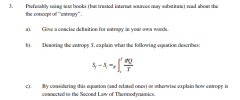 Preferably using text books (but trusted internet sources may
substitute) read about the the concept of “entropy”
3. Preferably using text books (but trusted internet sources may substitute) read about the the concept of “entropy". a). Give a concise definition for entropy in your own words. b). Denoting the entropy S, explain what the following equation describes: S-SER. c). By considering this equation and related ones) or otherwise explain how entropy is connected to the Second Law of Thermodynamics.
Preferably using text books (but trusted internet sources may
substitute) read about the the concept of “entropy”
3. Preferably using text books (but trusted internet sources may substitute) read about the the concept of “entropy". a). Give a concise definition for entropy in your own words. b). Denoting the entropy S, explain what the following equation describes: S-SER. c). By considering this equation and related ones) or otherwise explain how entropy is connected to the Second Law of Thermodynamics.
Please explain Entropy and the Second Law of Thermodynamics. Below you will find key questions. 1....
Please explain Entropy and the Second Law of Thermodynamics. Below you will find key questions. 1. Know that spontaneity is not solely dependent on the enthalpy change for a reaction or process. Some endothermic processes, like ice melting, are spontaneous under certain conditions. 2. Know that when ice melts, liquid water evaporates, or NaCl dissolves in water, the arrangement of molecules or ions becomes more disordered. 3 Define entropy in words, and know Boltzmann’s equation for entropy. 4 Know and...
Please explain Entropy Changes in Chemical Reactions: Calculating. Below are key questions I have. 1. Define...
Please explain Entropy Changes in Chemical Reactions: Calculating. Below are key questions I have. 1. Define and understand standard conditions. 2 .Use standard molar entropies to calculate the standard entropy change for a chemical reaction or physical process. 3 .Define and understand the third law of thermodynamics. 4 .Understand the dependence of standard molar entropy on physical state, molar mass, atomic arrangement, and molecular complexity.
A) First explain what is the first-law of thermodynamics; Give a common mathematical equation we use...
A) First explain what is the first-law of thermodynamics; Give a common mathematical equation we use for the first-law of thermodynamics (be sure to explain all variables in your equation) Give one example of spontaneous process; and one example of non-spontaneous process State second-law of thermodynamics in terms of entropy change What is the units of Entropy? What does entropy measure? If a gas is heated up, what happens to its entropy? If a gas is allowed to expand, what...
UJsing results from Chapter 9,show that from the statistical definition of the entropy that Consider a...
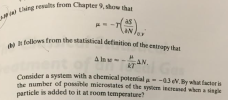 UJsing results from Chapter 9,show that from the statistical definition of the entropy that Consider a system with a chemical potential μ -0.3 eV. By what factor is number of possible microstates of the system increased when a single the particle is added to it at room temperature?
The second law of thermodynamics states that the entropy of a closed system always increases. Cellular...
The second law of thermodynamics states that the entropy of a closed system always increases. Cellular systems take disordered substrates to construct highly ordered molecules and organelles. How can photosynthesis be used to make glucose without violating this law? Note: glucose is more a ordered molecule then the CO2 used to construct it.
True or False (Problems 1 through 10) 1. The change in entropy of a closed system...
 True or False (Problems 1 through 10) 1. The change in entropy of a closed system is the same for every process between two specified states 2. The entropy of a fixed amount of an incompressible substance increases in every process for which temperature increases 3. A process that violates the second law of thermodynamics violates the first law of thermodynamics. 4. When a net amount of work is done on a closed system undergoing an internally reversible process, a...
1. For any process the change in entropy of the universe equals the sum of the...
1. For any process the change in entropy of the universe equals the sum of the entropy changes for the system and for the___ 2. Does the formation of complex molecules such as proteins and nucleic acids from more simple molecules contradict the second law of thermodynamics? Yes or no. Explain your answer.
Question 10 Statistical thermodynamics may be used to find the radiation pressure P for cavity (or...
 Question 10 Statistical thermodynamics may be used to find the radiation pressure P for cavity (or black body) radiation in terms of the energy per unit volume u. (a) An ideal quantum gas comprises non-interacting identical particles with discrete quantum states labelled 1, 2, ...,r ,....The partition function is given by Z (T,V,N)- > exp(-B(n,&, + п,&, +...)} пп. (i) Define the symbols n1, n2,...,n,...and 81, 82, ..., Er,... (iiExplain why, for photons, the partition function may be expressed as:...
 Preferably using text books (but trusted internet sources may
substitute) read about the the concept of “entropy”
3. Preferably using text books (but trusted internet sources may substitute) read about the the concept of “entropy". a). Give a concise definition for entropy in your own words. b). Denoting the entropy S, explain what the following equation describes: S-SER. c). By considering this equation and related ones) or otherwise explain how entropy is connected to the Second Law of Thermodynamics.
Preferably using text books (but trusted internet sources may
substitute) read about the the concept of “entropy”
3. Preferably using text books (but trusted internet sources may substitute) read about the the concept of “entropy". a). Give a concise definition for entropy in your own words. b). Denoting the entropy S, explain what the following equation describes: S-SER. c). By considering this equation and related ones) or otherwise explain how entropy is connected to the Second Law of Thermodynamics.
 UJsing results from Chapter 9,show that from the statistical definition of the entropy that Consider a system with a chemical potential μ -0.3 eV. By what factor is number of possible microstates of the system increased when a single the particle is added to it at room temperature?
 True or False (Problems 1 through 10) 1. The change in entropy of a closed system is the same for every process between two specified states 2. The entropy of a fixed amount of an incompressible substance increases in every process for which temperature increases 3. A process that violates the second law of thermodynamics violates the first law of thermodynamics. 4. When a net amount of work is done on a closed system undergoing an internally reversible process, a...
 Question 10 Statistical thermodynamics may be used to find the radiation pressure P for cavity (or black body) radiation in terms of the energy per unit volume u. (a) An ideal quantum gas comprises non-interacting identical particles with discrete quantum states labelled 1, 2, ...,r ,....The partition function is given by Z (T,V,N)- > exp(-B(n,&, + п,&, +...)} пп. (i) Define the symbols n1, n2,...,n,...and 81, 82, ..., Er,... (iiExplain why, for photons, the partition function may be expressed as:...
Most questions answered within 3 hours.
-
Where is the error in this code sequence?
String s1 = "Hello";
String s2 = "ello";...
asked 10 months ago -
Financial data for Joel de Paris, Inc., for last year
follow:
Joel de Paris, Inc.
Balance...
asked 10 months ago -
Consider this reaction:
Al2(SO4)3 (aq)+ BaCl3
(aq) Al2Cl6 (aq)- +
3BaSO4(s) . What is the...
asked 10 months ago -
Suppose that Savneet is considering increasing her
recent random sample from 20 car rentals to 40...
asked 10 months ago -
Trucks arrive at an unloading terminal at an average rate of 120
per hour.
Trucks arrive...
asked 10 months ago -
Why are methanol and ethanol completely soluble in water while
octanol is not very little soluble....
asked 10 months ago -
A facilities manager at a university reads in a research report
that the mean amount of...
asked 10 months ago -
When the CuSO4 is rehydrated by adding water to the anhydrous
compound, is this an endothermic...
asked 10 months ago -
A ray of sunlight is passing from diamond into crown glass; the
angle of incidence is...
asked 10 months ago -
A block of mass 0.249 kg is placed on top of a light, vertical
spring of...
asked 10 months ago -
how do the kidneys compensate in the presences of acidosis
a) trigger hyperventilate
b) reserve acid...
asked 10 months ago -
Question 501 pts
The rental rate of capital to the firm increases. Which of the
following...
asked 10 months ago