The mass density of air on Mars is ρ=0.016 kg/m3. The gravity on Mars is gMars=...
The mass density of air on Mars is ρ=0.016 kg/m3. The gravity on Mars is gMars= 3.7 m/s2. The mass density of air on earth under standard pressure and temperature conditions is ρ=1.225 kg/m3. A NASA mars probe weighs 1000 N on Earth. At terminal velocity, the weight of a falling object is equal to the drag force. Assume that the drag coefficient of the parachute used is constant, and has the same value on both Earth or Mars, and is CD=0.8.
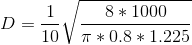
a. What diameter parachute will give a terminal velocity of V=10 m/s on Earth under standard air pressure and temperature conditions? Ans. Approximately 5 m.
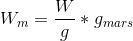
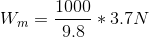
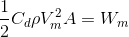
b. What is the terminal velocity on Mars if the same sized parachute is used? Ans. Approximately 50 m/s. Hint, is the weight of the probe the same on Mars?
c. What diameter of parachute is needed to land the this probe on Mars at a terminal velocity of V=10 m/s?
Homework Answers
Drag coefficient on Earth as well as om Mars, 
a. Mass density of air on earth, 
Weight of object on earth, W = 1000 N
Terminal velocity, V = 10 m/s
Drag force
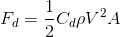
Where A = Reference Area
If D = diameter of parachute

The object aquires terminal velocity when its weight becomes equal to drag force

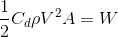
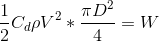
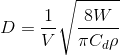


b. If m = mass of probe
then its weight on earth, W = mg

Acceleration due to gravity on Mars, 
Weight on Mars,


Let  = Terminal velocity on Mars
Density of air on Mars, 
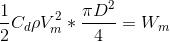
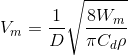


c. In this case,

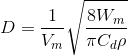
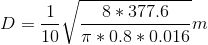

Diameter of parachute required in this case is 27.4 m
Add Answer to:
The mass density of air on Mars is ρ=0.016 kg/m3. The
gravity on Mars is gMars=...
The Canadian Space Agency has decided to send an experimental probe to Mars. Its weight on...
 The Canadian Space Agency has decided to send an experimental probe to Mars. Its weight on earth is 40 kgf. When the probe is near the planet it will be attracted by the its gravitational field (gMars = 3.75 m/s^2). You are asked to provide the parachute's diameter so that the probe will touch Mars' surface with a velocity of 3 m/s (which is equivalent of dropping the probe from 0.5 m height on Earth). (A_chute = pi D^2/4, C_D...
The drag force on falling box is described by FD=(1/2)ρACDv2, where ρ is the density of...
The drag force on falling box is described by FD=(1/2)ρACDv2, where ρ is the density of air, 1.2 kg/m3. The mass of the box is 12.0 g, and the effective area of the bottom of the box is 109 cm2. Assume a drag coefficient of 1.10 a) Determine the drag force on the box when it is falling at a speed of 1.21 m/s. b) The box will reach terminal speed when the drag force on it is equal to...
Compute the terminal settling velocity in air of a sphere with density of 1,000 kg/m3. The...
Compute the terminal settling velocity in air of a sphere with density of 1,000 kg/m3. The sphere with a diameter of 10 μm falls through standard air (25 °C and 1 Atm).
A light, plastic sphere with mass m = 9.00 g and density ρ = 5.00 kg/m3...
A light, plastic sphere with mass m = 9.00 g and density ρ = 5.00 kg/m3 is suspended in air by thread of negligible mass. a)What is the tension T in the thread if the air is at 5.00∘C and p = 1.00 atm? The molar mass of air is28.8 g/mol. b)How much does the tension in the thread change if the temperature of the gas is increased to 35.0 ∘C?Ignore the change in volume of the plastic sphere when...
4. (20pts) The atmosphere of mars is 95% Carbon dioxide (CO2), 3% Nitrogen (N2), and 2%...
4. (20pts) The atmosphere of mars is 95% Carbon dioxide (CO2), 3% Nitrogen (N2), and 2% Argon (Ar) by volume. Assume that k=1.3. The average temperature is T=200K. a. What is the molecular weight of the atmosphere on Mars in kg/kmol? b. What is the gas constant R of the atmosphere on Mars in kJ/(kg∙K)? c. What is the speed of sound in the atmosphere of Mars under these conditions? Ans. Approximately 220m/s. d. A mars probe is travelling through...
A small space probe of mass 180 kg is launched from a spacecraft near Mars. It...
A small space probe of mass 180 kg is launched from a spacecraft near Mars. It travels toward the surface of Mars, where it will eventually land. At a time 22.6 seconds after it is launched, the probe is at location <4000, 8700, 0> m, and at this same instant its momentum is <50000, -7400, 0> kg·m/s. At this instant, the net force on the probe due to the gravitational pull of Mars plus the air resistance acting on the...
The density of air at standard temperature and pressure (STP) is 1.20 kg/m3. If the density...
The density of air at standard temperature and pressure (STP) is 1.20 kg/m3. If the density of helium is 0.179 kg/m3 inside a perfectly spherical balloon of radius 5.00 m, how much mass, in kg, could this balloon carry?
A 6.5-cm-diameter ball has a terminal speed of 26 m/s. What is the ball’s mass? Use...
A 6.5-cm-diameter ball has a terminal speed of 26 m/s. What is the ball’s mass? Use ρ = 1.2 kg/m3 for the density of air at room temperature.
A 22 cm diameter bowling ball has a terminal speed of 75 m/s. Suppose that the density of air is 1.2 kg/m3. PART A: What...
A 22 cm diameter bowling ball has a terminal speed of 75 m/s. Suppose that the density of air is 1.2 kg/m3. PART A: What is the ball's mass?
A 0.01 mL spherical air bubble is injected into a polycarbonate cylindrical tube approximately 1.8 m...
 A 0.01 mL spherical air bubble is injected into a polycarbonate cylindrical tube approximately 1.8 m in height and 0.125 m in diameter. The tube is filled up with water. The air bubble rises slowly in water due to the buoyancy force. The drag and gravity forces are also acting on bubble when it rises. After some intervals, bubble achieves the terminal velocity (U,) at steady state conditions where all forces are balanced. The drag force of the water on...
 The Canadian Space Agency has decided to send an experimental probe to Mars. Its weight on earth is 40 kgf. When the probe is near the planet it will be attracted by the its gravitational field (gMars = 3.75 m/s^2). You are asked to provide the parachute's diameter so that the probe will touch Mars' surface with a velocity of 3 m/s (which is equivalent of dropping the probe from 0.5 m height on Earth). (A_chute = pi D^2/4, C_D...
 A 0.01 mL spherical air bubble is injected into a polycarbonate cylindrical tube approximately 1.8 m in height and 0.125 m in diameter. The tube is filled up with water. The air bubble rises slowly in water due to the buoyancy force. The drag and gravity forces are also acting on bubble when it rises. After some intervals, bubble achieves the terminal velocity (U,) at steady state conditions where all forces are balanced. The drag force of the water on...
Most questions answered within 3 hours.
-
Where is the error in this code sequence?
String s1 = "Hello";
String s2 = "ello";...
asked 11 months ago -
Financial data for Joel de Paris, Inc., for last year
follow:
Joel de Paris, Inc.
Balance...
asked 11 months ago -
Consider this reaction:
Al2(SO4)3 (aq)+ BaCl3
(aq) Al2Cl6 (aq)- +
3BaSO4(s) . What is the...
asked 11 months ago -
Suppose that Savneet is considering increasing her
recent random sample from 20 car rentals to 40...
asked 11 months ago -
Trucks arrive at an unloading terminal at an average rate of 120
per hour.
Trucks arrive...
asked 11 months ago -
Why are methanol and ethanol completely soluble in water while
octanol is not very little soluble....
asked 11 months ago -
A facilities manager at a university reads in a research report
that the mean amount of...
asked 11 months ago -
When the CuSO4 is rehydrated by adding water to the anhydrous
compound, is this an endothermic...
asked 11 months ago -
A ray of sunlight is passing from diamond into crown glass; the
angle of incidence is...
asked 11 months ago -
A block of mass 0.249 kg is placed on top of a light, vertical
spring of...
asked 11 months ago -
how do the kidneys compensate in the presences of acidosis
a) trigger hyperventilate
b) reserve acid...
asked 11 months ago -
Question 501 pts
The rental rate of capital to the firm increases. Which of the
following...
asked 11 months ago