Using the terms genotype and phenotype, describe the amount of DNA sequence difference between different people...
Using the terms genotype and phenotype, describe the amount of DNA sequence difference between different people and the significance of these differences.
Homework Answers
In this context, remember that the genotype is the DNA sequence that each individual has and the phenotype is the observable trait encoded by the genotype. For example, some people have a determined DNA sequence (genotype) that codes for a blond hair and others individuals have a genotype that codes for black hair. However, this does not depend on the amount of DNA since all humans have the same amount of DNA. What makes this difference is the sequence of DNA of each individual. Of course, all humans have common DNA sequence but at the same time we differ in particular sequences and that makes us different between each other.
Add Answer to:
Using the terms genotype and phenotype, describe the
amount of DNA sequence difference between different people...
1. Explain the difference between the terms genotype and phenotype. B / US ET Tz O...
 1. Explain the difference between the terms genotype and phenotype. B / US ET Tz O Words 2. The seeds in this exercise were produced by a heterozygous parent and homozygous recessive parent as describe in step 3. List all possible crosses that could have produced the homozygous recessive parent (rr). B US ET Tz O Words 3. Consider the seeds used in this exercise. What would happen if all the wrinkled seeds were removed from the population, and only...
Explain the difference between a genotype and a phenotype. Think or use a Punnett Square in...
Explain the difference between a genotype and a phenotype. Think or use a Punnett Square in your answer.
1. What is the difference between Phenotype and Genotype of bacteria? Phenotype characteristics Genotype characteristics 2....
 1. What is the difference between Phenotype and Genotype of bacteria? Phenotype characteristics Genotype characteristics 2. Write Write the temperatures, time and number of cycles for each steps Stops Temperature Time Cycles Initial denaturation 95°C Denaturation " C30 sec 10 min 1 72°C 60 sec Smin Anncaling 55°C Extension Final Extension . Hold 4-12°C 3. After PCR is performed on bacterial colonies, PCR products are run out on an agarose gel, what went wrong on this gel. Please write the...
4. Genotype Results Were you successful in isolating genomic DNA and obtaining a PCR product? (Describe size and estimated amount.) If answering No to either, explain why! a. /) enimenon....
 4. Genotype Results Were you successful in isolating genomic DNA and obtaining a PCR product? (Describe size and estimated amount.) If answering No to either, explain why! a. /) enimenon. TC alle )/.tet e t。 /1</i J What is your genotype as revealed by the Fnu4HI digest of your PCR product and if it matches your phenotype? b. c. Why might an individual's phenotype not match their genotype? DOPULATION GENETI ORY 7 AROSE GEL ELECTROPHORESis On the template below, indicate...
Describe the difference between objects and values using the terms “equivalent” and “identical”. Illustrate the difference...
Describe the difference between objects and values using the terms “equivalent” and “identical”. Illustrate the difference using your own examples with Python lists and the “is” operator. Describe the relationship between objects, references, and aliasing. Again, create your own examples with Python lists. Finally, create your own example of a function that modifies a list passed in as an argument. Describe what your function does in terms of arguments, parameters, objects, and references.
Complete the concept map. alleles chromatids chromatin chromosomes DNA genes genotype nucleic acids phenotype can occur...
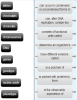 Complete the concept map.
alleles chromatids chromatin chromosomes DNA genes genotype nucleic acids phenotype can occur in condensed or uncondensed forms in can, after DNA replication, contain two consists of functional units called determine an organism's have different versions called is a polymer of is packed with proteins to form is the observable expression of
Complete the concept map.
alleles chromatids chromatin chromosomes DNA genes genotype nucleic acids phenotype can occur in condensed or uncondensed forms in can, after DNA replication, contain two consists of functional units called determine an organism's have different versions called is a polymer of is packed with proteins to form is the observable expression of
1.Describe the difference between a DNA molecule, a chromatid, and a chromosome. 2.Predict the number of...
1.Describe the difference between a DNA molecule, a chromatid, and a chromosome. 2.Predict the number of DNA molecules, chromatids, and chromosomes for a cell at a given stage of meiosis or mitosis. 3.Recognize the differences in meiosis in plants and animals (male and female).
Chapter 8: Microbial Genetics and Genetic Engineering Reading Assignment: Chapter 8 1. Describe the structure and...
 Chapter 8: Microbial Genetics and Genetic Engineering Reading Assignment: Chapter 8 1. Describe the structure and function of DNA in the microbial cell. List the chemical components of DNA including the nitrogen bases and the role of histones. 2. Define the following: genome, chromosome, gene, genotype, phenotype, and palindrome. 3. Describe the process of DNA replication in microbes. Explain the term semi-conservative replication 4. Describe the steps in protein synthesis. Compare and contrast transcription and translation. Describe the roles of...
Question 5 (1 point) Describe this: Tt Question 5 options: A) homozygous phenotype B) heterozygous genotype...
Question 5 (1 point) Describe this: Tt Question 5 options: A) homozygous phenotype B) heterozygous genotype C) homozygous genotype D) heterozygous phenotype Question 6 (1 point) Which of these is a prenatal genetic test? Question 6 options: A) in vitro fertilization B) nuclear transplantation C) chorionic villi sampling D) DNA profiling Question 7 (1 point) All the offspring of a white hen and a black rooster are gray. The simplest explanation for this type of inheritance is: Question 7 options:...
Briefly describe the difference between the mass of a DNA sample and the length of a...
Briefly describe the difference between the mass of a DNA sample and the length of a DNA molecule, and give the most common unit of measurement for each.
 1. Explain the difference between the terms genotype and phenotype. B / US ET Tz O Words 2. The seeds in this exercise were produced by a heterozygous parent and homozygous recessive parent as describe in step 3. List all possible crosses that could have produced the homozygous recessive parent (rr). B US ET Tz O Words 3. Consider the seeds used in this exercise. What would happen if all the wrinkled seeds were removed from the population, and only...
 1. What is the difference between Phenotype and Genotype of bacteria? Phenotype characteristics Genotype characteristics 2. Write Write the temperatures, time and number of cycles for each steps Stops Temperature Time Cycles Initial denaturation 95°C Denaturation " C30 sec 10 min 1 72°C 60 sec Smin Anncaling 55°C Extension Final Extension . Hold 4-12°C 3. After PCR is performed on bacterial colonies, PCR products are run out on an agarose gel, what went wrong on this gel. Please write the...
 4. Genotype Results Were you successful in isolating genomic DNA and obtaining a PCR product? (Describe size and estimated amount.) If answering No to either, explain why! a. /) enimenon. TC alle )/.tet e t。 /1</i J What is your genotype as revealed by the Fnu4HI digest of your PCR product and if it matches your phenotype? b. c. Why might an individual's phenotype not match their genotype? DOPULATION GENETI ORY 7 AROSE GEL ELECTROPHORESis On the template below, indicate...
 Complete the concept map.
alleles chromatids chromatin chromosomes DNA genes genotype nucleic acids phenotype can occur in condensed or uncondensed forms in can, after DNA replication, contain two consists of functional units called determine an organism's have different versions called is a polymer of is packed with proteins to form is the observable expression of
Complete the concept map.
alleles chromatids chromatin chromosomes DNA genes genotype nucleic acids phenotype can occur in condensed or uncondensed forms in can, after DNA replication, contain two consists of functional units called determine an organism's have different versions called is a polymer of is packed with proteins to form is the observable expression of
 Chapter 8: Microbial Genetics and Genetic Engineering Reading Assignment: Chapter 8 1. Describe the structure and function of DNA in the microbial cell. List the chemical components of DNA including the nitrogen bases and the role of histones. 2. Define the following: genome, chromosome, gene, genotype, phenotype, and palindrome. 3. Describe the process of DNA replication in microbes. Explain the term semi-conservative replication 4. Describe the steps in protein synthesis. Compare and contrast transcription and translation. Describe the roles of...
Most questions answered within 3 hours.
-
Where is the error in this code sequence?
String s1 = "Hello";
String s2 = "ello";...
asked 10 months ago -
Financial data for Joel de Paris, Inc., for last year
follow:
Joel de Paris, Inc.
Balance...
asked 10 months ago -
Consider this reaction:
Al2(SO4)3 (aq)+ BaCl3
(aq) Al2Cl6 (aq)- +
3BaSO4(s) . What is the...
asked 10 months ago -
Suppose that Savneet is considering increasing her
recent random sample from 20 car rentals to 40...
asked 10 months ago -
Trucks arrive at an unloading terminal at an average rate of 120
per hour.
Trucks arrive...
asked 10 months ago -
Why are methanol and ethanol completely soluble in water while
octanol is not very little soluble....
asked 10 months ago -
A facilities manager at a university reads in a research report
that the mean amount of...
asked 10 months ago -
When the CuSO4 is rehydrated by adding water to the anhydrous
compound, is this an endothermic...
asked 10 months ago -
A ray of sunlight is passing from diamond into crown glass; the
angle of incidence is...
asked 10 months ago -
A block of mass 0.249 kg is placed on top of a light, vertical
spring of...
asked 10 months ago -
how do the kidneys compensate in the presences of acidosis
a) trigger hyperventilate
b) reserve acid...
asked 10 months ago -
Question 501 pts
The rental rate of capital to the firm increases. Which of the
following...
asked 10 months ago