On a wet road, the coefficient of static friction between a car's tires and the flat...
On a wet road, the coefficient of static friction between a car's tires and the flat road is 0.24. What is the maximum speed a car can safely navigate a turn with a 50.0 m radius of curvature?
Homework Answers
The static friction force provide centripetal force for the car
to move around the curve. For maximum speed, the friction force
needs to have maximum value. We use this to find the required
solution as shown below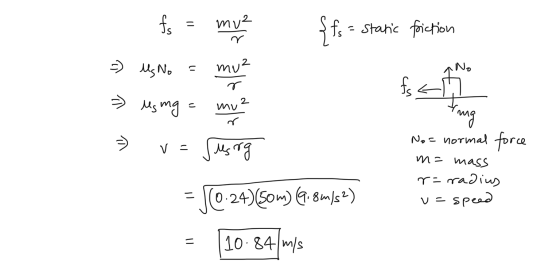
***********************************************************************************************
This concludes the answers. If there is any mistake or
omission, let me know in the comments immediately and I will fix
it....
Add Answer to:
On a wet road, the coefficient of static friction between a
car's tires and the flat...
Suppose that the coefficient of friction between a car's tires and the road is 0.600 when...
Suppose that the coefficient of friction between a car's tires and the road is 0.600 when the road is dry and 0.350 when the road is wet. If on a certain curve the maximum speed the car can go without slipping is 42.0 m/s when the road is dry, what is the maximum speed the car can go on the same curve without slipping when the road is wet?
Suppose that the coefficient of friction between a car's tires and the road is 0.300 when...
Suppose that the coefficient of friction between a car's tires and the road is 0.300 when the road is wet. If the car is going at 70.0 mph on a wet road and applies the maximum braking that does not result in a skid, what distance will it take for the car to stop? (Note: 1 mile = 1.609 km).
Suppose the coefficient of static friction between the road and the tires on a car is...
Suppose the coefficient of static friction between the road and the tires on a car is 0.60 and the car has no negative lift. What speed will put the car on the verge of sliding as it rounds a level curve of 31.6 m radius?
Suppose the coefficient of static friction between the road and the tires on a car is...
 Suppose the coefficient of static friction between the road and the tires on a car is 0.814 and the car has no negative lift. What speed will put the car on the verge of sliding as it rounds a level curve of 25.4 m radius? Number Units
(a) Suppose the coefficient of static friction between the road and the tires on a car...
(a) Suppose the coefficient of static friction between the road and the tires on a car is 0.60 and the car has no negative lift (aerodynamics pushing it downwards). What speed will put the car on the verge of slipping as it rounds a level curve of 60 m radius? (b) Considering the same friction coefficient, what is the steepest slope the car could be parked on and not slide?
Consider again the problem of a car traveling along a banked turn. Sometimes roads have a...
Consider again the problem of a car traveling along a banked turn. Sometimes roads have a "reversed" banking angle. That is, the road is tilted "away" from the center of curvature of the road. If the coefficient of static friction between the tires and the road is μs = 0.4, the radius of curvature is 25 m, and the banking angle is 14°, what is the maximum speed at which a car can safely navigate such a turn?
A particular unbanked turn in the road is shaped like a circle with a radius of...
A particular unbanked turn in the road is shaped like a circle with a radius of 30 meters. A car with a mass of 1500 kg can safely go around this turn at a maximum speed of 17 m/s. What is the coefficient of static friction between the car's tires and the road?
How large must the coefficient of static friction be between the tires and the road if...
How large must the coefficient of static friction be between the tires and the road if a car is to round a level curve of radius 125m at a speed of 112km/h ? NEED ANSWER
How large must the coefficient of static friction be between the tires and the road if...
How large must the coefficient of static friction be between the tires and the road if a car is to round a level curve of radius 93 mm at a speed of 94 km/h?
1.How large must the coefficient of static friction be between the tires and the road if...
1.How large must the coefficient of static friction be between the tires and the road if a car is to round a level curve of radius 85 m at a speed of 85 km/h ? 2.Calculate the period of a satellite orbiting the Moon, 170 km above the Moon's surface. Ignore effects of the Earth. The radius of the Moon is 1740 km.
 Suppose the coefficient of static friction between the road and the tires on a car is 0.814 and the car has no negative lift. What speed will put the car on the verge of sliding as it rounds a level curve of 25.4 m radius? Number Units
Most questions answered within 3 hours.
-
Where is the error in this code sequence?
String s1 = "Hello";
String s2 = "ello";...
asked 11 months ago -
Financial data for Joel de Paris, Inc., for last year
follow:
Joel de Paris, Inc.
Balance...
asked 11 months ago -
Consider this reaction:
Al2(SO4)3 (aq)+ BaCl3
(aq) Al2Cl6 (aq)- +
3BaSO4(s) . What is the...
asked 11 months ago -
Suppose that Savneet is considering increasing her
recent random sample from 20 car rentals to 40...
asked 11 months ago -
Trucks arrive at an unloading terminal at an average rate of 120
per hour.
Trucks arrive...
asked 11 months ago -
Why are methanol and ethanol completely soluble in water while
octanol is not very little soluble....
asked 11 months ago -
A facilities manager at a university reads in a research report
that the mean amount of...
asked 11 months ago -
When the CuSO4 is rehydrated by adding water to the anhydrous
compound, is this an endothermic...
asked 11 months ago -
A ray of sunlight is passing from diamond into crown glass; the
angle of incidence is...
asked 11 months ago -
A block of mass 0.249 kg is placed on top of a light, vertical
spring of...
asked 11 months ago -
how do the kidneys compensate in the presences of acidosis
a) trigger hyperventilate
b) reserve acid...
asked 11 months ago -
Question 501 pts
The rental rate of capital to the firm increases. Which of the
following...
asked 11 months ago