1. in the carbon cycle, carbon is returned to the atmosphere by (mark all answers that...
Homework Answers
1. Decomposition, cellular respiration, burning fossil fuels
Evaporation is the process of formation and release of water vapour into the atmosphere. Water contain hydrogen and oxygen. So by this process, hydrogen and Oxygen will be returned into the atmosphere and not carbon.
Decomposition is the process of breakdown of complex organic molecules into simple inorganic molecules like water and carbon dioxide. Carbon dioxide contains carbon and this will return carbon to the atmosphere.
Cellular respiration the process of breakdown of sugar into carbon dioxide and water. Carbon dioxide contains carbon and its will also return carbon to the atmosphere.
Burning fossil fuels release a very large amount of carbon dioxide returning carbon the atmosphere.
Photosynthesis is a process which takes up atmospheric carbon dioxide. So it will decrease the level of carbon in the atmosphere and not return it.
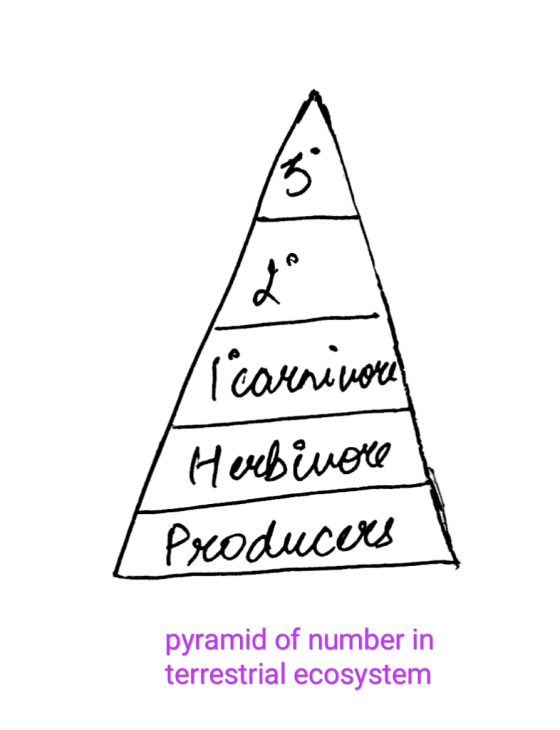
2. Tertiary consumers
The pyramid of number in attesting ecosystem decreases from producers to tertiary consumers, produces being at the maximum number and tertiary being at the lowest number.
I have answered the question in complete detail. Please rate positively.
Add Answer to:
1.
in the carbon cycle, carbon is returned to the atmosphere by (mark
all answers that...
What are the consequences if decomposers are removed from the carbon cycle? Fewer carbon compounds are...
What are the consequences if decomposers are removed from the carbon cycle? Fewer carbon compounds are broken down. The burning of wood and fossil fuels increases. Primary consumers are not able to consume as many producers. CO2 levels in the atmosphere increase.
Carbon is introduced into the atmosphere by all but which of the following means? a. respiration...
Carbon is introduced into the atmosphere by all but which of the following means? a. respiration b. volcanic eruptions c. burning of fossil fuels d. wind erosion e.All of them are correct
Which process fixes carbon (i.e., captures carbon and incorporates it into a living thing)? A. fire...
Which process fixes carbon (i.e., captures carbon and incorporates it into a living thing)? A. fire B. Respiration C. carnivory D. photosynthesis Plants manufacture a wide variety of carbohydrates, oils, and proteins, all of which contain carbon atoms. Where do plants get the carbon atoms? A. from water B. from soil C. from the atmosphere D. from sunlight “Fossil fuels” developed from A. Carbon-rich deposits of limestone that went through complex chemical changes. B. Pools of sand, gravel, and ground...
1) If you examined predator-prey relationships within an ecosystem and noticed that the removal of predators...
1) If you examined predator-prey relationships within an ecosystem and noticed that the removal of predators also resulted in the die-off of herbivores, what would you suspect occurred? a) Removal of predators would directly lower the number of herbivores. b) The lack of predators could mean that too much primary production occurred. c) Herbivores from another region may have entered the ecosystem and consumed the primary producers, causing death of the original herbivores species. d) Overeating by herbivores could have...
Which organisms would likely be the most difficult to kill? A. endospore B. staphylococci C. streptococci...
Which organisms would likely be the most difficult to kill? A. endospore B. staphylococci C. streptococci Burning fossil fuels and deforestation have resulted in an increase in the concentration of _________ in the atmosphere, which may be causing the global climate to change. A. O3 B. DDT C. CO2 D. NO2 In a food chain, which organisms are in the first trophic level, supporting all of the other levels? A. producers B. primary consumers C. secondary consumers D. tertiary consumers...
Which arrow shows CO2 released as a product of cellular respiration? CO2 in atmosphere Plants, algae,...
 Which arrow shows CO2 released as a product of cellular respiration? CO2 in atmosphere Plants, algae, cyanobacteria Higher-level consumers Wood and fossil fuels Primary consumers B Wastes; death Plant litter; death Decomposers soil microbes) Detritus Select one: a. arrow A b. arrow B c. arrow C d. arrow D
The diagram above shows the fluxes in the carbon cycle. Fluxes in the carbon cycle are shown in b...
 The diagram above shows the
fluxes in the carbon cycle. Fluxes in the carbon cycle are shown in
billion tons (gigatons) of CO2 per year. Use this diagram to fill
in the boxes in the diagram below where there is a number (1-3),
stating the flux through that process.e flux through that
process.
The Global Carbon Cycle 450 439 29 Ocean Vegetation & Land Fossil Fuel Burning + Land Use The diagram below shows the carbon cycle. Combustion of fuels...
The diagram above shows the
fluxes in the carbon cycle. Fluxes in the carbon cycle are shown in
billion tons (gigatons) of CO2 per year. Use this diagram to fill
in the boxes in the diagram below where there is a number (1-3),
stating the flux through that process.e flux through that
process.
The Global Carbon Cycle 450 439 29 Ocean Vegetation & Land Fossil Fuel Burning + Land Use The diagram below shows the carbon cycle. Combustion of fuels...
NPP = GPP – R Net primary production = ______________ = GPP – energy used for...
 NPP = GPP – R
Net primary production =
______________
= GPP – energy used for cellular respiration
Gross primary production = ________________ production of
primary producers
Respiration = ______________________
Thus NPP is the amount of energy available to primary
consumers = primary production
Explain the different ways in which primary production is
influenced in terrestrial and aquatic ecosystems
Primary production: terrestrial
ecosystems influenced by water, temperature, and
nutrient availability
Evapotranspiration rate measures the amount of
water entering the atmosphere...
NPP = GPP – R
Net primary production =
______________
= GPP – energy used for cellular respiration
Gross primary production = ________________ production of
primary producers
Respiration = ______________________
Thus NPP is the amount of energy available to primary
consumers = primary production
Explain the different ways in which primary production is
influenced in terrestrial and aquatic ecosystems
Primary production: terrestrial
ecosystems influenced by water, temperature, and
nutrient availability
Evapotranspiration rate measures the amount of
water entering the atmosphere...
What is the hydrologic cycle? the cycle that illustrates how water cycles in, on and above...
 What is the hydrologic cycle? the cycle that illustrates how water cycles in, on and above the Earth it illustrates the linear step by step way water moves it is a cycle that started when humans began overconsumption of water Sublimation is the process where --- O ice turns directly into vapor. liquid water turns into vapor. Transpiration is the process where O liquid enters the food chain. O liquid water turns into vapor. plants release water vapor. 1. A...
1.Which of the following would act as a negative feedback loop? Select one: a. Increased evaporation...
1.Which of the following would act as a negative feedback loop? Select one: a. Increased evaporation of water, which results in more clouds. b. Higher temperatures, which increase release of dissolved carbon dioxide from the oceans. c. Increased absorption of carbon dioxide by the oceans, which results in ocean acidification. d. Melting of polar ice, which alters ocean circulation patterns. 2.The sawtooth pattern of increasing and decreasing carbon dioxide concentrations observed by Charles Keeling at Mauna Loa Observatory was a...
 Which arrow shows CO2 released as a product of cellular respiration? CO2 in atmosphere Plants, algae, cyanobacteria Higher-level consumers Wood and fossil fuels Primary consumers B Wastes; death Plant litter; death Decomposers soil microbes) Detritus Select one: a. arrow A b. arrow B c. arrow C d. arrow D
 The diagram above shows the
fluxes in the carbon cycle. Fluxes in the carbon cycle are shown in
billion tons (gigatons) of CO2 per year. Use this diagram to fill
in the boxes in the diagram below where there is a number (1-3),
stating the flux through that process.e flux through that
process.
The Global Carbon Cycle 450 439 29 Ocean Vegetation & Land Fossil Fuel Burning + Land Use The diagram below shows the carbon cycle. Combustion of fuels...
The diagram above shows the
fluxes in the carbon cycle. Fluxes in the carbon cycle are shown in
billion tons (gigatons) of CO2 per year. Use this diagram to fill
in the boxes in the diagram below where there is a number (1-3),
stating the flux through that process.e flux through that
process.
The Global Carbon Cycle 450 439 29 Ocean Vegetation & Land Fossil Fuel Burning + Land Use The diagram below shows the carbon cycle. Combustion of fuels...
 NPP = GPP – R
Net primary production =
______________
= GPP – energy used for cellular respiration
Gross primary production = ________________ production of
primary producers
Respiration = ______________________
Thus NPP is the amount of energy available to primary
consumers = primary production
Explain the different ways in which primary production is
influenced in terrestrial and aquatic ecosystems
Primary production: terrestrial
ecosystems influenced by water, temperature, and
nutrient availability
Evapotranspiration rate measures the amount of
water entering the atmosphere...
NPP = GPP – R
Net primary production =
______________
= GPP – energy used for cellular respiration
Gross primary production = ________________ production of
primary producers
Respiration = ______________________
Thus NPP is the amount of energy available to primary
consumers = primary production
Explain the different ways in which primary production is
influenced in terrestrial and aquatic ecosystems
Primary production: terrestrial
ecosystems influenced by water, temperature, and
nutrient availability
Evapotranspiration rate measures the amount of
water entering the atmosphere...
 What is the hydrologic cycle? the cycle that illustrates how water cycles in, on and above the Earth it illustrates the linear step by step way water moves it is a cycle that started when humans began overconsumption of water Sublimation is the process where --- O ice turns directly into vapor. liquid water turns into vapor. Transpiration is the process where O liquid enters the food chain. O liquid water turns into vapor. plants release water vapor. 1. A...
Most questions answered within 3 hours.
-
Where is the error in this code sequence?
String s1 = "Hello";
String s2 = "ello";...
asked 11 months ago -
Financial data for Joel de Paris, Inc., for last year
follow:
Joel de Paris, Inc.
Balance...
asked 11 months ago -
Consider this reaction:
Al2(SO4)3 (aq)+ BaCl3
(aq) Al2Cl6 (aq)- +
3BaSO4(s) . What is the...
asked 11 months ago -
Suppose that Savneet is considering increasing her
recent random sample from 20 car rentals to 40...
asked 11 months ago -
Trucks arrive at an unloading terminal at an average rate of 120
per hour.
Trucks arrive...
asked 11 months ago -
Why are methanol and ethanol completely soluble in water while
octanol is not very little soluble....
asked 11 months ago -
A facilities manager at a university reads in a research report
that the mean amount of...
asked 11 months ago -
When the CuSO4 is rehydrated by adding water to the anhydrous
compound, is this an endothermic...
asked 11 months ago -
A ray of sunlight is passing from diamond into crown glass; the
angle of incidence is...
asked 11 months ago -
A block of mass 0.249 kg is placed on top of a light, vertical
spring of...
asked 11 months ago -
how do the kidneys compensate in the presences of acidosis
a) trigger hyperventilate
b) reserve acid...
asked 11 months ago -
Question 501 pts
The rental rate of capital to the firm increases. Which of the
following...
asked 11 months ago