Solve the following questions. All questions are mandatory. Q1: What’s wrong in the following grammar? S...
Solve the following questions. All questions are mandatory.
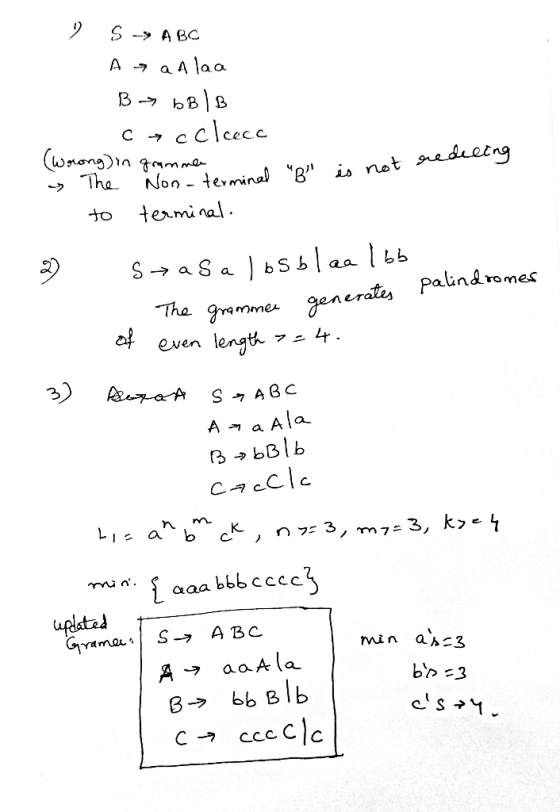
Q1: What’s wrong in the following grammar?
S → ABC
A → aA|aa
B → bB|B
C → cC|cccc
Q2: Describe the strings generated by the following grammar
S → aSa
S → bSb
S → aa
S → bb
Q3: Consider the following grammar:
S → ABC
A → aA|a
B → bB|b
C → cC|c
Change the above grammar such that it generates L1={anbmck; n>=3,m>=3,k>=4}
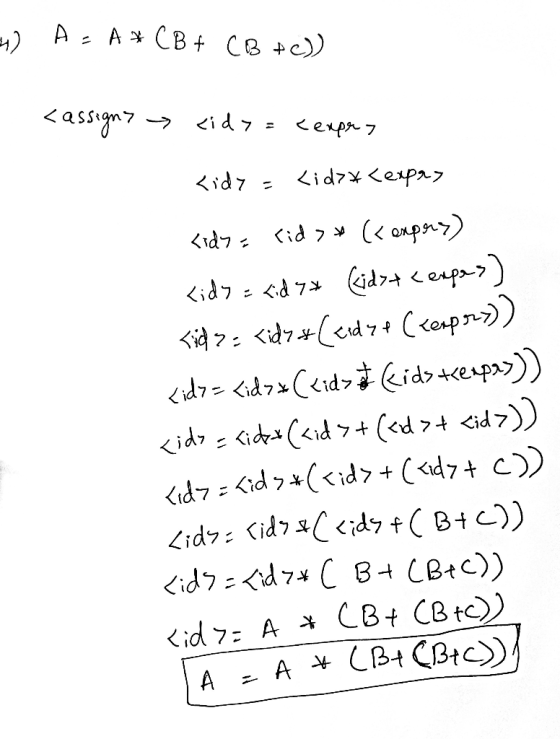
Q4: Use the following grammar to show a rightmost derivation for
the following statement: A = A * ( B + ( C ) )
<assign> → <id> = <expr>
<expr> → <id> + <expr> | <id> * <expr> | ( <expr> ) | <id>
<id> → A | B | C
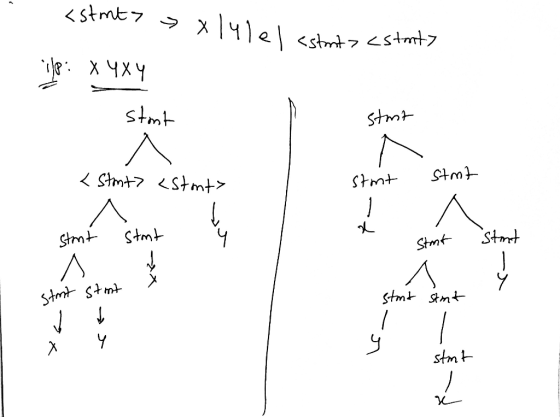
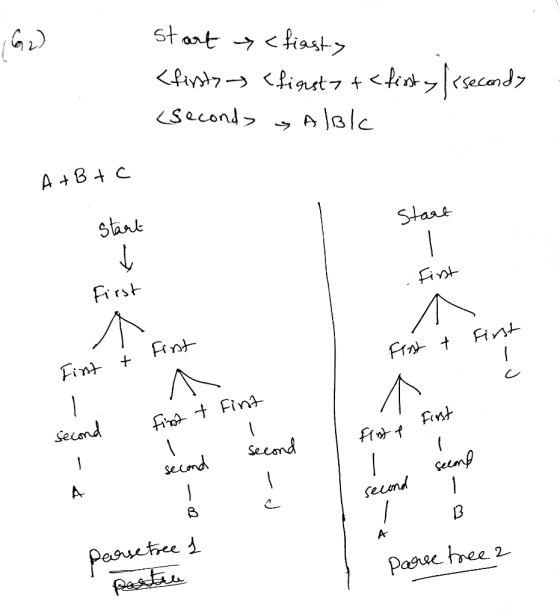
Q5: Prove that the following grammars are ambiguous:
G1:
<stmt> → X|Y|e|<stmt><stmt>
G2: <start> → <first>
<first> → <first> + <first> | <second>
<second> → A | B | C
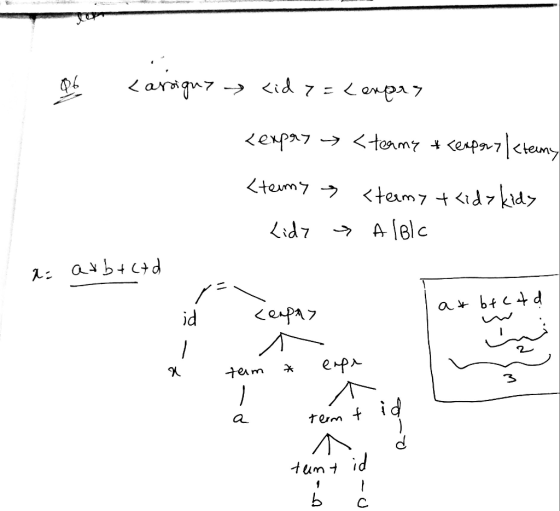
Q6: Rewrite the following BNF to give + precedence over * and force + to be left associative.
<assign> → <id> = <expr>
<expr> → <term> + <expr> | <term>
<term> → <id> * <term> | <id>
<id> → A | B | C
Homework Answers
5) any grammar that produces more than treone parse tree for any input then it is ambiguous.
Add Answer to:
Solve the following questions. All questions are mandatory.
Q1: What’s wrong in the following grammar?
S...
Considering the following BNF grammar, answer the questions. <prog> - <assign> | <expr> <assign> = <id>...
 Considering the following BNF grammar, answer the questions. <prog> - <assign> | <expr> <assign> = <id> = <expr> <expr> := <expr> + <term> | <expr> - <term> | <term> <term> := <factor> | <factor> * <term> <factor> ::= ( <expr> ) | <id> | <num> <id>::= ABC <num> := 0|1|2|3 2a - What is the associativity of the * operator? (5 points) 2b - For the * and + operators, do they have the same precedence, does the * operator...
The questions in this section are based on the grammar given as the following: prog ->...
The questions in this section are based on the grammar given as the following: prog -> assign | expr assign -> id = expr expr -> expr + term | expr - term | term term -> factor | factor * term factor -> ( expr ) | id | num id -> A | B | C num -> 0 | 1 | 2 | 3 (2a) What is the associativity of the * operator? (5 points) (2b) What...
The questions in this section are based on the grammar given as the following: prog ->...
The questions in this section are based on the grammar given as the following: prog -> assign | expr assign -> id = expr expr -> expr + term | expr - term | term term -> factor | factor * term factor -> ( expr ) | id | num id -> A | B | C num -> 0 | 1 | 2 | 3 (2a) What is the associativity of the * operator? (5 points) (2b) What...
Question 3: Given the following grammar: assign → id := expr expr → expr + term \ term term -term *factor lfactor factor-(expr) id Using the above grammar, show a leftmost derivation (first five step...
 Question 3: Given the following grammar: assign → id := expr expr → expr + term \ term term -term *factor lfactor factor-(expr) id Using the above grammar, show a leftmost derivation (first five steps) for the following assignment statement: A ((A B)+ C) a. [3 marks] b. Using the above grammar, show a rightmost derivation (first five steps) for the following assignment statement: A:-A+B+C)+A [3 marks] Draw the abstract syntax tree for each of the above statements [4 marks]...
(20 pts) To understand the value of recursion in a programming language: implement the binary search...
(20 pts) To understand the value of recursion in a programming language: implement the binary search algorithm first as a recursive function and again using a conditional loop. Your program should create an array of characters holding the letters ‘A’ – ‘Z’ and find the index in the array where the letter ‘K’ is stored. You may use any programming language that supports recursion. (5pts) Define syntax and semantics and give an example. (5pts) Why is it important for a...
Question Set 2 1. Given the following grammar dactor>-> ( <expr> ) a) What is the...
 Question Set 2 1. Given the following grammar dactor>-> ( <expr> ) a) What is the associativity of each of the operators? What is precedence of the operators? Show a leftmost derivation and parse tree for the following sentence: b) c) A-A(B(C A)) d) Rewrite the BNF grammar above to give precedence over and force to be right associative.
Question Set 2 1. Given the following grammar dactor>-> ( <expr> ) a) What is the...
 Question Set 2 1. Given the following grammar dactor>-> ( <expr> ) a) What is the associativity of each of the operators? What is precedence of the operators? Show a leftmost derivation and parse tree for the following sentence: b) c) A-A(B(C A)) d) Rewrite the BNF grammar above to give precedence over and force to be right associative.
Consider the following grammar (G1) for simple assignment statements. (The symbols in double quotation marks are...
Consider the following grammar (G1) for simple assignment statements. (The symbols in double quotation marks are terminal symbols.) assign → id “ = ” expr id → “A” | “B” | “C” expr → expr “ + ” expr | expr “ ∗ ” expr | “(” expr “)” | id a) Give a (leftmost) derivation for string A = B ∗ A + C. b) Give the parse tree for string A = B ∗ A + C. c)...
2. Consider the following grammar: <assign> à <id> = <expr>
2. Consider the following grammar: <assign> à <id> = <expr> <id> à A | B | C <expr> à <id> + <expr> | <id> * <expr> | ( <expr> ) | <id> Show a parse tree and leftmost derivation for the following statements: (a) A = ( A + B ) * C (b) A = A * ( B + C ) 3. [10 Points] Show that the following grammar is...
P2) Given grammar in BNF, answer the following questions (30 points) <stmt-list>→<stmt> | <stmt»; <stmt-list> (a) Rewrite the given grammar into a EBNF (b) Is the given gramm...
 P2) Given grammar in BNF, answer the following questions (30 points) <stmt-list>→<stmt> | <stmt»; <stmt-list> (a) Rewrite the given grammar into a EBNF (b) Is the given grammar ambiguous? Support your answer to receive the full credit. (c) Given string A-B C-D: B-C-A-D, draw a parsing tree
P2) Given grammar in BNF, answer the following questions (30 points) → |
P2) Given grammar in BNF, answer the following questions (30 points) <stmt-list>→<stmt> | <stmt»; <stmt-list> (a) Rewrite the given grammar into a EBNF (b) Is the given grammar ambiguous? Support your answer to receive the full credit. (c) Given string A-B C-D: B-C-A-D, draw a parsing tree
P2) Given grammar in BNF, answer the following questions (30 points) → |
 Considering the following BNF grammar, answer the questions. <prog> - <assign> | <expr> <assign> = <id> = <expr> <expr> := <expr> + <term> | <expr> - <term> | <term> <term> := <factor> | <factor> * <term> <factor> ::= ( <expr> ) | <id> | <num> <id>::= ABC <num> := 0|1|2|3 2a - What is the associativity of the * operator? (5 points) 2b - For the * and + operators, do they have the same precedence, does the * operator...
 Question 3: Given the following grammar: assign → id := expr expr → expr + term \ term term -term *factor lfactor factor-(expr) id Using the above grammar, show a leftmost derivation (first five steps) for the following assignment statement: A ((A B)+ C) a. [3 marks] b. Using the above grammar, show a rightmost derivation (first five steps) for the following assignment statement: A:-A+B+C)+A [3 marks] Draw the abstract syntax tree for each of the above statements [4 marks]...
 Question Set 2 1. Given the following grammar dactor>-> ( <expr> ) a) What is the associativity of each of the operators? What is precedence of the operators? Show a leftmost derivation and parse tree for the following sentence: b) c) A-A(B(C A)) d) Rewrite the BNF grammar above to give precedence over and force to be right associative.
 Question Set 2 1. Given the following grammar dactor>-> ( <expr> ) a) What is the associativity of each of the operators? What is precedence of the operators? Show a leftmost derivation and parse tree for the following sentence: b) c) A-A(B(C A)) d) Rewrite the BNF grammar above to give precedence over and force to be right associative.
 P2) Given grammar in BNF, answer the following questions (30 points) <stmt-list>→<stmt> | <stmt»; <stmt-list> (a) Rewrite the given grammar into a EBNF (b) Is the given grammar ambiguous? Support your answer to receive the full credit. (c) Given string A-B C-D: B-C-A-D, draw a parsing tree
P2) Given grammar in BNF, answer the following questions (30 points) → |
P2) Given grammar in BNF, answer the following questions (30 points) <stmt-list>→<stmt> | <stmt»; <stmt-list> (a) Rewrite the given grammar into a EBNF (b) Is the given grammar ambiguous? Support your answer to receive the full credit. (c) Given string A-B C-D: B-C-A-D, draw a parsing tree
P2) Given grammar in BNF, answer the following questions (30 points) → |
Most questions answered within 3 hours.
-
Where is the error in this code sequence?
String s1 = "Hello";
String s2 = "ello";...
asked 10 months ago -
Financial data for Joel de Paris, Inc., for last year
follow:
Joel de Paris, Inc.
Balance...
asked 10 months ago -
Consider this reaction:
Al2(SO4)3 (aq)+ BaCl3
(aq) Al2Cl6 (aq)- +
3BaSO4(s) . What is the...
asked 10 months ago -
Suppose that Savneet is considering increasing her
recent random sample from 20 car rentals to 40...
asked 10 months ago -
Trucks arrive at an unloading terminal at an average rate of 120
per hour.
Trucks arrive...
asked 10 months ago -
Why are methanol and ethanol completely soluble in water while
octanol is not very little soluble....
asked 10 months ago -
A facilities manager at a university reads in a research report
that the mean amount of...
asked 10 months ago -
When the CuSO4 is rehydrated by adding water to the anhydrous
compound, is this an endothermic...
asked 10 months ago -
A ray of sunlight is passing from diamond into crown glass; the
angle of incidence is...
asked 10 months ago -
A block of mass 0.249 kg is placed on top of a light, vertical
spring of...
asked 10 months ago -
how do the kidneys compensate in the presences of acidosis
a) trigger hyperventilate
b) reserve acid...
asked 10 months ago -
Question 501 pts
The rental rate of capital to the firm increases. Which of the
following...
asked 10 months ago