You have a tube with 5ml of infected blood that has a concentration of bacteria at...
You have a tube with 5ml of infected blood that has a concentration of bacteria at 10(8) cells per ml. You wish to make a serial dilution of the blood so when you take 100 ul of the last dilution and spread it on a Petri dish you will have between 30-300 colonies growing on the plate. You have plenty of empty 1.5 ml microfuge tubes, a bottle of sterile water, a p1000 pipettor (100-1000ul) and tips, for the dilutions, BUT you can only have ONE petri dish. Clearly diagram how you would make these dilitions, add them to the plate, and prepare for incubation. Also, show exactly how many colonies you would expect to have on the plate when using your procedure. Don't forget to clearly label the amounts measured and transferred. One of your goals is to make these dilutions with the fewest possible numbers of tubes and materials.
Homework Answers
Initial concentration of bacteria in infected blood is 108 bacteria/ml. As we have only p1000 pipettor we can make highest 10 fold serial dilution. Therefore, the serial dilution will be as follows-
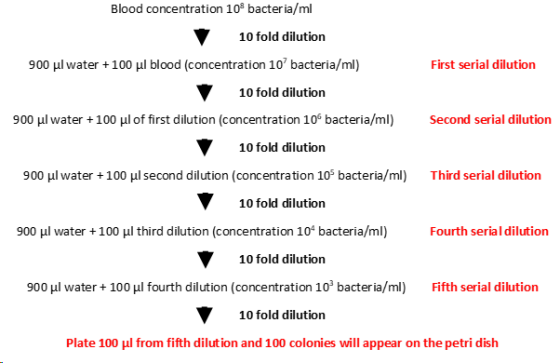
I would expect 100 colonies on the plate.
Add Answer to:
You have a tube with 5ml of infected blood that has a
concentration of bacteria at...
You have a stock of an E. coli cell culture of an unknown concentration. You want...
You have a stock of an E. coli cell culture of an unknown concentration. You want to set up a serial dilution experiment so that you can count the viable colonies and determine the concentration of the stock in cells/ml. In tube A, you add 1 ml of the stock to 999 ml of media. In tube B, you add 1 ml of the material from tube A to 24 ml of media. In tube C, you add 50 microliters...
You are given a 1 gram soil sample of unknown bacterial load. After doing 10-fold serial...
You are given a 1 gram soil sample of unknown bacterial load. After doing 10-fold serial dilutions of the soil in sterile water, 100 uL volumes are taken from each dilution for preparation of pour plates. Following incubation, each half of the 10-8 plate has 46 colonies. a) What was the dilution factor? b) How many bacteria were present in the soil?
A polluted water sample has 2,400,000 bacteria per ml. You transfer 1.0 ml of sample to...
A polluted water sample has 2,400,000 bacteria per ml. You transfer 1.0 ml of sample to a bottle containing 99ml of sterile water. You then take 0.1 ml from this dilution bottle and transfer to a second bottle with 0.9 ml of sterile water. Finally, you transfer 1 ml to a Petri dish with nutrient agar. How many colonies would you expect to find on this plate? Would it be countable?
You are given a culture that has a concentration of 2.1x10^9 cfu.ml. you are asked to...
You are given a culture that has a concentration of 2.1x10^9 cfu.ml. you are asked to dilute it and plate it so that you have 270 colonies on one plate. you are given plenty diluent but only 4 tubes with which to make your dilutions. Demonstrate how you would set up the dilution. For each step indicate in an orderly fashion the V2, V1, Diluent volume, dilution, c-dilution, DF, CDF up to that step and the concentration of each tube.
I have to do a serial dilution for plating bacteria, and I am given a sample...
I have to do a serial dilution for plating bacteria, and I am given a sample that has been diluted to 10-4 already. I will need to plate the 10-5 and 10-7 dilutions. What will be the steps I will have to do? Note: I cannot use any more tubes/saline outside of what I have been given. Materials: 2 tubes labelled 10-5 and 10-7. 20ml of sterile saline 5 ml of the 10-4 diluted sample. Sterile pipettes
Hello, just wanted to check my answers. Answer as many as you like/can. Thankyou. 1) Four...
Hello, just wanted to check my answers. Answer as many as you like/can. Thankyou. 1) Four grams of soil are added to 36 ml sterile water and mixed well. 0.1 ml of this mix was added to 9.9 ml sterile water. This was diluted by 4 successive 1/10 dilutions. 1.0 ml from the last dilution was used to prepare a pour plate. After incubation 289 colonies were counted. Calculate the # CFU/g soil. 2) A 0.1 ml aliquot of a...
1. You are given a 1 gram soil sample of unknown bacterial load. After doing 10-fold...
1. You are given a 1 gram soil sample of unknown bacterial load. After doing 10-fold serial dilutions of the soil in sterile water, 100 uL volumes are taken from each dilution for preparation of pour plates. Following incubation, each half of the 10-8 plate has 46 colonies. a) What was the dilution factor? b) How many bacteria were present in the soil? 2. Staphylococcus aureus divides every 20 minutes. A culture begins with 10 bacterial cells. a) After 5...
A. You have been given a tube of E. coli. You are asked to make 1...
A. You have been given a tube of E. coli. You are asked to make 1 mL total volume of 10-1 dilution of the bacterial culture. Explain how you would do this. Show all necessary calculations. ____ ml cells + _____ ml water = 1 ml (total volume) B. Next, you were asked to make a 10-2 dilution of the bacterial sample. Explain how you would perform this. Show all necessary calculations. You have bacteria at a concentration of 2...
1. You have been given a tube that contains 2.4 x 10⁹ bacteria/ml. Diagram a complete...
 1. You have been given a tube that contains 2.4 x 10⁹
bacteria/ml. Diagram a complete dilution scheme so that you will
have a plate with 240 colonies on it.
How would you change the scheme you have drawn above so that the
plate had 100 colonies on it?
1. You have been given a tube that contains 2.4 x 10⁹ bacteria/ml. Diagram a complete dilution scheme so that you will have a plate with 240 colonies on it. (3...
1. You have been given a tube that contains 2.4 x 10⁹
bacteria/ml. Diagram a complete dilution scheme so that you will
have a plate with 240 colonies on it.
How would you change the scheme you have drawn above so that the
plate had 100 colonies on it?
1. You have been given a tube that contains 2.4 x 10⁹ bacteria/ml. Diagram a complete dilution scheme so that you will have a plate with 240 colonies on it. (3...
please help with whatever possible. thank you so much in advance. Name One use of serial...
 please help with whatever possible. thank you so much in
advance.
Name One use of serial dilutions is to calculate the concentration of microorganisms. Since it would usually be challenging or even impossible to actually count the number of microorganisms in a sample, the sample is diluted and plated to get a reasonable number of colonies to count (usually between 25 to 250 colonies is the goal). Since each colony on an agar plate theoretically grew from a single microorganism,...
please help with whatever possible. thank you so much in
advance.
Name One use of serial dilutions is to calculate the concentration of microorganisms. Since it would usually be challenging or even impossible to actually count the number of microorganisms in a sample, the sample is diluted and plated to get a reasonable number of colonies to count (usually between 25 to 250 colonies is the goal). Since each colony on an agar plate theoretically grew from a single microorganism,...
 1. You have been given a tube that contains 2.4 x 10⁹
bacteria/ml. Diagram a complete dilution scheme so that you will
have a plate with 240 colonies on it.
How would you change the scheme you have drawn above so that the
plate had 100 colonies on it?
1. You have been given a tube that contains 2.4 x 10⁹ bacteria/ml. Diagram a complete dilution scheme so that you will have a plate with 240 colonies on it. (3...
1. You have been given a tube that contains 2.4 x 10⁹
bacteria/ml. Diagram a complete dilution scheme so that you will
have a plate with 240 colonies on it.
How would you change the scheme you have drawn above so that the
plate had 100 colonies on it?
1. You have been given a tube that contains 2.4 x 10⁹ bacteria/ml. Diagram a complete dilution scheme so that you will have a plate with 240 colonies on it. (3...
 please help with whatever possible. thank you so much in
advance.
Name One use of serial dilutions is to calculate the concentration of microorganisms. Since it would usually be challenging or even impossible to actually count the number of microorganisms in a sample, the sample is diluted and plated to get a reasonable number of colonies to count (usually between 25 to 250 colonies is the goal). Since each colony on an agar plate theoretically grew from a single microorganism,...
please help with whatever possible. thank you so much in
advance.
Name One use of serial dilutions is to calculate the concentration of microorganisms. Since it would usually be challenging or even impossible to actually count the number of microorganisms in a sample, the sample is diluted and plated to get a reasonable number of colonies to count (usually between 25 to 250 colonies is the goal). Since each colony on an agar plate theoretically grew from a single microorganism,...
Most questions answered within 3 hours.
-
Where is the error in this code sequence?
String s1 = "Hello";
String s2 = "ello";...
asked 11 months ago -
Financial data for Joel de Paris, Inc., for last year
follow:
Joel de Paris, Inc.
Balance...
asked 11 months ago -
Consider this reaction:
Al2(SO4)3 (aq)+ BaCl3
(aq) Al2Cl6 (aq)- +
3BaSO4(s) . What is the...
asked 11 months ago -
Suppose that Savneet is considering increasing her
recent random sample from 20 car rentals to 40...
asked 11 months ago -
Trucks arrive at an unloading terminal at an average rate of 120
per hour.
Trucks arrive...
asked 11 months ago -
Why are methanol and ethanol completely soluble in water while
octanol is not very little soluble....
asked 11 months ago -
A facilities manager at a university reads in a research report
that the mean amount of...
asked 11 months ago -
When the CuSO4 is rehydrated by adding water to the anhydrous
compound, is this an endothermic...
asked 11 months ago -
A ray of sunlight is passing from diamond into crown glass; the
angle of incidence is...
asked 11 months ago -
A block of mass 0.249 kg is placed on top of a light, vertical
spring of...
asked 11 months ago -
how do the kidneys compensate in the presences of acidosis
a) trigger hyperventilate
b) reserve acid...
asked 11 months ago -
Question 501 pts
The rental rate of capital to the firm increases. Which of the
following...
asked 11 months ago