6. A mutation in one gene knocks out transcription of most mRNA genes in eukaryotic cells,...
6. A mutation in one gene knocks out transcription of most mRNA genes in eukaryotic cells, what does this gene encode?
7. If you were to study where P53 regulates an oncogene, you will begin your study by examining whether P53 binds to the promoter of the oncogene; a. Briefly describe the role of transcription factor P53. b. Which methods can be used for your study and what are the expected results?
Homework Answers
6- The most probable explanation is that gene encodes for a transcription factor which results in the expression of many genes. This transcription factor binds to the promoter of the gene which it regulates.
7 -p53 is a transcription factor which gets activated upon DNA damage. Upon activation, it leads to the expression of many proteins such as p21, BAX, PUMA, NOXA, MDM2, GADD45 and many other genes.
p53 has a DNA binding domain which helps it to bind to the promoter of the gene and regulates their expression.
We can check the p53 transcription activity by using Electrophoretic Mobility Shift Assay (EMSA) and luciferase assays.
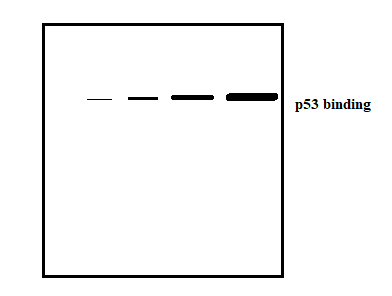
For EMSA we need to design a primer which has a p53 binding site in it. Upon activation levels of p53 increase in the cell. When we incubate the cell lyase with the primers, p53 will bind to its binding site on the DNA. If p53 is activated then we will get the pattern as shown in the below figure.
In luciferase assay, we clone the promoter in the plasmid which the luciferase gene under the promoter of the gene which is regulated by p53. Upon activation levels of p53 is increased which leads to its binding the luciferase plasmid. As the p53 bins to the promoter, it will start expressing the luciferase gene.
Levels of luciferase can be measured by luciferase assay.
if p53 is activated then we will get more amount of luciferase activity
Add Answer to:
6. A mutation in one gene knocks out transcription of most mRNA
genes in eukaryotic cells,...
2. a) Sketch a eukaryotic gene (brns) that is regulated by one transcription factor - Brt...
2. a) Sketch a eukaryotic gene (brns) that is regulated by one transcription factor - Brt - that bind 50 bps upstream of the transcription start site and an enhancer - Ned - that binds 10 kb upstream of the transcription start site. In your sketch, indicate the start of transcription, TATA box beginning of the open reading frame for your gene (ATG), location of the promoter, location of the transcription factors, location of the RNA polymerase II, location of...
In eukaryotic cells, there are specific transcription factors (activators) that regulate gene expression. Describe the organization...
In eukaryotic cells, there are specific transcription factors (activators) that regulate gene expression. Describe the organization of eukaryotic genes (i.e. promoters/enhancers) and how transcription factors are able to control gene expression and enzyme activity. a) Throughout the course we discussed the enzyme lactase and how it is differently regulated (and therefore expressed) in different human populations. Describe how this gene is differently expressed in different populations and when this/these change(s) are predicted to have taken place. b) Differential gene expression...
3) Gene Control in Bacteria - Transcription Activators and Repressors You are interested in examining the...
 3) Gene Control in Bacteria - Transcription Activators and Repressors You are interested in examining the regulation of the gene that encodes an enzyme, Tre- ase, important in metabolizing trehalose into glucose in bacteria. Trehalose is a disaccharide formed of two glucose units. It is known that two DNA-binding proteins, TreA and TreB, are important for binding to the promoter of the Tre-ase gene and are involved in regulating the transcription of the Tre-ase gene: TreA binds to the "A"...
Question 1 Match the term with the best definition or description; most topics relate to the...
 Question 1 Match the term with the best definition or description; most topics relate to the regulation of gene expression. General type of protein which will increase transcription rates when it attaches to a site A. Factor connected to a particular gene - B. Co-repressor C. Enhancer D. Promoter E. Structural F. Intron G. Activator H. Operator I. Basal transcription J. Glucocorticoid receptor K. Sigma factor L. Mediator M. Inducer N. TATA box O. Repressor The rates of mRNA produced...
Yet, all the cells in your body contain the same genes (and same alleles). The difference...
 Yet, all the cells in your body contain the same
genes (and same alleles). The difference across cell types
is that genes get selectively expressed (turned on or off)
based on the proteins needed for cellular function given their
environment.
Select which statement explains the reason why hair does not
normally grow on your muscle cells.
a.
Muscle cells have the gene for keratin, but do not express
it
b.
Muscle cells do not have the gene for keratin and...
Yet, all the cells in your body contain the same
genes (and same alleles). The difference across cell types
is that genes get selectively expressed (turned on or off)
based on the proteins needed for cellular function given their
environment.
Select which statement explains the reason why hair does not
normally grow on your muscle cells.
a.
Muscle cells have the gene for keratin, but do not express
it
b.
Muscle cells do not have the gene for keratin and...
Genetics Worksheet Week 3: Gene Regulation and Epigenetics 1. Duchenne muscular dystrophy is caused by a mutation in a gene that is 2.5 million nucleotides in length and encodes a protein called dyst...
 Genetics Worksheet Week 3: Gene Regulation and Epigenetics 1. Duchenne muscular dystrophy is caused by a mutation in a gene that is 2.5 million nucleotides in length and encodes a protein called dystrophin. The dystrophin protein itself is 3684 amino acids in length. Calculate below the approximate size of the mRNA that encodes dystrophin. Approximately what percentage of the gene that encodes dystrophin is intron sequence? The human genome encodes a much greater variety and number of proteins than the...
1. A sequence of a eukaryotic gene (coding strand) is shown below, RNA polymerase recognizes the...
1. A sequence of a eukaryotic gene (coding strand) is shown below, RNA polymerase recognizes the sequence ‘TATAAT’ and initiates transcription six nucleotides downstream of the sequence. The in tron splice sites are CUU (5’ splice site) and AAG (3’ splice site), poly -A tails are added following the sequence AGUUGG. The poly- A tails are 20 nucleotides. a. Predict the sequence of mature mRNA and denote 5’ and 3’ ends. b. If this is an oncogene that is elevated...
1. Check all genes you would expect to be significantly expressed in eye cells. A.the RPSA...
1. Check all genes you would expect to be significantly expressed in eye cells. A.the RPSA gene B. the OPN1SW gene C. the OCT-4 gene D. the INS gene 2. Check all genes you would expect to be significantly expressed in stem cells. A.the RPSA gene B. the OPN1SW gene C. the OCT-4 gene D. the INS gene 3. Check all genes you would expect to be significantly expressed in pancreatic cells. A.the RPSA gene B. the OPN1SW gene C....
1. (a) Microorganisms can be used to remove chemical pollutants from the environment. ine gene cluster...
 1. (a) Microorganisms can be used to remove chemical pollutants from the environment. ine gene cluster xyl encodes several enzymes that are involved in degrading toluene, and transcription of these genes is activated when the xylS protein (expressed continuously under a constitutively active promoter p) binds to toluene. Only then can the resulting xyls/toluene complex bind to the pm promoter to activate transcription of the genes in the xyl cluster. By considering the cellular location of the enzymes that degrade...
genetics. I have part B. I am just confused on what it is asking in part...
 genetics.
I have part B. I am just confused on what it is asking in part
A
DU V AAA Pane 3. (2pts) Interestingly, after identifying the region your mutation resides in, you discover that you have a nonsense mutation early on in a putative gene that has never been studied before! A quick structure prediction and protein homology domain search suggests this protein may be a transcription factor. You therefore name it ATF1 for Aging-related Transcription Factor. To identify...
genetics.
I have part B. I am just confused on what it is asking in part
A
DU V AAA Pane 3. (2pts) Interestingly, after identifying the region your mutation resides in, you discover that you have a nonsense mutation early on in a putative gene that has never been studied before! A quick structure prediction and protein homology domain search suggests this protein may be a transcription factor. You therefore name it ATF1 for Aging-related Transcription Factor. To identify...
 3) Gene Control in Bacteria - Transcription Activators and Repressors You are interested in examining the regulation of the gene that encodes an enzyme, Tre- ase, important in metabolizing trehalose into glucose in bacteria. Trehalose is a disaccharide formed of two glucose units. It is known that two DNA-binding proteins, TreA and TreB, are important for binding to the promoter of the Tre-ase gene and are involved in regulating the transcription of the Tre-ase gene: TreA binds to the "A"...
 Question 1 Match the term with the best definition or description; most topics relate to the regulation of gene expression. General type of protein which will increase transcription rates when it attaches to a site A. Factor connected to a particular gene - B. Co-repressor C. Enhancer D. Promoter E. Structural F. Intron G. Activator H. Operator I. Basal transcription J. Glucocorticoid receptor K. Sigma factor L. Mediator M. Inducer N. TATA box O. Repressor The rates of mRNA produced...
 Yet, all the cells in your body contain the same
genes (and same alleles). The difference across cell types
is that genes get selectively expressed (turned on or off)
based on the proteins needed for cellular function given their
environment.
Select which statement explains the reason why hair does not
normally grow on your muscle cells.
a.
Muscle cells have the gene for keratin, but do not express
it
b.
Muscle cells do not have the gene for keratin and...
Yet, all the cells in your body contain the same
genes (and same alleles). The difference across cell types
is that genes get selectively expressed (turned on or off)
based on the proteins needed for cellular function given their
environment.
Select which statement explains the reason why hair does not
normally grow on your muscle cells.
a.
Muscle cells have the gene for keratin, but do not express
it
b.
Muscle cells do not have the gene for keratin and...
 Genetics Worksheet Week 3: Gene Regulation and Epigenetics 1. Duchenne muscular dystrophy is caused by a mutation in a gene that is 2.5 million nucleotides in length and encodes a protein called dystrophin. The dystrophin protein itself is 3684 amino acids in length. Calculate below the approximate size of the mRNA that encodes dystrophin. Approximately what percentage of the gene that encodes dystrophin is intron sequence? The human genome encodes a much greater variety and number of proteins than the...
 1. (a) Microorganisms can be used to remove chemical pollutants from the environment. ine gene cluster xyl encodes several enzymes that are involved in degrading toluene, and transcription of these genes is activated when the xylS protein (expressed continuously under a constitutively active promoter p) binds to toluene. Only then can the resulting xyls/toluene complex bind to the pm promoter to activate transcription of the genes in the xyl cluster. By considering the cellular location of the enzymes that degrade...
 genetics.
I have part B. I am just confused on what it is asking in part
A
DU V AAA Pane 3. (2pts) Interestingly, after identifying the region your mutation resides in, you discover that you have a nonsense mutation early on in a putative gene that has never been studied before! A quick structure prediction and protein homology domain search suggests this protein may be a transcription factor. You therefore name it ATF1 for Aging-related Transcription Factor. To identify...
genetics.
I have part B. I am just confused on what it is asking in part
A
DU V AAA Pane 3. (2pts) Interestingly, after identifying the region your mutation resides in, you discover that you have a nonsense mutation early on in a putative gene that has never been studied before! A quick structure prediction and protein homology domain search suggests this protein may be a transcription factor. You therefore name it ATF1 for Aging-related Transcription Factor. To identify...
Most questions answered within 3 hours.
-
Where is the error in this code sequence?
String s1 = "Hello";
String s2 = "ello";...
asked 10 months ago -
Financial data for Joel de Paris, Inc., for last year
follow:
Joel de Paris, Inc.
Balance...
asked 10 months ago -
Consider this reaction:
Al2(SO4)3 (aq)+ BaCl3
(aq) Al2Cl6 (aq)- +
3BaSO4(s) . What is the...
asked 10 months ago -
Suppose that Savneet is considering increasing her
recent random sample from 20 car rentals to 40...
asked 10 months ago -
Trucks arrive at an unloading terminal at an average rate of 120
per hour.
Trucks arrive...
asked 10 months ago -
Why are methanol and ethanol completely soluble in water while
octanol is not very little soluble....
asked 10 months ago -
A facilities manager at a university reads in a research report
that the mean amount of...
asked 10 months ago -
When the CuSO4 is rehydrated by adding water to the anhydrous
compound, is this an endothermic...
asked 10 months ago -
A ray of sunlight is passing from diamond into crown glass; the
angle of incidence is...
asked 10 months ago -
A block of mass 0.249 kg is placed on top of a light, vertical
spring of...
asked 10 months ago -
how do the kidneys compensate in the presences of acidosis
a) trigger hyperventilate
b) reserve acid...
asked 10 months ago -
Question 501 pts
The rental rate of capital to the firm increases. Which of the
following...
asked 10 months ago