


5. What would be the expected effect on GAL gene expression of a mutation in the GAL80 gene (such that no GAL80 is produced in the cell)? What about a mutation in GAL4? 6. You are studying the regulation of a eukaryotic gene, and have identified three DNA sequences (Sequences A, B, C) that are required for normal expression of the gene. Sequence A is found less than 200 base pairs upstream of the start site of transcription Sequence B is found approximately 3 kilobases upstream, while Sequence C is found in the second intron of the gene. Using recombinant DNA techniques that we will discuss soon, you systematically reverse the orientation (5' to 3' direction) of each of these sequences and determine the effects of this manipulation on gene expression. In the case of Sequence A, you find that flipping the sequence into the reverse orientation completely abolishes expression of your gene. However, reversing the orientations of Sequences B and C has no effect on gene expression Finally, you mutate the three sequences. Mutations in Sequence A lead to complete loss of gene expression. Mutations in sequence B cause a reduction in expression, but not total loss. Mutations in Sequence C lead to inappropriate expression of the gene in tissues where normally it is not expressed. Which of these sequences is likely to be the promoter for your gene? Why? a. The other two sequences most likely function as enhancer elements. What is the evidence that they are enhancers? b. Which enhancer element likely binds to a repressor of transcription, and why? c.
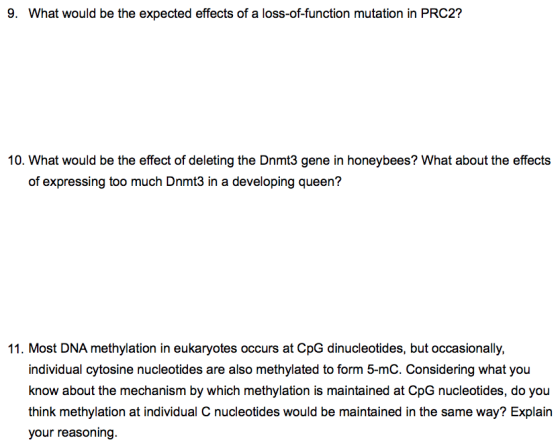
9. What would be the expected effects of a loss-of-function mutation in PRC2? 10. What would be the effect of deleting the Dnmt3 gene in honeybees? What about the effects of expressing too much Dnmt3 in a developing queen? 11. Most DNA methylation in eukaryotes occurs at CpG dinucleotides, but occasionally, individual cytosine nucleotides are also methylated to form 5-mC. Considering what you know about the mechanism by which methylation is maintained at CpG nucleotides, do you think methylation at individual C nucleotides would be maintained in the same way? Explain your reasoning.
Homework Answers
1). an enhancer is a piece of DNA that enhances gene transcription. a promoter is a piece of DNA which acts to initiate or gene transcription.
an enhancer binds with transcription factors. while a promoter binds with transcription and RNA polymerase enzymes.
an enhancer can be upstream or downstream from the site where transcription is initiated while a promoter always upstream from the site where transcription is initiated.
an enhancer doesn't need to be close to the site where transcription is initiated while a promoter does need to be close to the site where transcription is initiated.
Add Answer to:
Genetics Worksheet Week 3: Gene Regulation and Epigenetics 1. Duchenne muscular dystrophy is caused by a mutation in a gene that is 2.5 million nucleotides in length and encodes a protein called dyst...
Dystrophin is a protein that forms part of a vital protein complex that connects the cytoskeleton...
 Dystrophin is a protein that forms part of a vital protein complex that connects the cytoskeleton of a muscle fiber cell to the extracellular matrix. This connection strengthens and shapes the muscle fibers. Dystrophin is coded by the DMD gene. This is one of the longest human genes known, covering 2,300,000 base pairs (0.08% of the human genome) It is located in chromosome 21. The immature mRNA is 2,100,000 bases long and takes 16 hours to transcribe. It contains 79...
Question 1 Match the term with the best definition or description; most topics relate to the...
 Question 1 Match the term with the best definition or description; most topics relate to the regulation of gene expression. General type of protein which will increase transcription rates when it attaches to a site A. Factor connected to a particular gene - B. Co-repressor C. Enhancer D. Promoter E. Structural F. Intron G. Activator H. Operator I. Basal transcription J. Glucocorticoid receptor K. Sigma factor L. Mediator M. Inducer N. TATA box O. Repressor The rates of mRNA produced...
Gene Mutation Worksheet 1. There are several types of gene mutations. (a) List two. (b) What...
 Gene Mutation Worksheet 1. There are several types of gene mutations. (a) List two. (b) What do they have in common? (c) How are they different? 2. A geneticist found that a particular DNA mutation had no effect on the protein coded by a gene. What kind of mutation was this? Why? 3. (a) Name one amino acid that has more than one codon. (b) Name an amino acid that has only one codon 4. Look at the following sequence:...
Assume that the The DNA changes provided above represent the sequences in the TEMPLATE STRAND. Determine...
 Assume that the The DNA changes provided above represent the sequences in the TEMPLATE STRAND. Determine what effect would mutation 3 have on the protein. For location of mutation- either "Present in mature RNA"or "Absent in mature RNA" For Amino Acids- three letters in upper case, if no amino acids are formed, write "NA", if stop codon is coded write "STOP" For type of change-write "missense", "nonsense", "silent", "neutral" or "NA" Location of mutation Amino acid for Amino acid Type...
3. (2 points) In the nematode roundworm, Caenorhabditis elegans, the LIN-14 protein controls the timing of...
 3. (2 points) In the nematode roundworm, Caenorhabditis elegans, the LIN-14 protein controls the timing of certain cell divisions during development. LIN-14 protein levels are normally high in early development but decrease in the later stages. In a lin-4 mutant, the level of LIN-14 protein stays high throughout development, changing the pattern of cell divisions in the animal and producing defects in the shape of the animal. The lin-4 gene encodes a microRNA that binds to a sequence in the...
please answer all the questions Question 8 0 / 1 pts Our understanding of RNA ...
 please answer all the questions
Question 8
0 / 1 pts
Our understanding of RNA
was non-existent until 2000
started with the identification of a tRNA which suggested a
method of converting DNA to protein
began to identify that DNA-->protein--> RNA
stopped growing after it's original discovery in the 70s
IncorrectQuestion 10
0 / 1 pts
Enzymes allow for chemical reactions to occur in the cell that
may not naturally occur at the right place at...
please answer all the questions
Question 8
0 / 1 pts
Our understanding of RNA
was non-existent until 2000
started with the identification of a tRNA which suggested a
method of converting DNA to protein
began to identify that DNA-->protein--> RNA
stopped growing after it's original discovery in the 70s
IncorrectQuestion 10
0 / 1 pts
Enzymes allow for chemical reactions to occur in the cell that
may not naturally occur at the right place at...
PLEASE ANSWER ALL THE QUESTIONS: 1.What is true of tRNA (transfer RNA)? A they contain an...
PLEASE ANSWER ALL THE QUESTIONS: 1.What is true of tRNA (transfer RNA)? A they contain an anti-codon B they carry an amino acid C they can interpret the genetic code D all of these are true 2. How can transcription factors bound to distant enhancers influence gene expression? A the transcription factors can slide along the DNA until they get to the gene's promoter B DNA can loop, bringing these proteins into contact with the gene's promoter C both of...
2. A dominant allele H reduces the number of body bristles that Drosophila flies have, giving...
2. A dominant allele H reduces the number of body bristles that Drosophila flies have, giving rise to a “hairless” phenotype. In the homozygous condition, H is lethal. An independently assorting dominant allele S has no effect on bristle number except in the presence of H, in which case a single dose of S suppresses the hairless phenotype, thus restoring the "hairy" phenotype. However, S also is lethal in the homozygous (S/S) condition. What ratio of hairy to hairless flies...
Question 2: a) You determine that xpd is expressed preferentially in muscle. Your colleague wants to...
 Question 2:
a)
You determine that
xpd
is expressed preferentially in muscle. Your colleague wants to
know
if any of the mutations affect the stability of the RNA
transcript, thereby leading to higher
turnover and lower overall mRNA levels. What techniques could
you use to test her
hypothesis? List the pros and cons of each method. (hint: try to
think of at least three methods
you could use)
b) You find that your collegue is correct, and that the xpda...
Question 2:
a)
You determine that
xpd
is expressed preferentially in muscle. Your colleague wants to
know
if any of the mutations affect the stability of the RNA
transcript, thereby leading to higher
turnover and lower overall mRNA levels. What techniques could
you use to test her
hypothesis? List the pros and cons of each method. (hint: try to
think of at least three methods
you could use)
b) You find that your collegue is correct, and that the xpda...
 Dystrophin is a protein that forms part of a vital protein complex that connects the cytoskeleton of a muscle fiber cell to the extracellular matrix. This connection strengthens and shapes the muscle fibers. Dystrophin is coded by the DMD gene. This is one of the longest human genes known, covering 2,300,000 base pairs (0.08% of the human genome) It is located in chromosome 21. The immature mRNA is 2,100,000 bases long and takes 16 hours to transcribe. It contains 79...
 Question 1 Match the term with the best definition or description; most topics relate to the regulation of gene expression. General type of protein which will increase transcription rates when it attaches to a site A. Factor connected to a particular gene - B. Co-repressor C. Enhancer D. Promoter E. Structural F. Intron G. Activator H. Operator I. Basal transcription J. Glucocorticoid receptor K. Sigma factor L. Mediator M. Inducer N. TATA box O. Repressor The rates of mRNA produced...
 Gene Mutation Worksheet 1. There are several types of gene mutations. (a) List two. (b) What do they have in common? (c) How are they different? 2. A geneticist found that a particular DNA mutation had no effect on the protein coded by a gene. What kind of mutation was this? Why? 3. (a) Name one amino acid that has more than one codon. (b) Name an amino acid that has only one codon 4. Look at the following sequence:...
 Assume that the The DNA changes provided above represent the sequences in the TEMPLATE STRAND. Determine what effect would mutation 3 have on the protein. For location of mutation- either "Present in mature RNA"or "Absent in mature RNA" For Amino Acids- three letters in upper case, if no amino acids are formed, write "NA", if stop codon is coded write "STOP" For type of change-write "missense", "nonsense", "silent", "neutral" or "NA" Location of mutation Amino acid for Amino acid Type...
 3. (2 points) In the nematode roundworm, Caenorhabditis elegans, the LIN-14 protein controls the timing of certain cell divisions during development. LIN-14 protein levels are normally high in early development but decrease in the later stages. In a lin-4 mutant, the level of LIN-14 protein stays high throughout development, changing the pattern of cell divisions in the animal and producing defects in the shape of the animal. The lin-4 gene encodes a microRNA that binds to a sequence in the...
 please answer all the questions
Question 8
0 / 1 pts
Our understanding of RNA
was non-existent until 2000
started with the identification of a tRNA which suggested a
method of converting DNA to protein
began to identify that DNA-->protein--> RNA
stopped growing after it's original discovery in the 70s
IncorrectQuestion 10
0 / 1 pts
Enzymes allow for chemical reactions to occur in the cell that
may not naturally occur at the right place at...
please answer all the questions
Question 8
0 / 1 pts
Our understanding of RNA
was non-existent until 2000
started with the identification of a tRNA which suggested a
method of converting DNA to protein
began to identify that DNA-->protein--> RNA
stopped growing after it's original discovery in the 70s
IncorrectQuestion 10
0 / 1 pts
Enzymes allow for chemical reactions to occur in the cell that
may not naturally occur at the right place at...
 Question 2:
a)
You determine that
xpd
is expressed preferentially in muscle. Your colleague wants to
know
if any of the mutations affect the stability of the RNA
transcript, thereby leading to higher
turnover and lower overall mRNA levels. What techniques could
you use to test her
hypothesis? List the pros and cons of each method. (hint: try to
think of at least three methods
you could use)
b) You find that your collegue is correct, and that the xpda...
Question 2:
a)
You determine that
xpd
is expressed preferentially in muscle. Your colleague wants to
know
if any of the mutations affect the stability of the RNA
transcript, thereby leading to higher
turnover and lower overall mRNA levels. What techniques could
you use to test her
hypothesis? List the pros and cons of each method. (hint: try to
think of at least three methods
you could use)
b) You find that your collegue is correct, and that the xpda...
Most questions answered within 3 hours.
-
Where is the error in this code sequence?
String s1 = "Hello";
String s2 = "ello";...
asked 10 months ago -
Financial data for Joel de Paris, Inc., for last year
follow:
Joel de Paris, Inc.
Balance...
asked 10 months ago -
Consider this reaction:
Al2(SO4)3 (aq)+ BaCl3
(aq) Al2Cl6 (aq)- +
3BaSO4(s) . What is the...
asked 10 months ago -
Suppose that Savneet is considering increasing her
recent random sample from 20 car rentals to 40...
asked 10 months ago -
Trucks arrive at an unloading terminal at an average rate of 120
per hour.
Trucks arrive...
asked 10 months ago -
Why are methanol and ethanol completely soluble in water while
octanol is not very little soluble....
asked 10 months ago -
A facilities manager at a university reads in a research report
that the mean amount of...
asked 10 months ago -
When the CuSO4 is rehydrated by adding water to the anhydrous
compound, is this an endothermic...
asked 10 months ago -
A ray of sunlight is passing from diamond into crown glass; the
angle of incidence is...
asked 10 months ago -
A block of mass 0.249 kg is placed on top of a light, vertical
spring of...
asked 10 months ago -
how do the kidneys compensate in the presences of acidosis
a) trigger hyperventilate
b) reserve acid...
asked 10 months ago -
Question 501 pts
The rental rate of capital to the firm increases. Which of the
following...
asked 10 months ago