penicillin kills bacteria bu affecting its protein sunthesis cell wall DNA gurase all of the above
Homework Answers
- Penicillin is a Beta-lactum antibiotic.
- Penicillin is specific in targeting bacterial cell (more effective against Gram positive bacteria), as it inhibits cell wall synthesis of bacterial cell.
- When bacterial cells try to divide by binary fission, new cell wall formation is required, which is prevented by penicillin.
- Hence, bacterial cells cannot divide.
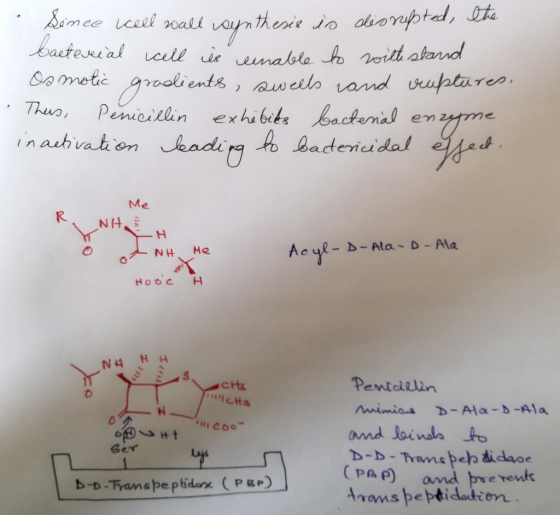
Answer: Cell wall
Add Answer to:
penicillin kills bacteria bu affecting its
protein sunthesis
cell wall
DNA gurase
all of the above
Penicillin is an enzyme-inhibiting antibiotic that kills bacteria by suppressing the synthesis of bacterial cell walls....
 Penicillin is an enzyme-inhibiting antibiotic that kills bacteria by suppressing the synthesis of bacterial cell walls. The bacterial cell wall is made of cross-linked peptidoglycan, which is synthesized from peptidoglycan monomers by transpeptidase enzymes. How does penicillin suppress the synthesis of bacterial cell walls? O Penicillin binds to the cross-linked peptidoglycan, preventing further bacterial cell wall growth. Penicillin signals the bacterial cell to stop producing the transpeptidase enzymes. Penicillin binds to the transpeptidase enzymes, preventing the synthesis of cross-linked peptidoglycan....
For each of the following statements about Peptidoglycan, answer TRUE or FALSE Penicillin kills bacteria by...
 For each of the following statements about Peptidoglycan, answer TRUE or FALSE Penicillin kills bacteria by inhibiting peptidoglycan synthesis. Muramic acid is a modified sugar that is found in bacterial cell walls. The cell wall of yeast and other fungi is made of peptidoglycan. peptidoglycan are not seen in proteins. peptidoglycan. peptidoglycan. Some of the amino acids found in The cell wall of Archeae is made of Viruses do not have a cell wall made of Submit Answer Tries 0/3
The bactericidal antibiotic penicillin kills bacterial cells by preventing peptidoglycan (cell wall) biosynthesis. Which of the...
The bactericidal antibiotic penicillin kills bacterial cells by preventing peptidoglycan (cell wall) biosynthesis. Which of the following phases of the bacterial growth curve would you expect penicillin to be most active against?
Penicillin affects bacterial cell metabolism by targeting O DNA and RNA synthesis O protein synthesis O...
 Penicillin affects bacterial cell metabolism by targeting O DNA and RNA synthesis O protein synthesis O vitamin synthesis O cell wall synthesis iron transport
Briefly explain how each of the following mechanisms of action inhibits or kills bacteria and give...
Briefly explain how each of the following mechanisms of action inhibits or kills bacteria and give examples of each: Inhibition of cell wall biosynthesis Inhibition of protein synthesis Inhibition of membrane function. Inhibition of nucleic acid synthesis Inhibition of metabolic pathways Inhibition of ATP synthase
a cell that allows a cell free DNA to enter by passing through its cell wall...
a cell that allows a cell free DNA to enter by passing through its cell wall and cell membrane has to be a.competent b.mutated c. lysed
Which of the following is not a characteristic of bacteria? DNA is free in the cytoplasm....
Which of the following is not a characteristic of bacteria? DNA is free in the cytoplasm. Ribosomes are present as the site of protein synthesis. The cell wall is made of peptidoglycan or other distinct polysaccharides. Organelles termed mitochondria are the site of ATP production.
Which is NOT a structure associated with bacteria? membrane cell wall nucleolus nucleoid none are found...
 Which is NOT a structure associated with bacteria? membrane cell wall nucleolus nucleoid none are found m bacteria) modifies molecules such as proteins and lipids for secretion (release from the cell) Chloroplast Golgi apparatus lysosomc Mrtochondren none Energy extraction from nutrients; site of cellular respiration; produces ATP Chloroplast Golgi apparatus lysosome Mitochondrion none Endomembrane Involved in lipid and steroid synthesis Lysosome Peroxisome smooth ER Ribosome rough ER Translates mRNA into protein Lysosome Peroxisome smooth ER Ribosome rough ER Meiosis is...
Which of the following statements is NOT true of current-living bacteria (Eubacteria) Peptidoglycan cell wall  
Which of the following statements is NOT true of current-living bacteria (Eubacteria) Peptidoglycan cell wall c. Often named by their shape Cellulose cell membrane d. Capable of motion 2. Which of the following components is NOT one of the 4 main types of organic molecules? Nucleic Acids/DNA c. Minerals/Micronutrients Amino Acids/Proteins d. Fatty Acids/Lipids 3. In a scientific experiment, the variable that provides direct observable, changes to the data as it is directly influenced by the experiment’s conditions,...
1. Regarding the structure of bacteria cells: a) They always have a cell wall b) They...
 1. Regarding the structure of bacteria cells: a) They always have a cell wall b) They are structurally the same as human cells c) They contain a distinct nucleus d) All of the above are correct 2. Cold sores and fever blisters are an example of a) A recurring bacterial infection b) A latent viral infection c) A nosocomial infection d) A fungal infection 3. Fungal infections: a) Are always a minor illness b) May present with pneumonia - like...
 Penicillin is an enzyme-inhibiting antibiotic that kills bacteria by suppressing the synthesis of bacterial cell walls. The bacterial cell wall is made of cross-linked peptidoglycan, which is synthesized from peptidoglycan monomers by transpeptidase enzymes. How does penicillin suppress the synthesis of bacterial cell walls? O Penicillin binds to the cross-linked peptidoglycan, preventing further bacterial cell wall growth. Penicillin signals the bacterial cell to stop producing the transpeptidase enzymes. Penicillin binds to the transpeptidase enzymes, preventing the synthesis of cross-linked peptidoglycan....
 For each of the following statements about Peptidoglycan, answer TRUE or FALSE Penicillin kills bacteria by inhibiting peptidoglycan synthesis. Muramic acid is a modified sugar that is found in bacterial cell walls. The cell wall of yeast and other fungi is made of peptidoglycan. peptidoglycan are not seen in proteins. peptidoglycan. peptidoglycan. Some of the amino acids found in The cell wall of Archeae is made of Viruses do not have a cell wall made of Submit Answer Tries 0/3
 Penicillin affects bacterial cell metabolism by targeting O DNA and RNA synthesis O protein synthesis O vitamin synthesis O cell wall synthesis iron transport
 Which is NOT a structure associated with bacteria? membrane cell wall nucleolus nucleoid none are found m bacteria) modifies molecules such as proteins and lipids for secretion (release from the cell) Chloroplast Golgi apparatus lysosomc Mrtochondren none Energy extraction from nutrients; site of cellular respiration; produces ATP Chloroplast Golgi apparatus lysosome Mitochondrion none Endomembrane Involved in lipid and steroid synthesis Lysosome Peroxisome smooth ER Ribosome rough ER Translates mRNA into protein Lysosome Peroxisome smooth ER Ribosome rough ER Meiosis is...
 1. Regarding the structure of bacteria cells: a) They always have a cell wall b) They are structurally the same as human cells c) They contain a distinct nucleus d) All of the above are correct 2. Cold sores and fever blisters are an example of a) A recurring bacterial infection b) A latent viral infection c) A nosocomial infection d) A fungal infection 3. Fungal infections: a) Are always a minor illness b) May present with pneumonia - like...
Most questions answered within 3 hours.
-
Where is the error in this code sequence?
String s1 = "Hello";
String s2 = "ello";...
asked 10 months ago -
Financial data for Joel de Paris, Inc., for last year
follow:
Joel de Paris, Inc.
Balance...
asked 10 months ago -
Consider this reaction:
Al2(SO4)3 (aq)+ BaCl3
(aq) Al2Cl6 (aq)- +
3BaSO4(s) . What is the...
asked 10 months ago -
Suppose that Savneet is considering increasing her
recent random sample from 20 car rentals to 40...
asked 10 months ago -
Trucks arrive at an unloading terminal at an average rate of 120
per hour.
Trucks arrive...
asked 10 months ago -
Why are methanol and ethanol completely soluble in water while
octanol is not very little soluble....
asked 10 months ago -
A facilities manager at a university reads in a research report
that the mean amount of...
asked 10 months ago -
When the CuSO4 is rehydrated by adding water to the anhydrous
compound, is this an endothermic...
asked 10 months ago -
A ray of sunlight is passing from diamond into crown glass; the
angle of incidence is...
asked 10 months ago -
A block of mass 0.249 kg is placed on top of a light, vertical
spring of...
asked 10 months ago -
how do the kidneys compensate in the presences of acidosis
a) trigger hyperventilate
b) reserve acid...
asked 10 months ago -
Question 501 pts
The rental rate of capital to the firm increases. Which of the
following...
asked 10 months ago