________ In probability theory we can define an event as: to. The possibility of an action...
Homework Answers
The correct answer to this question is (D)- All the possible results of an experiment.
Event can be understood as all the possible outcomes that can be obtained after an experiment is performed. For example- tossing of a coin gives us two possibilities- head or tail. Both are events for that experiment.
Example- Throwing a dice gives us six possiblities- 1,2,3,4,5 and 6. All the six outcomes are the events for that experiment.
Add Answer to:
________ In probability theory we can define an event
as:
to. The possibility of an action...
Choose Probability(chance)experiment, event, simple event, sample space. 1, The collection of all possible outcomes of a...
Choose Probability(chance)experiment, event, simple event, sample space. 1, The collection of all possible outcomes of a probability experiment 2, An experiment for which there is an uncertainty concerning the resulting outcomes 3, The set of one or more outcomes of a probability experiment 4, One specific outcome of a probability experiment
The probability of any one single event used to define the joint probability table is a...
The probability of any one single event used to define the joint probability table is a __________ probability. a proportional b relative c prior d subjective e marginal
(1) Consider the probability space 2 [0, 1. We define the probability of an event A Ω to be its length, we define a sequence random variables as follows: When n is odd Xn (u) 0 otherwise while, when...
 (1) Consider the probability space 2 [0, 1. We define the probability of an event A Ω to be its length, we define a sequence random variables as follows: When n is odd Xn (u) 0 otherwise while, when n is even otherwise (a) Compute the PMF and CDF of each Xn (b) Deduce that X converge in distribution (c) Show that for any n and any random variable X : Ω R. (d) Deduce that Xn does not converge...
1. Consider a statistical experiment E: (, F,P) and an event A . Note: A EF....
 1. Consider a statistical experiment E: (, F,P) and an event A . Note: A EF. a. Use the axioms of probability to show that P(A) 1-P(A). b. Repeat (a) using the definition of the σ-field. 2. Consider a statistical experiment E: (, F,P) in which a fair coin is flipped successively until the same face is observed on successive flips. Let A = {x: x = 3, 4, 5, . . .); that is, A is the event that...
1-Assuming events are independent when they are not- The likelihood of two independent events both happening...
1-Assuming events are independent when they are not- The likelihood of two independent events both happening is the product of their individual probability.So if we assume the events to be independent when they are actually not, pose problems and results in wrong interpretations of the overall probability for the overall event. 2- Not understanding when events are NOT independent- A different kind of mistake occurs when events that are not independent treated as such.As The likelihood of two independent events,...
Why does event causation (transeunt causation) pose a problem for free will, if it is the...
Why does event causation (transeunt causation) pose a problem for free will, if it is the only form of causation (according to Chisholm)? Select one: A. If previous events cause our actions, even if they are internal psychological events, then it seems the events, and not us, cause our actions. B. If events are the causes of our actions, then sometimes we do things for reasons, which is not how we normally think of free wil (which is doing something...
7 Which of the following statements are true about probability (more than one may be correct)?...
 7 Which of the following statements are true about probability (more than one may be correct)? (5 pts) 2 a Can be determined both objectively or subjectively b. The law of large numbers only applies to objective probabilities c Al events in a statistical experiment must have a probability of occurrence d Every event in a statistical experiment has the same chance of occurring e Subjective probabilities follow the usual axioms of probability
Question 3: We can define cost: a) The consumption valued in money of the goods and...
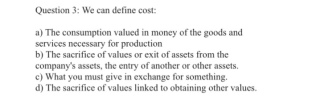 Question 3: We can define cost: a) The consumption valued in money of the goods and services necessary for production b) The sacrifice of values or exit of assets from the company's assets, the entry of another or other assets. c) What you must give in exchange for something d) The sacrifice of values linked to obtaining other values
Event A occurs with probability 0.3, and event B occurs with probability 0.4. If A and B are...
Event A occurs with probability 0.3, and event B occurs with probability 0.4. If A and B are independent, we may concludeA. P(A and B) = 0.12.B. P(A|B) = 0.3.C. P(B|A) = 0.4.D. All of the above
introduction health behavior theory 1. If you were using the Theory of Reasoned Action Planned Behavior,...
 introduction health behavior
theory
1. If you were using the Theory of Reasoned Action Planned Behavior, to change behavior, which of the following would be your focus? A. strengthening self-efficacy B. increasing awareness of health issue. C.altering intention D. improving networks 2. Which of the following theories would be consistent with addressing the issue of student alcohol use by forming a club for students who don't drink so they can support each other's decision not to drink. A. Health Belief...
introduction health behavior
theory
1. If you were using the Theory of Reasoned Action Planned Behavior, to change behavior, which of the following would be your focus? A. strengthening self-efficacy B. increasing awareness of health issue. C.altering intention D. improving networks 2. Which of the following theories would be consistent with addressing the issue of student alcohol use by forming a club for students who don't drink so they can support each other's decision not to drink. A. Health Belief...
 (1) Consider the probability space 2 [0, 1. We define the probability of an event A Ω to be its length, we define a sequence random variables as follows: When n is odd Xn (u) 0 otherwise while, when n is even otherwise (a) Compute the PMF and CDF of each Xn (b) Deduce that X converge in distribution (c) Show that for any n and any random variable X : Ω R. (d) Deduce that Xn does not converge...
 1. Consider a statistical experiment E: (, F,P) and an event A . Note: A EF. a. Use the axioms of probability to show that P(A) 1-P(A). b. Repeat (a) using the definition of the σ-field. 2. Consider a statistical experiment E: (, F,P) in which a fair coin is flipped successively until the same face is observed on successive flips. Let A = {x: x = 3, 4, 5, . . .); that is, A is the event that...
 7 Which of the following statements are true about probability (more than one may be correct)? (5 pts) 2 a Can be determined both objectively or subjectively b. The law of large numbers only applies to objective probabilities c Al events in a statistical experiment must have a probability of occurrence d Every event in a statistical experiment has the same chance of occurring e Subjective probabilities follow the usual axioms of probability
 Question 3: We can define cost: a) The consumption valued in money of the goods and services necessary for production b) The sacrifice of values or exit of assets from the company's assets, the entry of another or other assets. c) What you must give in exchange for something d) The sacrifice of values linked to obtaining other values
 introduction health behavior
theory
1. If you were using the Theory of Reasoned Action Planned Behavior, to change behavior, which of the following would be your focus? A. strengthening self-efficacy B. increasing awareness of health issue. C.altering intention D. improving networks 2. Which of the following theories would be consistent with addressing the issue of student alcohol use by forming a club for students who don't drink so they can support each other's decision not to drink. A. Health Belief...
introduction health behavior
theory
1. If you were using the Theory of Reasoned Action Planned Behavior, to change behavior, which of the following would be your focus? A. strengthening self-efficacy B. increasing awareness of health issue. C.altering intention D. improving networks 2. Which of the following theories would be consistent with addressing the issue of student alcohol use by forming a club for students who don't drink so they can support each other's decision not to drink. A. Health Belief...
Most questions answered within 3 hours.
-
Where is the error in this code sequence?
String s1 = "Hello";
String s2 = "ello";...
asked 10 months ago -
Financial data for Joel de Paris, Inc., for last year
follow:
Joel de Paris, Inc.
Balance...
asked 10 months ago -
Consider this reaction:
Al2(SO4)3 (aq)+ BaCl3
(aq) Al2Cl6 (aq)- +
3BaSO4(s) . What is the...
asked 10 months ago -
Suppose that Savneet is considering increasing her
recent random sample from 20 car rentals to 40...
asked 10 months ago -
Trucks arrive at an unloading terminal at an average rate of 120
per hour.
Trucks arrive...
asked 10 months ago -
Why are methanol and ethanol completely soluble in water while
octanol is not very little soluble....
asked 10 months ago -
A facilities manager at a university reads in a research report
that the mean amount of...
asked 10 months ago -
When the CuSO4 is rehydrated by adding water to the anhydrous
compound, is this an endothermic...
asked 10 months ago -
A ray of sunlight is passing from diamond into crown glass; the
angle of incidence is...
asked 10 months ago -
A block of mass 0.249 kg is placed on top of a light, vertical
spring of...
asked 10 months ago -
how do the kidneys compensate in the presences of acidosis
a) trigger hyperventilate
b) reserve acid...
asked 10 months ago -
Question 501 pts
The rental rate of capital to the firm increases. Which of the
following...
asked 10 months ago