describe how the neurotransmitter is synthesized in the presynaptic neuron, how it is released (mechanism of...
describe how the neurotransmitter is synthesized in the presynaptic neuron, how it is released (mechanism of vesicular release), how it affects the postsynaptic cell (excitation or inhibition) and how it is degraded or recycled.
Homework Answers
There are two types of neurotransmitters small-molecule, rapidly acting transmitters and the neuropeptides which are of much larger molecular size that usually acts much slowly. The small-molecule, rapidly acting transmitters cause most acute responses of the nervous system, such as transmission of sensory signals to the brain and of motor signals back to the muscles. The neuropeptides, usually cause more prolonged actions. In most cases, the small-molecule types of transmitters are synthesized in the cytosol of the presynaptic terminal. The neuropeptides are synthesized as integral parts of large-protein molecules by ribosomes in the neuronal cell body.
The membrane of the presynaptic terminal is called the presynaptic membrane. It contains large numbers of voltage-gated calcium channels. When an action potential depolarizes the presynaptic membrane, these calcium channels open and allow large numbers of calcium ions to flow into the terminal. When the calcium ions enter the presynaptic terminal, they bind with special protein molecules on the inside surface of the presynaptic membrane, called release sites. This binding in turn causes the release sites to open through the membrane, allowing a few transmitter vesicles to release their transmitter into the cleft after each single action potential.
The transmitter vesicles contain the neurotransmitter that, when released into the synaptic cleft, either excites or inhibits the postsynaptic neuron. It excites the postsynaptic neuron if the neuronal membrane contains excitatory receptors, and it inhibits the neuron if the membrane contains inhibitory receptors.
Vesicles that store and release small-molecule transmitters are continually recycled and used over and over again. After they fuse with the synaptic membrane and open to release their transmitter substance, the vesicle membrane at first simply becomes part of the synaptic membrane. The vesicle portion of the membrane invaginates back to the inside of the presynaptic terminal and pinches off to form a new vesicle. The new vesicular membrane still contains appropriate enzyme proteins or transport proteins required for synthesizing new transmitter substance inside the vesicle. Acetylcholine is a typical small-molecule transmitter that obeys the principles of synthesis and release.
Add Answer to:
describe how the neurotransmitter is synthesized in the
presynaptic neuron, how it is released (mechanism of...
Describe what happens in a postsynaptic cell when an excitatory neurotransmitter is released into the synapse...
Describe what happens in a postsynaptic cell when an excitatory neurotransmitter is released into the synapse by a presynaptic neuron. Describe what happens in a pos-synaptic cell when an inhibitory neurotransmitter is released into the synapse by a presynaptic neuron.
1. What determines how much neurotransmitter is released into the synaptic cleft? A. The size of...
1. What determines how much neurotransmitter is released into the synaptic cleft? A. The size of the end-plate potentials in the postsynaptic cell B. The rate of neurotransmitter degradation in the synaptic cleft C. Action potential frequency in the presynaptic neuron D. The diameter of synaptic vesicles in the presynaptic neuron 2. Which of the following ions is necessary for exocytosis of synaptic vesicles? A.Calcium ions B.Potassium ions C.Magnesium ions D.Sodium ions
40. The effect of a neurotransmitter on a postsynaptic neuron is determined by the a. speed...
 40. The effect of a neurotransmitter on a postsynaptic neuron is determined by the a. speed the action potential traveled down the axon b. number of branches of the presynaptic axon c. receptors on the postsynaptic membrane d. distance between the synapse and the cell body
Why are the receptors on the postsynaptic neuron more important than the neurotransmitter released at the...
Why are the receptors on the postsynaptic neuron more important than the neurotransmitter released at the synapse for the response of the postsynaptic neuron?
Which of the following does NOT correctly reflect the criteria for a molecule to be consider...
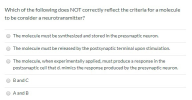 Which of the following does NOT correctly reflect the criteria for a molecule to be consider a neurotransmitter? The molecule must be synthesized and stored in the presynaptic neuron. O The molecule must be released by the postsynaptic terminal upon stimulation. The molecule, when experimentally applied, must produce a response in the postsynaptic cell that d. mimics the response produced by the presynaptic neuron. Band C O A and B
Explain in detail how a neurotransmitter is released from a presynaptic cell. You may provide a...
Explain in detail how a neurotransmitter is released from a presynaptic cell. You may provide a drawing for your answer, provided the text clearly matches what is occurring in your drawing
4. Draw a synapse between 2 neurons. Label the following: Presynaptic neuron, Postsynaptic neuron, Synaptic vesicles,...
 4. Draw a synapse between 2 neurons. Label the following: Presynaptic neuron, Postsynaptic neuron, Synaptic vesicles, Voltage-regulated calcium channel, Chemical-regulated sodium channel. 5. Draw a diagram of the preganglionic neuron, postganglionic neuron, and effector for both Sympathetic Nervous System and Parasympathetic Nervous System. indicate which neurotransmitter is released by each neuron and label the receptors at all locations for the neurotransmitter. 6. Which cells have a resting membrane potential? Which cells can have an action potential? 7. Circle which of...
Question 14 2.5 pts A. Use several sentences to describe Ca2+-based mechanisms underlying neurotransmitter release. B....
 Question 14 2.5 pts A. Use several sentences to describe Ca2+-based mechanisms underlying neurotransmitter release. B. Assume you are recording from the squid giant synapse and are able to stimulate the presynaptic neuron and record the response in the postsynaptic neuron. Describe a set of experiments (and their results) to demonstrate that Ca2is both necessary and sufficient for neurotransmitter release. State which experiment you describe shows necessity and which shows sufficiency. Use several paragraphs to discuss your proposed experiments, what...
20) After a neurotransmitter is released, it must _____________ to the postsynaptic receptor to induce an...
20) After a neurotransmitter is released, it must _____________ to the postsynaptic receptor to induce an excitatory postsynaptic potential or an inhibitory postsynaptic potential. All of the answers provided are correct Bind None of the answers provided are correct Be degraded by enzymes before binding 22) Which of the following is a method for terminating an action potential? Postsynaptic binding All of the answers provided are correct Reuptake Enzymatic degredation 23) Drugs of abuse exert their effects in the brain...
1. The chemical reasons for the value of the resting membrane potential for a typical neuron...
1. The chemical reasons for the value of the resting membrane potential for a typical neuron (-70mV) and the electrochemical forces that act on sodium and potassium. Know the role of the Na+/K+ pump. What is a K+ leak channel? 2. Describe the events at a synapse during neurotransmission including how a neurotransmitter is released from the presynaptic cell (calcium triggers exocytosis), and what determines the effect that a neurotransmitter will have on the postsynaptic cell. 3. A function of:...
 40. The effect of a neurotransmitter on a postsynaptic neuron is determined by the a. speed the action potential traveled down the axon b. number of branches of the presynaptic axon c. receptors on the postsynaptic membrane d. distance between the synapse and the cell body
 Which of the following does NOT correctly reflect the criteria for a molecule to be consider a neurotransmitter? The molecule must be synthesized and stored in the presynaptic neuron. O The molecule must be released by the postsynaptic terminal upon stimulation. The molecule, when experimentally applied, must produce a response in the postsynaptic cell that d. mimics the response produced by the presynaptic neuron. Band C O A and B
 4. Draw a synapse between 2 neurons. Label the following: Presynaptic neuron, Postsynaptic neuron, Synaptic vesicles, Voltage-regulated calcium channel, Chemical-regulated sodium channel. 5. Draw a diagram of the preganglionic neuron, postganglionic neuron, and effector for both Sympathetic Nervous System and Parasympathetic Nervous System. indicate which neurotransmitter is released by each neuron and label the receptors at all locations for the neurotransmitter. 6. Which cells have a resting membrane potential? Which cells can have an action potential? 7. Circle which of...
 Question 14 2.5 pts A. Use several sentences to describe Ca2+-based mechanisms underlying neurotransmitter release. B. Assume you are recording from the squid giant synapse and are able to stimulate the presynaptic neuron and record the response in the postsynaptic neuron. Describe a set of experiments (and their results) to demonstrate that Ca2is both necessary and sufficient for neurotransmitter release. State which experiment you describe shows necessity and which shows sufficiency. Use several paragraphs to discuss your proposed experiments, what...
Most questions answered within 3 hours.
-
Where is the error in this code sequence?
String s1 = "Hello";
String s2 = "ello";...
asked 11 months ago -
Financial data for Joel de Paris, Inc., for last year
follow:
Joel de Paris, Inc.
Balance...
asked 11 months ago -
Consider this reaction:
Al2(SO4)3 (aq)+ BaCl3
(aq) Al2Cl6 (aq)- +
3BaSO4(s) . What is the...
asked 11 months ago -
Suppose that Savneet is considering increasing her
recent random sample from 20 car rentals to 40...
asked 11 months ago -
Trucks arrive at an unloading terminal at an average rate of 120
per hour.
Trucks arrive...
asked 11 months ago -
Why are methanol and ethanol completely soluble in water while
octanol is not very little soluble....
asked 11 months ago -
A facilities manager at a university reads in a research report
that the mean amount of...
asked 11 months ago -
When the CuSO4 is rehydrated by adding water to the anhydrous
compound, is this an endothermic...
asked 11 months ago -
A ray of sunlight is passing from diamond into crown glass; the
angle of incidence is...
asked 11 months ago -
A block of mass 0.249 kg is placed on top of a light, vertical
spring of...
asked 11 months ago -
how do the kidneys compensate in the presences of acidosis
a) trigger hyperventilate
b) reserve acid...
asked 11 months ago -
Question 501 pts
The rental rate of capital to the firm increases. Which of the
following...
asked 11 months ago