Discribe a strategy to clone a bacterial Gene into a plasmid vector for propagation in E....
Discribe a strategy to clone a bacterial Gene into a plasmid vector for propagation in E. coli. Assume that the target DNA sequence is known. Describe the selection for E. coli cells that carry the cloned gene. Consider methods to minimize unwanted products.
Homework Answers
By using RDT ( recombinant DNA technology) we can clone desired gene in to plants and amplify it using host at a large scale
Step involve in this process are
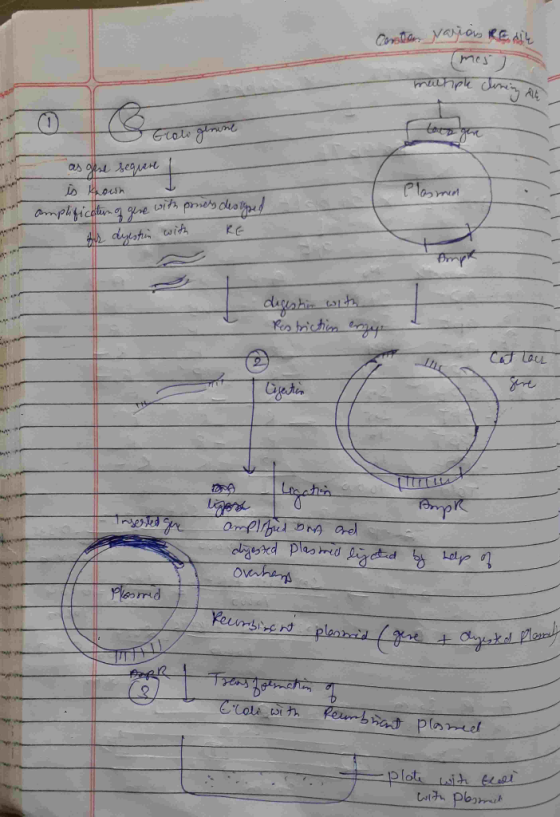
1) amplification of desired gene using primer containg desired restriction site
2) restriction digestion of amplified fragment and plasmid - it will lead to formation of sticky ends in both of amplified gene and in plasmid.
3) ligation of both digested and gene and plasmid. - both will ligareusing sticky end.
4) transformation of recommit plasmid in to E coli cell
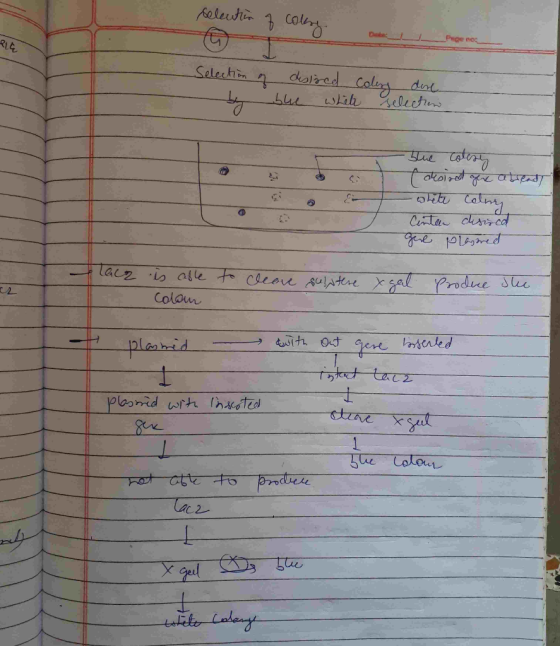
5) selection of E coli cell containing desired recombinant plasmid using blue white selection .
These steps are explained in attached image below . Hope this will help
Add Answer to:
Discribe a strategy to clone a bacterial Gene into a
plasmid vector for propagation in E....
Please answer these four questions. 6C. A type of plasmid used frequently as a vector in...
 Please answer these four questions.
6C. A type of plasmid used frequently as a vector in recombinant DNA procedures carries gene markers for resistance to tetracycline (Tet') and to ampicillin (Amp). In one experiment, such plasmids were exposed to a restriction enzyme that cuts within the Amp' gene but leaves the Tet' gene intact. Plasmids exposed to the enzyme were next mixed with genomic restriction fragments from a cloned library of mouse DNA. The aim was to produce and detect...
Please answer these four questions.
6C. A type of plasmid used frequently as a vector in recombinant DNA procedures carries gene markers for resistance to tetracycline (Tet') and to ampicillin (Amp). In one experiment, such plasmids were exposed to a restriction enzyme that cuts within the Amp' gene but leaves the Tet' gene intact. Plasmids exposed to the enzyme were next mixed with genomic restriction fragments from a cloned library of mouse DNA. The aim was to produce and detect...
12. If you used the PBLU plasmid as a vector to carry a desirable human gene...
 12. If you used the PBLU plasmid as a vector to carry a desirable human gene into E. coli recipient cells. The insertion site is inside the B-galactosidase gene on the p-BLU plasmid. After the transformation, you plate the cells on LBA+amp+X-Gal to screen for E. coli cells with the desirable gene. You saw both blue and white colonies on the plate. Which type of colonies carry the desirable human gene? A. White B. Blue C. both D. neither one...
You have cloned the Pepsi Gene into the vector pKEN. You used two restriction enzymes, BamHI...
You have cloned the Pepsi Gene into the vector pKEN. You used two restriction enzymes, BamHI and EcoRI to force the cloning in a directional way. The plasmid (pKEN) is ~5 kb long and the insert Pepsi 800bp long. After transformation into E. coli you grow up several colonies and isolate the vector. After digestion of the vector it looks like you have three potential clones. You need to sequence the gene to make sure you have the correct clone....
BTH2732 Recombinant DNA Technology For answer all questions below part, Ignore question 1. Just do question...
 BTH2732 Recombinant DNA Technology
For answer all questions below part, Ignore question 1. Just
do question 2 and below
Part A: Refer to Lecture 3 & Supplementary Video: https://www.youtube.com/watch?v SiwNtQYLKeU Virtual cloning of the Human p53 gene You are required to devise a set of practical methodologies in order to carry out a relatively simple molecular biology task. 1. You must identify the steps required 2. Formulate a set of practical protocols needed to carry out those steps . Consider...
BTH2732 Recombinant DNA Technology
For answer all questions below part, Ignore question 1. Just
do question 2 and below
Part A: Refer to Lecture 3 & Supplementary Video: https://www.youtube.com/watch?v SiwNtQYLKeU Virtual cloning of the Human p53 gene You are required to devise a set of practical methodologies in order to carry out a relatively simple molecular biology task. 1. You must identify the steps required 2. Formulate a set of practical protocols needed to carry out those steps . Consider...
Bacterial cells, such as E. coli, are surrounded by a fluid plasma membrane and enclosed by...
 Bacterial cells, such as E. coli, are surrounded by a fluid plasma membrane and enclosed by a rigid cell wall that protects the cell from damage. You will recall that there is no nuclear envelope in prokaryotic cells, but rather a “nucleoid region” with a single chromosome that is continuous (circular), not linear, as in eukaryotes. All of the genes required for basic survival and reproduction are found in the main chromosome. In addition to the main chromosomes, some DNA...
8. DNA cloning. The first DNA clone using recombinant DNA technology was human insulin, which was...
 8. DNA cloning. The first DNA clone using recombinant DNA technology was human insulin, which was made in 1978. The insulin gene was inserted into a plasmid and the gene was transcribed and translated from the plasmid in E coll cells. Insulin is synthesized by ribosomes in human pancreatic cells. Insulin is synthesized as a longer polypeptide, which is then trimmed by proteases to make the mature chains A and B (see Fig. 2.17 on page 39 of your textbook)....
Below is a set of experiments for cloning the human growth hormone (HGH) gene and then...
Below is a set of experiments for cloning the human growth hormone (HGH) gene and then expressing the HGH protein in E. coli starting from human pituitary glands and a tube of plasmid vector DNA. The plasmid expression vector contains the arabinose inducible expression system. Specify the correct order for carrying out these experiments, using the letter codes in front of each procedure. Use all of the steps in your answer, except for one step that should NOT be included....
1. In a transformation experiment, E. coli uptake pRGLO plasmids that carry GFP gene. The transformed...
 1. In a transformation experiment, E. coli uptake pRGLO plasmids that carry GFP gene. The transformed bacterial cells are grown on an ampicillin-treated agar plate. Which of the following is considered as a vector? GFP gene C E. coli cell c ampicillin-treated agar plate 0.5 points QUESTION 2 1. What is the function of bla gene? Break down the ampicillin Regulate the transcription of GFP gene Express the fluorescent trait in bacteria Control the uptake of DNA molecules in bacteria...
Protein P is synthesized in relatively high amounts in the human pancreas. This protein has been...
 Protein P is synthesized in relatively high amounts in the human pancreas. This protein has been isolated and purified, but its amino acid sequence has not been determined. We wish to clone the gene for protein P. (a) How can a probe be prepared to identify the gene for protein P? (b) If we have prepared a radioactive messenger RNA as our probe in part (a), how could we verify that it is the mRNA for protein P? (c) If...
What are SOS gene products? How are they induced? A. SOS proteins (RecA, SSB, uvrABC, etc);...
What are SOS gene products? How are they induced? A. SOS proteins (RecA, SSB, uvrABC, etc); nicked DNA binds to the Lac repressor, causing its release and degradation, thereby triggering expression of the SOS genes B. SOS proteins are the heat-shock proteins; the “chi” sequence binds to some transcription factors inducing expression of these genes C. SOS proteins are only transcription factors that activate other genes; DNA damage causes induction of these transcription factors through single-stranded DNA binding proteins D....
 Please answer these four questions.
6C. A type of plasmid used frequently as a vector in recombinant DNA procedures carries gene markers for resistance to tetracycline (Tet') and to ampicillin (Amp). In one experiment, such plasmids were exposed to a restriction enzyme that cuts within the Amp' gene but leaves the Tet' gene intact. Plasmids exposed to the enzyme were next mixed with genomic restriction fragments from a cloned library of mouse DNA. The aim was to produce and detect...
Please answer these four questions.
6C. A type of plasmid used frequently as a vector in recombinant DNA procedures carries gene markers for resistance to tetracycline (Tet') and to ampicillin (Amp). In one experiment, such plasmids were exposed to a restriction enzyme that cuts within the Amp' gene but leaves the Tet' gene intact. Plasmids exposed to the enzyme were next mixed with genomic restriction fragments from a cloned library of mouse DNA. The aim was to produce and detect...
 12. If you used the PBLU plasmid as a vector to carry a desirable human gene into E. coli recipient cells. The insertion site is inside the B-galactosidase gene on the p-BLU plasmid. After the transformation, you plate the cells on LBA+amp+X-Gal to screen for E. coli cells with the desirable gene. You saw both blue and white colonies on the plate. Which type of colonies carry the desirable human gene? A. White B. Blue C. both D. neither one...
 BTH2732 Recombinant DNA Technology
For answer all questions below part, Ignore question 1. Just
do question 2 and below
Part A: Refer to Lecture 3 & Supplementary Video: https://www.youtube.com/watch?v SiwNtQYLKeU Virtual cloning of the Human p53 gene You are required to devise a set of practical methodologies in order to carry out a relatively simple molecular biology task. 1. You must identify the steps required 2. Formulate a set of practical protocols needed to carry out those steps . Consider...
BTH2732 Recombinant DNA Technology
For answer all questions below part, Ignore question 1. Just
do question 2 and below
Part A: Refer to Lecture 3 & Supplementary Video: https://www.youtube.com/watch?v SiwNtQYLKeU Virtual cloning of the Human p53 gene You are required to devise a set of practical methodologies in order to carry out a relatively simple molecular biology task. 1. You must identify the steps required 2. Formulate a set of practical protocols needed to carry out those steps . Consider...
 Bacterial cells, such as E. coli, are surrounded by a fluid plasma membrane and enclosed by a rigid cell wall that protects the cell from damage. You will recall that there is no nuclear envelope in prokaryotic cells, but rather a “nucleoid region” with a single chromosome that is continuous (circular), not linear, as in eukaryotes. All of the genes required for basic survival and reproduction are found in the main chromosome. In addition to the main chromosomes, some DNA...
 8. DNA cloning. The first DNA clone using recombinant DNA technology was human insulin, which was made in 1978. The insulin gene was inserted into a plasmid and the gene was transcribed and translated from the plasmid in E coll cells. Insulin is synthesized by ribosomes in human pancreatic cells. Insulin is synthesized as a longer polypeptide, which is then trimmed by proteases to make the mature chains A and B (see Fig. 2.17 on page 39 of your textbook)....
 1. In a transformation experiment, E. coli uptake pRGLO plasmids that carry GFP gene. The transformed bacterial cells are grown on an ampicillin-treated agar plate. Which of the following is considered as a vector? GFP gene C E. coli cell c ampicillin-treated agar plate 0.5 points QUESTION 2 1. What is the function of bla gene? Break down the ampicillin Regulate the transcription of GFP gene Express the fluorescent trait in bacteria Control the uptake of DNA molecules in bacteria...
 Protein P is synthesized in relatively high amounts in the human pancreas. This protein has been isolated and purified, but its amino acid sequence has not been determined. We wish to clone the gene for protein P. (a) How can a probe be prepared to identify the gene for protein P? (b) If we have prepared a radioactive messenger RNA as our probe in part (a), how could we verify that it is the mRNA for protein P? (c) If...
Most questions answered within 3 hours.
-
Where is the error in this code sequence?
String s1 = "Hello";
String s2 = "ello";...
asked 10 months ago -
Financial data for Joel de Paris, Inc., for last year
follow:
Joel de Paris, Inc.
Balance...
asked 10 months ago -
Consider this reaction:
Al2(SO4)3 (aq)+ BaCl3
(aq) Al2Cl6 (aq)- +
3BaSO4(s) . What is the...
asked 10 months ago -
Suppose that Savneet is considering increasing her
recent random sample from 20 car rentals to 40...
asked 10 months ago -
Trucks arrive at an unloading terminal at an average rate of 120
per hour.
Trucks arrive...
asked 10 months ago -
Why are methanol and ethanol completely soluble in water while
octanol is not very little soluble....
asked 10 months ago -
A facilities manager at a university reads in a research report
that the mean amount of...
asked 10 months ago -
When the CuSO4 is rehydrated by adding water to the anhydrous
compound, is this an endothermic...
asked 10 months ago -
A ray of sunlight is passing from diamond into crown glass; the
angle of incidence is...
asked 10 months ago -
A block of mass 0.249 kg is placed on top of a light, vertical
spring of...
asked 10 months ago -
how do the kidneys compensate in the presences of acidosis
a) trigger hyperventilate
b) reserve acid...
asked 10 months ago -
Question 501 pts
The rental rate of capital to the firm increases. Which of the
following...
asked 10 months ago