Can E.Coli conjugate with Enterobacter or Serratia?
Homework Answers
E.coli conjugate with Serratia.
When experiment perform between the E. coli (R) to Serratia marcesens (S) then conjugation occurred.
Detection :-
- Produces a pink pigment on the test plate.
- Conjugation is unable to produce through Enterobacter i.e ( Gram -ve bacteria).
With these results which bacteria can it be? Alcaligenes faecalis Enterobacter aerogenes Escherichia coli Proteus vulgaris Pseudomonas aeruginosa Serratia marcescens Gram Stain Results Organism Cell...
 With these results which bacteria can it be?
Alcaligenes faecalis
Enterobacter aerogenes
Escherichia coli
Proteus vulgaris
Pseudomonas aeruginosa
Serratia marcescens
Gram Stain Results Organism Cell Shape Gram Stain Cell Arrangement Single Unknown sample Gram negative Rod Oxidase Results Color after Adding Reagent Organism Unknown sample Yellow, Negative SIM Results Motility Organismm Sulfur reductionn Indole production Unknown sample EMB Results Organismm Unknown sample Growth Colony Appearance Raised, Circular, Entired Purple, some colonies Glucose and Lactose Fermentation Glucose Lactose Organism Growth Color...
With these results which bacteria can it be?
Alcaligenes faecalis
Enterobacter aerogenes
Escherichia coli
Proteus vulgaris
Pseudomonas aeruginosa
Serratia marcescens
Gram Stain Results Organism Cell Shape Gram Stain Cell Arrangement Single Unknown sample Gram negative Rod Oxidase Results Color after Adding Reagent Organism Unknown sample Yellow, Negative SIM Results Motility Organismm Sulfur reductionn Indole production Unknown sample EMB Results Organismm Unknown sample Growth Colony Appearance Raised, Circular, Entired Purple, some colonies Glucose and Lactose Fermentation Glucose Lactose Organism Growth Color...
Can this standard curve for yeast cells be used for E.coli cells why/why not? - conc...
 Can this standard curve for yeast cells be used for
E.coli cells why/why not?
- conc of dilu Trendline for conc of dilu R2 = 1 1.00 0.75 Concentration 0.50 0.25 0.00 0.2 0.3 0.4 0.5 0.6 0.7 od
Can this standard curve for yeast cells be used for
E.coli cells why/why not?
- conc of dilu Trendline for conc of dilu R2 = 1 1.00 0.75 Concentration 0.50 0.25 0.00 0.2 0.3 0.4 0.5 0.6 0.7 od
1) MacConkey agar is elective because a) It can identify mixed acid producing E.coli b) Contains...
1) MacConkey agar is elective because a) It can identify mixed acid producing E.coli b) Contains bile salts and crystal violet c) It contains lactose d) It contains glucose
For a different experiment you are growing up Saccharomyces cerivisiae instead of E.coli. The measured OD...
For a different experiment you are growing up Saccharomyces cerivisiae instead of E.coli. The measured OD is 0.89. A) In order to calculate the concentration of the Saccharomyces cerivisiae culture, can you use the equation that you use to calculate the concentration of an E.coli culture? If yes or no, give a detailed explanation. B) Does E.coli or Saccharomyces cerivisiae have a shorter generation time? Give a detailed explanation!
What is E.coli O157;H7? How can laboratory quickly identify this organism? Where were the three most...
What is E.coli O157;H7? How can laboratory quickly identify this organism? Where were the three most recent outbreaks and what foods were they associated with? What is your suggestion/s to prevent the spread of the organism?
Answer and explain please Question A student infects his E.coli with Bacteriophage Lambda and then spreads...
 Answer and explain please
Question A student infects his E.coli with Bacteriophage Lambda and then spreads his E.coli on a Tryptic Soy agar plate. He looks at his plates 2 days later and see bacteria growing (like a lawn) on his plate. What can he conclude about his bacteriophage infection other than that no infection occurred?
Answer and explain please
Question A student infects his E.coli with Bacteriophage Lambda and then spreads his E.coli on a Tryptic Soy agar plate. He looks at his plates 2 days later and see bacteria growing (like a lawn) on his plate. What can he conclude about his bacteriophage infection other than that no infection occurred?
QUESTION 13 1 points Quiz 5 Extra Credit: Why can scFvs be made efficiently in E.coli?...
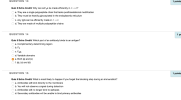 QUESTION 13 1 points Quiz 5 Extra Credit: Why can scFvs be made efficiently in E.coli? a. They are a single polypeptide chain that lacks posttranslational modification b. They must be heavily glycosylated in the endoplasmic reticulum c. Any IgG can be efficiently made in E.coli d. They are made of multiple polypeptide chains QUESTION 14 1 pc Quiz 5 Extra Credit: Which part of an antibody binds to an antigen? a. Complimentary determining region b. Fc c. Fab Od....
I don't understand this at all, how can you determine the strength of conjugate base by...
 I don't understand this at all, how can you determine the
strength of conjugate base by looking at these molecules? How would
you determine conjugate acid if that was the question?
7) What is the order of increasing strength of the conjugate base in the following molecules? Cl Cl
I don't understand this at all, how can you determine the
strength of conjugate base by looking at these molecules? How would
you determine conjugate acid if that was the question?
7) What is the order of increasing strength of the conjugate base in the following molecules? Cl Cl
The following product can be synthesized from a conjugate addition reaction. Draw the starting materials needed...
 The following product can be synthesized from a conjugate addition
reaction. Draw the starting materials needed in the appropriately
labeled boxes. aldehyde or ketone ?-dicarbonyl compound
The following product can be synthesized from a conjugate addition reaction. Draw the starting materials needed in the appropriately labeled boxes. can te ieneesiced from a conjugate adlition reac aldehyde or ketone B-dicarbonyl compound NaOEt EtOH
The following product can be synthesized from a conjugate addition
reaction. Draw the starting materials needed in the appropriately
labeled boxes. aldehyde or ketone ?-dicarbonyl compound
The following product can be synthesized from a conjugate addition reaction. Draw the starting materials needed in the appropriately labeled boxes. can te ieneesiced from a conjugate adlition reac aldehyde or ketone B-dicarbonyl compound NaOEt EtOH
E.coli cell is a cylindar about 2 um long and 1 um in diameter. Its total...
E.coli cell is a cylindar about 2 um long and 1 um in diameter. Its total mass is about 1 pico gram, 70% of which is water and the half of the rest mass (dry mass) is protein (15%). Lipid molecule's dimension can be simplified as 0.5 nm x 0.5 nm x 1.0 nm. Ribosome is a molecular complex with total molecular mass of 2.5 x 10⁶ Da. It is made of 1/3 of protein and 2/3 of RNA. In...
 With these results which bacteria can it be?
Alcaligenes faecalis
Enterobacter aerogenes
Escherichia coli
Proteus vulgaris
Pseudomonas aeruginosa
Serratia marcescens
Gram Stain Results Organism Cell Shape Gram Stain Cell Arrangement Single Unknown sample Gram negative Rod Oxidase Results Color after Adding Reagent Organism Unknown sample Yellow, Negative SIM Results Motility Organismm Sulfur reductionn Indole production Unknown sample EMB Results Organismm Unknown sample Growth Colony Appearance Raised, Circular, Entired Purple, some colonies Glucose and Lactose Fermentation Glucose Lactose Organism Growth Color...
With these results which bacteria can it be?
Alcaligenes faecalis
Enterobacter aerogenes
Escherichia coli
Proteus vulgaris
Pseudomonas aeruginosa
Serratia marcescens
Gram Stain Results Organism Cell Shape Gram Stain Cell Arrangement Single Unknown sample Gram negative Rod Oxidase Results Color after Adding Reagent Organism Unknown sample Yellow, Negative SIM Results Motility Organismm Sulfur reductionn Indole production Unknown sample EMB Results Organismm Unknown sample Growth Colony Appearance Raised, Circular, Entired Purple, some colonies Glucose and Lactose Fermentation Glucose Lactose Organism Growth Color...
 Can this standard curve for yeast cells be used for
E.coli cells why/why not?
- conc of dilu Trendline for conc of dilu R2 = 1 1.00 0.75 Concentration 0.50 0.25 0.00 0.2 0.3 0.4 0.5 0.6 0.7 od
Can this standard curve for yeast cells be used for
E.coli cells why/why not?
- conc of dilu Trendline for conc of dilu R2 = 1 1.00 0.75 Concentration 0.50 0.25 0.00 0.2 0.3 0.4 0.5 0.6 0.7 od
 Answer and explain please
Question A student infects his E.coli with Bacteriophage Lambda and then spreads his E.coli on a Tryptic Soy agar plate. He looks at his plates 2 days later and see bacteria growing (like a lawn) on his plate. What can he conclude about his bacteriophage infection other than that no infection occurred?
Answer and explain please
Question A student infects his E.coli with Bacteriophage Lambda and then spreads his E.coli on a Tryptic Soy agar plate. He looks at his plates 2 days later and see bacteria growing (like a lawn) on his plate. What can he conclude about his bacteriophage infection other than that no infection occurred?
 QUESTION 13 1 points Quiz 5 Extra Credit: Why can scFvs be made efficiently in E.coli? a. They are a single polypeptide chain that lacks posttranslational modification b. They must be heavily glycosylated in the endoplasmic reticulum c. Any IgG can be efficiently made in E.coli d. They are made of multiple polypeptide chains QUESTION 14 1 pc Quiz 5 Extra Credit: Which part of an antibody binds to an antigen? a. Complimentary determining region b. Fc c. Fab Od....
 I don't understand this at all, how can you determine the
strength of conjugate base by looking at these molecules? How would
you determine conjugate acid if that was the question?
7) What is the order of increasing strength of the conjugate base in the following molecules? Cl Cl
I don't understand this at all, how can you determine the
strength of conjugate base by looking at these molecules? How would
you determine conjugate acid if that was the question?
7) What is the order of increasing strength of the conjugate base in the following molecules? Cl Cl
 The following product can be synthesized from a conjugate addition
reaction. Draw the starting materials needed in the appropriately
labeled boxes. aldehyde or ketone ?-dicarbonyl compound
The following product can be synthesized from a conjugate addition reaction. Draw the starting materials needed in the appropriately labeled boxes. can te ieneesiced from a conjugate adlition reac aldehyde or ketone B-dicarbonyl compound NaOEt EtOH
The following product can be synthesized from a conjugate addition
reaction. Draw the starting materials needed in the appropriately
labeled boxes. aldehyde or ketone ?-dicarbonyl compound
The following product can be synthesized from a conjugate addition reaction. Draw the starting materials needed in the appropriately labeled boxes. can te ieneesiced from a conjugate adlition reac aldehyde or ketone B-dicarbonyl compound NaOEt EtOH
Most questions answered within 3 hours.
-
Where is the error in this code sequence?
String s1 = "Hello";
String s2 = "ello";...
asked 10 months ago -
Financial data for Joel de Paris, Inc., for last year
follow:
Joel de Paris, Inc.
Balance...
asked 10 months ago -
Consider this reaction:
Al2(SO4)3 (aq)+ BaCl3
(aq) Al2Cl6 (aq)- +
3BaSO4(s) . What is the...
asked 10 months ago -
Suppose that Savneet is considering increasing her
recent random sample from 20 car rentals to 40...
asked 10 months ago -
Trucks arrive at an unloading terminal at an average rate of 120
per hour.
Trucks arrive...
asked 10 months ago -
Why are methanol and ethanol completely soluble in water while
octanol is not very little soluble....
asked 10 months ago -
A facilities manager at a university reads in a research report
that the mean amount of...
asked 10 months ago -
When the CuSO4 is rehydrated by adding water to the anhydrous
compound, is this an endothermic...
asked 10 months ago -
A ray of sunlight is passing from diamond into crown glass; the
angle of incidence is...
asked 10 months ago -
A block of mass 0.249 kg is placed on top of a light, vertical
spring of...
asked 10 months ago -
how do the kidneys compensate in the presences of acidosis
a) trigger hyperventilate
b) reserve acid...
asked 10 months ago -
Question 501 pts
The rental rate of capital to the firm increases. Which of the
following...
asked 10 months ago