Theoretically, can you tell the difference between the maleic anhydride and the product by their IR...
Theoretically, can you tell the difference between the maleic anhydride and the product by their IR spectra? Can you distinguish the anhydride cycloadduct from the hydrolyzed di-acid product? Explain. The product obtained was cis-4-cyclohexene-1,2-dicarboxylic anhydride.
Homework Answers
Yes theoriticaly it is possible to differentiate between the maleic anhydride and there diels elder product. There is considerable effect of double bond conjugation on IR frequency . Conjugation of double bond decreases the Carbonyl stretching frequency. Maleic anhydride contains a single double bond which is in conjugation with carbonyl groups . when it's undergo cycloaddition reaction with diene the double bond will no more in conjugation with carbonyl. So there will be difference between the carbonyl stretching frequency of maleic anhydride and cycloadduct and can be differentiated based on IR.
We can also differentiate between the cycloadduct of anhydride and there hydrolyzed diacid product. The carboxylic acid shows the absorption pattern the region of 3300-2500cm^- with a broad OH band ,which is absent in cycloadduct . The carbonyl frequency are also different in both cases the cases . Anhydrides show two IR absorption for carbonyl (symmetric CO and asymmetric CO streaching)
While carboxylic acid has a single carbonyl absorption.
Add Answer to:
Theoretically, can you tell the difference between the maleic
anhydride and the product by their IR...
Label the peaks. The lab had to synthesize a bicyclic ring system, 4-cyclohexene-cis-1,2-dicarboxylic anhydride by reacting...
 Label the peaks. The lab had
to synthesize a bicyclic ring system,
4-cyclohexene-cis-1,2-dicarboxylic anhydride by reacting butadiene
(prepared in situ from sulfolene) with maleic anhydride.
Label the peaks. The lab had
to synthesize a bicyclic ring system,
4-cyclohexene-cis-1,2-dicarboxylic anhydride by reacting butadiene
(prepared in situ from sulfolene) with maleic anhydride.
Draw a structure for the exo product formed by cyclopentadiene and maleic anhydride. Because the exo...
Draw a structure for the exo product formed by cyclopentadiene and maleic anhydride. Because the exo form is more stable than the endo form, why is the endo product formed almost exclusively in this reaction? In addition to the main product, what are two side reactions that could occur in the preparation of cis-Norbornene-5,6-endo-dicarboxylic anhydride from cyclopentadiene and maleic acid in the presence of ethyl acetate and ligroin?
The Diels-Alder reaction you will conduct in this experiment is between cyclopentadiene and maleic anhydride (the...
 The Diels-Alder reaction you will conduct in this experiment is between cyclopentadiene and maleic anhydride (the anhydride of cis-2-butendioic acid): diene dienophile The glassware is predried and a drying tube is used to prevent the hydrolysis of maleic anhydride to maleic acid (cis-2-butendioic acid): On heating, maleic acid isomerizes to fumaric acid (trans-2-butendioic acid). Show the mixture of products that would be formed if a small amount of moisture was present in the Diels-Alder reaction you have performed.
- vivUINUAR 3) Why is cyclopentadiene more reactive ntadiene more reactive with maleic anhydride than with...
 - vivUINUAR 3) Why is cyclopentadiene more reactive ntadiene more reactive with maleic anhydride than with itself? chiral centers does endo-norbornene-cis-5,6-dicarboxylic acid possess? Is the 4) How many chiral centers does endo molecule itself chiral? (continued) 5) Endo-norbornene-cis-5,6-dicarboxylic acid can be converted back into its anhydride precursor by treatment with anhydrous acid. Propose a mechanism for this reaction.
Assume you obtained 13C NMR spectra for the maleic anhydride and the final product. By comparing...
 Assume you obtained 13C NMR spectra for the maleic anhydride and
the final product. By comparing the two spectrums, provide evidence
for the presence of Diels Alder cycloadduct.
1. Briefly describe the evidence you have to support that your final product is pure? 2. Assume you obtained C NMR spectra for the maleic anhydride and the final product. By comparing the two spectrums, provide evidence for the presence of Diels Alder cycloadduct. 3. What starting materials would be necessary to...
Assume you obtained 13C NMR spectra for the maleic anhydride and
the final product. By comparing the two spectrums, provide evidence
for the presence of Diels Alder cycloadduct.
1. Briefly describe the evidence you have to support that your final product is pure? 2. Assume you obtained C NMR spectra for the maleic anhydride and the final product. By comparing the two spectrums, provide evidence for the presence of Diels Alder cycloadduct. 3. What starting materials would be necessary to...
Reaction 0 Maleic anhydride mp 53°C, MW 98.06 cis-Norbornene-5,6-endo-dicarboxylic anhydride mp 165°C, MW 164.16 Problem: 1)...
 Reaction 0 Maleic anhydride mp 53°C, MW 98.06 cis-Norbornene-5,6-endo-dicarboxylic anhydride mp 165°C, MW 164.16 Problem: 1) You are given 1 mL of freshly distilled cyclopentadiene in a clean vial and I g of maleic anhydride in weigh boat. The mass of the final product is 1.1g. A) Calculate percent yield. B) Interpret IR spectrum of product (shown below) and provide a table listing functional groups and peak intensity, 5. Which of the following dienes are s-trans and which are s-cis?...
Why would you NOT run a TLC plate to determine purity for the following reaction? Please...
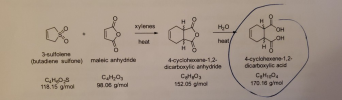 Why would you NOT run a TLC plate to determine purity
for the following reaction?
Please disregard the blue circle
H H xylenes H₂O OH ОН heat heat H H 3-sulfolene (butadiene sulfone) maleic anhydride 4-cyclohexene-1,2- dicarboxylic anhydride CgH803 152.05 g/mol 4-cyclohexene-1,2- dicarboxylic acid CgH1004 170.16 g/mol CAHOS 118.15 g/mol C4H2O3 98.06 g/mol
Why would you NOT run a TLC plate to determine purity
for the following reaction?
Please disregard the blue circle
H H xylenes H₂O OH ОН heat heat H H 3-sulfolene (butadiene sulfone) maleic anhydride 4-cyclohexene-1,2- dicarboxylic anhydride CgH803 152.05 g/mol 4-cyclohexene-1,2- dicarboxylic acid CgH1004 170.16 g/mol CAHOS 118.15 g/mol C4H2O3 98.06 g/mol
How would I calculate the theoretical yield of endo-cis-norbornene-5,6-endo-dicarboxylic anhydride and endo-cis-norbornene-5,6-dicarboxylic acid? Can you please...
 How would I calculate the theoretical yield of
endo-cis-norbornene-5,6-endo-dicarboxylic anhydride and
endo-cis-norbornene-5,6-dicarboxylic acid? Can you please show me
step by step? Can you show me the balanced chemical equation (with
molecular formulas, not the pictures) with the mole ratios as well?
How do we figure out the limiting reagent? Can you also show how to
convert mL to grams for cyclopentadiene, if needed?
We used:
2g of maleic acid
6mL of ethyl acetate
6mL of ligroin (hexanes)
2mL of cyclopentadiene...
How would I calculate the theoretical yield of
endo-cis-norbornene-5,6-endo-dicarboxylic anhydride and
endo-cis-norbornene-5,6-dicarboxylic acid? Can you please show me
step by step? Can you show me the balanced chemical equation (with
molecular formulas, not the pictures) with the mole ratios as well?
How do we figure out the limiting reagent? Can you also show how to
convert mL to grams for cyclopentadiene, if needed?
We used:
2g of maleic acid
6mL of ethyl acetate
6mL of ligroin (hexanes)
2mL of cyclopentadiene...
Calculating the theoretical yield for a Diels-Alder reaction: Reactants: 0.555 g of butadiene sulfone (MW =...
Calculating the theoretical yield for a Diels-Alder reaction: Reactants: 0.555 g of butadiene sulfone (MW = 118.15 g/mol) 0.305 g of maleic anhydride (MW = 98.06 g/mol) 1 mL of Xylene (MW = 106.16 g/mol) (density = 0.866 g/mL) 2 mL of Hexane (68 g/mol) Product: cis-4-cyclohexene-1,2-dicarboxylic acid anhydride (MW = 152.15 g/mol)
POSTLAB QUESTIONS: 1) Explain why a 4M solution of maleic anhydride is made in CH2Cl2 and...
 POSTLAB QUESTIONS: 1) Explain why a 4M solution of maleic anhydride is made in CH2Cl2 and not in water. Show the reaction between maleic anhydride and water. 2) Give structures for the major Diels-Alder product of the following reactions: a) 1,3-cyclohexadiene and tetrachloroethene b) 1,3-cylcohexadiene and fumaric acid, the trans isomer of maleic acid 3) Identify the starting materials that can be used to produce the compounds shown using a Diels-Alder reaction.. COOH CO2CH3 CO2CH3
 Label the peaks. The lab had
to synthesize a bicyclic ring system,
4-cyclohexene-cis-1,2-dicarboxylic anhydride by reacting butadiene
(prepared in situ from sulfolene) with maleic anhydride.
Label the peaks. The lab had
to synthesize a bicyclic ring system,
4-cyclohexene-cis-1,2-dicarboxylic anhydride by reacting butadiene
(prepared in situ from sulfolene) with maleic anhydride.
 The Diels-Alder reaction you will conduct in this experiment is between cyclopentadiene and maleic anhydride (the anhydride of cis-2-butendioic acid): diene dienophile The glassware is predried and a drying tube is used to prevent the hydrolysis of maleic anhydride to maleic acid (cis-2-butendioic acid): On heating, maleic acid isomerizes to fumaric acid (trans-2-butendioic acid). Show the mixture of products that would be formed if a small amount of moisture was present in the Diels-Alder reaction you have performed.
 - vivUINUAR 3) Why is cyclopentadiene more reactive ntadiene more reactive with maleic anhydride than with itself? chiral centers does endo-norbornene-cis-5,6-dicarboxylic acid possess? Is the 4) How many chiral centers does endo molecule itself chiral? (continued) 5) Endo-norbornene-cis-5,6-dicarboxylic acid can be converted back into its anhydride precursor by treatment with anhydrous acid. Propose a mechanism for this reaction.
 Assume you obtained 13C NMR spectra for the maleic anhydride and
the final product. By comparing the two spectrums, provide evidence
for the presence of Diels Alder cycloadduct.
1. Briefly describe the evidence you have to support that your final product is pure? 2. Assume you obtained C NMR spectra for the maleic anhydride and the final product. By comparing the two spectrums, provide evidence for the presence of Diels Alder cycloadduct. 3. What starting materials would be necessary to...
Assume you obtained 13C NMR spectra for the maleic anhydride and
the final product. By comparing the two spectrums, provide evidence
for the presence of Diels Alder cycloadduct.
1. Briefly describe the evidence you have to support that your final product is pure? 2. Assume you obtained C NMR spectra for the maleic anhydride and the final product. By comparing the two spectrums, provide evidence for the presence of Diels Alder cycloadduct. 3. What starting materials would be necessary to...
 Reaction 0 Maleic anhydride mp 53°C, MW 98.06 cis-Norbornene-5,6-endo-dicarboxylic anhydride mp 165°C, MW 164.16 Problem: 1) You are given 1 mL of freshly distilled cyclopentadiene in a clean vial and I g of maleic anhydride in weigh boat. The mass of the final product is 1.1g. A) Calculate percent yield. B) Interpret IR spectrum of product (shown below) and provide a table listing functional groups and peak intensity, 5. Which of the following dienes are s-trans and which are s-cis?...
 Why would you NOT run a TLC plate to determine purity
for the following reaction?
Please disregard the blue circle
H H xylenes H₂O OH ОН heat heat H H 3-sulfolene (butadiene sulfone) maleic anhydride 4-cyclohexene-1,2- dicarboxylic anhydride CgH803 152.05 g/mol 4-cyclohexene-1,2- dicarboxylic acid CgH1004 170.16 g/mol CAHOS 118.15 g/mol C4H2O3 98.06 g/mol
Why would you NOT run a TLC plate to determine purity
for the following reaction?
Please disregard the blue circle
H H xylenes H₂O OH ОН heat heat H H 3-sulfolene (butadiene sulfone) maleic anhydride 4-cyclohexene-1,2- dicarboxylic anhydride CgH803 152.05 g/mol 4-cyclohexene-1,2- dicarboxylic acid CgH1004 170.16 g/mol CAHOS 118.15 g/mol C4H2O3 98.06 g/mol
 How would I calculate the theoretical yield of
endo-cis-norbornene-5,6-endo-dicarboxylic anhydride and
endo-cis-norbornene-5,6-dicarboxylic acid? Can you please show me
step by step? Can you show me the balanced chemical equation (with
molecular formulas, not the pictures) with the mole ratios as well?
How do we figure out the limiting reagent? Can you also show how to
convert mL to grams for cyclopentadiene, if needed?
We used:
2g of maleic acid
6mL of ethyl acetate
6mL of ligroin (hexanes)
2mL of cyclopentadiene...
How would I calculate the theoretical yield of
endo-cis-norbornene-5,6-endo-dicarboxylic anhydride and
endo-cis-norbornene-5,6-dicarboxylic acid? Can you please show me
step by step? Can you show me the balanced chemical equation (with
molecular formulas, not the pictures) with the mole ratios as well?
How do we figure out the limiting reagent? Can you also show how to
convert mL to grams for cyclopentadiene, if needed?
We used:
2g of maleic acid
6mL of ethyl acetate
6mL of ligroin (hexanes)
2mL of cyclopentadiene...
 POSTLAB QUESTIONS: 1) Explain why a 4M solution of maleic anhydride is made in CH2Cl2 and not in water. Show the reaction between maleic anhydride and water. 2) Give structures for the major Diels-Alder product of the following reactions: a) 1,3-cyclohexadiene and tetrachloroethene b) 1,3-cylcohexadiene and fumaric acid, the trans isomer of maleic acid 3) Identify the starting materials that can be used to produce the compounds shown using a Diels-Alder reaction.. COOH CO2CH3 CO2CH3
Most questions answered within 3 hours.
-
Where is the error in this code sequence?
String s1 = "Hello";
String s2 = "ello";...
asked 10 months ago -
Financial data for Joel de Paris, Inc., for last year
follow:
Joel de Paris, Inc.
Balance...
asked 10 months ago -
Consider this reaction:
Al2(SO4)3 (aq)+ BaCl3
(aq) Al2Cl6 (aq)- +
3BaSO4(s) . What is the...
asked 10 months ago -
Suppose that Savneet is considering increasing her
recent random sample from 20 car rentals to 40...
asked 10 months ago -
Trucks arrive at an unloading terminal at an average rate of 120
per hour.
Trucks arrive...
asked 10 months ago -
Why are methanol and ethanol completely soluble in water while
octanol is not very little soluble....
asked 10 months ago -
A facilities manager at a university reads in a research report
that the mean amount of...
asked 10 months ago -
When the CuSO4 is rehydrated by adding water to the anhydrous
compound, is this an endothermic...
asked 10 months ago -
A ray of sunlight is passing from diamond into crown glass; the
angle of incidence is...
asked 10 months ago -
A block of mass 0.249 kg is placed on top of a light, vertical
spring of...
asked 10 months ago -
how do the kidneys compensate in the presences of acidosis
a) trigger hyperventilate
b) reserve acid...
asked 10 months ago -
Question 501 pts
The rental rate of capital to the firm increases. Which of the
following...
asked 10 months ago