Two systems are connected by two routers. Both systems and the routers have transmission rates of...
Two systems are connected by two routers. Both systems and the routers have transmission rates of 1000 bps. Each link has a propagation delay of 10 ms. It takes each router 2ms in order to process the packet (i.e decide where to forward it). Suppose the first system wants to send a 10,000 bit packet to the second system.
How long will it take before the receiver system receives the entire packet?
Homework Answers
Answer:
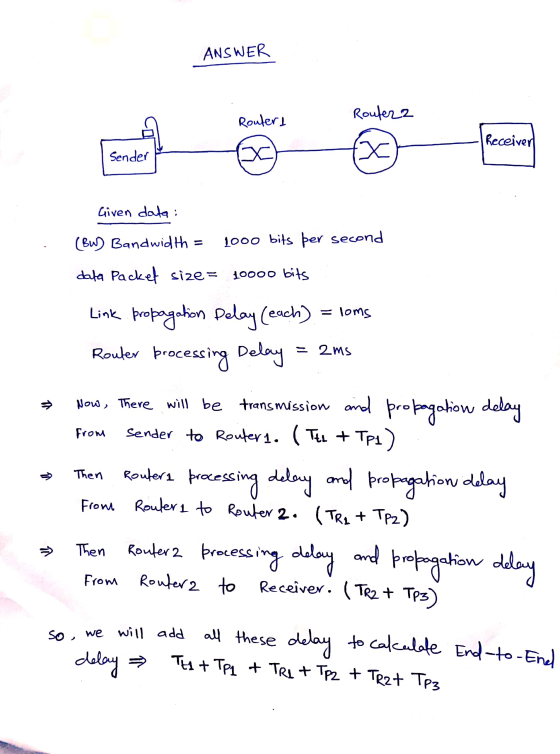
Here there is one sender and one receiver. And in between two router is there.
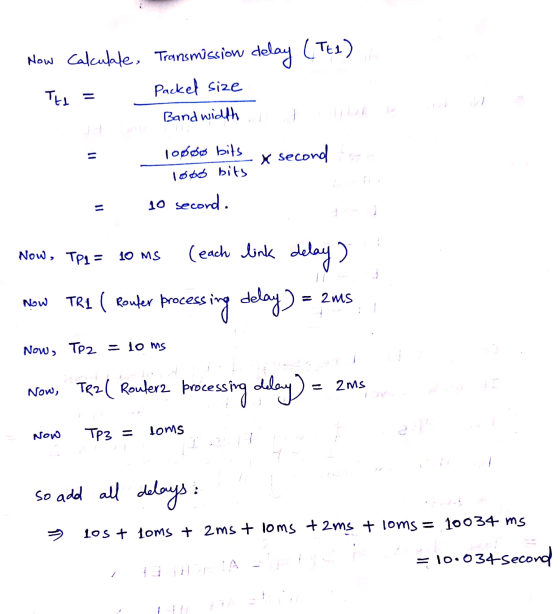
so there will be first transmission delay(time taken by sender to put data packets on the link) and then propagation delay from sender to router1. After that router1 will process the packets(processing delay).And then propagation delay from router1 to router2. After that router2 will process the packets(processing delay).And then propagation delay from router2 to receiver. So we will add all these delays to get the end-to-end delay.
some notation:
Tt = Transmission delay
Tp = Propagation delay
Tr = Router processing delay
rest thing is in figure:
Add Answer to:
Two systems are
connected by two routers. Both systems and the
routers have transmission rates of...
Consider a two-link network where Host A is connected to the router by a 1 Mbps...
Consider a two-link network where Host A is connected to the router by a 1 Mbps link with 10 ms propagation delay and the router is connected to Host B by a 15 Mbps link with a 25 ms propagation delay. Host A sends a 1500-byte packet to Host B. What is the transmission delay (in ms) of the packet from Host A to the router?
Suppose that Router A and Router B are connected via a 10 Kbps link, and that...
 Suppose that Router A and Router B are connected via a 10 Kbps link, and that the two routers are 20 meters apart. Suppose that Router A is transmitting a packet, and that there are 7 additional packets in the queue of the router, when a new packet arrives at Router A. Suppose that 500 bits of the currently-being-transmitted packet has been transmitted by Router A. Also, assume the following a. Every packet consists of 1000 bits. b. Propagation speed...
3. Suppose there is exactly one packet switch (or router) between a sending host and a...
3. Suppose there is exactly one packet switch (or router) between a sending host and a receiving host. The transmission rates between the sending host and the switch and between the switch and the receiving host are R1 = 1Mbps and R2 = 2Mbps, respectively. Assuming that the switch uses store-and-forward packet switching, what is the total end-to-end delay to send a packet of length 18000bits? Assume that the propagation speed is 2 * 108 meters/sec, the distance between source...
Consider a scenario where the transmitting host and the receiving host are separated by two routers....
Consider a scenario where the transmitting host and the receiving host are separated by two routers. Suppose the packet length is L= 2000 bits, and that the link transmission rate R for both the leg is 10Mbps across all legs 1. What is the transmission delay (the time needed to transmit all the packets)? 2. Suppose the packet is split into two 1000 bits packet. How long will (transmission delay) it take for both the packets to reach the receiver?
1. What is end-system? List example of end-systems 2. Define network edge and network core 3....
 1. What is end-system? List example of end-systems 2. Define network edge and network core 3. Explain Packet-switching 4. List five tasks that a computer network layer can perform Is it possible that one (or more) of these tasks could be performed by two (or more) layers? 5. This elementary problem begins to explore propagation delay and transmission delay, two central concepts in data networking. Consider two hosts, A and B, connected by a single link of rate R bps....
P6. This elementary problem begins to explore propagation delay and transmis- sion delay, two central concepts...
 P6. This elementary problem begins to explore propagation delay and transmis- sion delay, two central concepts in data networking. Consider two hosts, A and B, connected by a single link of rate R bps. Suppose that the two hosts are separated by m meters, and suppose the propagation speed along the link is s meters/sec. Host A is to send a packet of size L bits to Host B a. Express the propagation delay, dprops in terms of m and...
QUESTION 1 "A single router is transmitting packets, each of length L bits, over a single...
QUESTION 1 "A single router is transmitting packets, each of length L bits, over a single link with transmission rate R Mbps to another router at the other end of the link. Suppose that the packet length is L= 12000 bits, and that the link transmission rate along the link to router on the right is R = 1000 Mbps. What is the maximum number of packets per second that can be transmitted by the link (use a whole number)?"...
Final Cxa am CSIT 340 Computer Networks, fall 2018 received at the receiver b) Assume that we send a packet transmission delay? What's the total deluy et with 100 Mega bytes from one nade to...
 Final Cxa am CSIT 340 Computer Networks, fall 2018 received at the receiver b) Assume that we send a packet transmission delay? What's the total deluy et with 100 Mega bytes from one nade to the other. What's the isnoring queueing delay and nodal processing delay)? rors B. Wwhat's the meaning for (c) Calculate the Propagation value? e the Propugation Delay and Bandwidth product, Le, da te ale be forwarded to the link interfaces using the prefix entries tching" to...
Tig. 1 2. Consider the scenario shown below where (from the bottom up), you notice three...
 Tig. 1 2. Consider the scenario shown below where (from the bottom up), you notice three hosts and a local logging server (that stores information that is sent to it) are connected to a router and to each other by a 100 Mbps link, with a near-zero ms propagation delay. That router in turn is connected to another router over a 30 Mbps link with a 50 ms propagation delay, and that latter router is connected to two remote logging...
1. Consider a packet of length L which begins at end system A and travels over...
1. Consider a packet of length L which begins at end system A and travels over three links to a destination end system. These three links are connected by two packet switches. Let di, si, and Ri denote the length, propagation speed, and the transmission rate of link i, for i=1,2,3. The packet switch delays each packet by dproc. Assuming no queuing delays, in terms of di, si, and Ri, (i=1,2,3), and L, what is the total end-to-end delay for...
 Suppose that Router A and Router B are connected via a 10 Kbps link, and that the two routers are 20 meters apart. Suppose that Router A is transmitting a packet, and that there are 7 additional packets in the queue of the router, when a new packet arrives at Router A. Suppose that 500 bits of the currently-being-transmitted packet has been transmitted by Router A. Also, assume the following a. Every packet consists of 1000 bits. b. Propagation speed...
 1. What is end-system? List example of end-systems 2. Define network edge and network core 3. Explain Packet-switching 4. List five tasks that a computer network layer can perform Is it possible that one (or more) of these tasks could be performed by two (or more) layers? 5. This elementary problem begins to explore propagation delay and transmission delay, two central concepts in data networking. Consider two hosts, A and B, connected by a single link of rate R bps....
 P6. This elementary problem begins to explore propagation delay and transmis- sion delay, two central concepts in data networking. Consider two hosts, A and B, connected by a single link of rate R bps. Suppose that the two hosts are separated by m meters, and suppose the propagation speed along the link is s meters/sec. Host A is to send a packet of size L bits to Host B a. Express the propagation delay, dprops in terms of m and...
 Final Cxa am CSIT 340 Computer Networks, fall 2018 received at the receiver b) Assume that we send a packet transmission delay? What's the total deluy et with 100 Mega bytes from one nade to the other. What's the isnoring queueing delay and nodal processing delay)? rors B. Wwhat's the meaning for (c) Calculate the Propagation value? e the Propugation Delay and Bandwidth product, Le, da te ale be forwarded to the link interfaces using the prefix entries tching" to...
 Tig. 1 2. Consider the scenario shown below where (from the bottom up), you notice three hosts and a local logging server (that stores information that is sent to it) are connected to a router and to each other by a 100 Mbps link, with a near-zero ms propagation delay. That router in turn is connected to another router over a 30 Mbps link with a 50 ms propagation delay, and that latter router is connected to two remote logging...
Most questions answered within 3 hours.
-
Where is the error in this code sequence?
String s1 = "Hello";
String s2 = "ello";...
asked 10 months ago -
Financial data for Joel de Paris, Inc., for last year
follow:
Joel de Paris, Inc.
Balance...
asked 10 months ago -
Consider this reaction:
Al2(SO4)3 (aq)+ BaCl3
(aq) Al2Cl6 (aq)- +
3BaSO4(s) . What is the...
asked 10 months ago -
Suppose that Savneet is considering increasing her
recent random sample from 20 car rentals to 40...
asked 10 months ago -
Trucks arrive at an unloading terminal at an average rate of 120
per hour.
Trucks arrive...
asked 10 months ago -
Why are methanol and ethanol completely soluble in water while
octanol is not very little soluble....
asked 10 months ago -
A facilities manager at a university reads in a research report
that the mean amount of...
asked 10 months ago -
When the CuSO4 is rehydrated by adding water to the anhydrous
compound, is this an endothermic...
asked 10 months ago -
A ray of sunlight is passing from diamond into crown glass; the
angle of incidence is...
asked 10 months ago -
A block of mass 0.249 kg is placed on top of a light, vertical
spring of...
asked 10 months ago -
how do the kidneys compensate in the presences of acidosis
a) trigger hyperventilate
b) reserve acid...
asked 10 months ago -
Question 501 pts
The rental rate of capital to the firm increases. Which of the
following...
asked 10 months ago