In a petri dish, there are 50+ colonies and each colony is small in size. In...
In a petri dish, there are 50+ colonies and each colony is small in size. In another petri dish, there are only 10 colonies but they are bigger in size. Why does this occur?
Homework Answers
The observed change can either be due to the nature of the microorganism plated on the two plates, or due to the plates themselves which may be different in their composition.
For example if equal the same microbial culture was used to inoculate both plates, then we can assume that the antibiotic/antimicrobial concentration is higher in the second plate compared to the first plate. If we were dealing with bacteria for example, the first plate may contain antibiotics below the resistance threshold of the bacteria, but still close to the minimal inhibitory concentration (MIC), and hence multiple bacteria may be able to replicate and form colonies albeit slowly, forming many small colonies (these are called colony forming units or CFUs). The second plate may contain a higher concentration of antibiotics, and hence only those bacteria in the inoculum that possess a higher resistance threshold can survive. On this plate, most of the bacteria won't be able to replicate, but the ones that are tolerant to the high antibiotic stress can grow and flourish, since they don't have to compete with many others for resources. A similar phenotype can be observed if the two plates differ in the concentration of some essential amino acids which the bacteria cannot synthesise by themselves. In this case, the second plate may be deficient in that amino acid,making growth and replication impossible for individuals who cannot synthesise that amino acid de novo. Here too individuals that harbour mutations that help them to synthesise that amino acid can survive and replicate on the plate, forming large colonies. This is because the number of mutants with a particular mutation in any given population is very small. Such results can be obtained from replica plating experiments where the same colonies of bacteria that are obtained after mutagenesis are plated on selection plates deficient in one or more essential nutrients, to screen for specific mutants.
The alternate explanation is that the plates are identical, but the microorganisms plated on the two plates are different. Here too one can expect the individual characteristics of the microorganism to influence its growth and survival on the plate which may be why one plate has a larger number small colonies (for example bacteria) while the other has smaller number of large colonies (for example fungus).
I hope this helps :)
Add Answer to:
In a petri dish, there are 50+ colonies and each colony is small
in size. In...
When a petri dish was inoculated from liquid culture, the colony on the petri dish arose...
 When a petri dish was inoculated from liquid culture, the colony on the petri dish arose from ------ O A cells that were alive in liquid culture cells that were dead in liquid culture OB o c cells that were lysed in liquid culture cells that cannot divide in liquid culture OD
A colony of bacteria is growing in a petri dish which has a maximum capacity of...
 A colony of bacteria is growing in a petri dish which has a maximum capacity of 60mg. The mass of bacteria is increasing at a rate given by the logistic equation. Initially there is 2mg of bacteria and the rate of increase is img per day. Write down the logistic equation satisfied by the mass, m. m' = When will the mass of bacteria be 30mg? number of days What is the mass (in GRAMS) of bacteria 10 days after...
does E. coli spread out (swarm) from the circular inoculation on a Petri dish. Why or...
does E. coli spread out (swarm) from the circular inoculation on a Petri dish. Why or Why not? when you inoculate a petri dish with e coli by only forming a circular inoculation, how is the bacteria moving? it is forming biofilm
The shape of a colony of bacteria on a Petri dish is circular. Find the approximate...
 The shape of a colony of bacteria on a Petri dish is circular. Find the approximate increase in its area if its radius increases from 10 mm to 16 mm. The estimated change in area is mm2 (Type an exact answer in terms of t.) Sociologists have found that crime rates are influenced by temperature. In a town of 100,000 people, the crime rate has been approximated as C = (T-60)2 + 100, where C is the number of crimes...
what is the prediction for each of these petri dishes Petri Dish #1: Control Agar with...
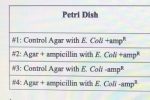 what is the prediction for each of these petri dishes
Petri Dish #1: Control Agar with E. Coli +ampR #2: Agar + ampicillin with E. Coli +ampR #3: Control Agar with E. Coli -ampR #4: Agar + ampicillin with E. Coli -ampR
what is the prediction for each of these petri dishes
Petri Dish #1: Control Agar with E. Coli +ampR #2: Agar + ampicillin with E. Coli +ampR #3: Control Agar with E. Coli -ampR #4: Agar + ampicillin with E. Coli -ampR
Question 17. Saccharomyces cerevisiae (also called budding yeast or baker's yeast) normally makes LARGE colonies on...
 Question 17. Saccharomyces cerevisiae (also called budding yeast or baker's yeast) normally makes LARGE colonies on the Petri dish. The fungus can exist as either a haploid or as a diploid. As a geneticist, you decide to isolate haploid mutants with altered size of colonies. You collect 6 such haploid mutants, which you arbitrarily name M1, M2, M3, M4, M5, and M6. To determine how many genes are represented by your mutants, you do a series of crosses resulting in...
Directions: There are two parts for this lab. The first part is working with the Microscope...
 Directions: There are two parts for this lab. The first part is
working with the Microscope slides. The second part is working with
media.
Task 1 – Bacteriology Survey Microscope Slides
Directions: There are eight different bacterium you need to
research.
Below is the following bacterium you need to describe and include
an image for.
• Streptococcus
• Treponema
• Neisseria gonorrhoeae
• Klebisella pneumonia
• Unstained Bacillus
• Bacillus cereus
• Clostridium tetani
• Escherichia coli
Task 2 –...
Directions: There are two parts for this lab. The first part is
working with the Microscope slides. The second part is working with
media.
Task 1 – Bacteriology Survey Microscope Slides
Directions: There are eight different bacterium you need to
research.
Below is the following bacterium you need to describe and include
an image for.
• Streptococcus
• Treponema
• Neisseria gonorrhoeae
• Klebisella pneumonia
• Unstained Bacillus
• Bacillus cereus
• Clostridium tetani
• Escherichia coli
Task 2 –...
e) Can you identify any wildtype (nonmutant) colonies in the figures? Explain your answer. f) Can...
 e) Can you identify any wildtype (nonmutant) colonies in the figures? Explain your answer. f) Can you identify any standard (non-conditional) mutants in the figures? Explain your answer. g) Can you identify any conditional mutants in the figures? Explain your answer. 23°C mutant colony in which cells proliferate at the cooler, permissive temperature but fail to proliferate at the warmer, nonpermissive temperature 23°C colonies replicated onto two identical plates and incubated at two different temperatures mutagenized cells plated out in...
To begin a bacteria study, a petri dish had 1500 bacteria cells. Each hour since, the...
To begin a bacteria study, a petri dish had 1500 bacteria cells. Each hour since, the number of cells has increased by 6.3%. Let t be the number of hours since the start of the study. Let y be the number of bacteria cells. Write an exponential function showing the relationship between y and t.
Question 17. Saccharomyces cerevisiae (also called budding yeast or baker's yeast) normally makes LARGE colonies on...
 Question 17. Saccharomyces cerevisiae (also called budding yeast or baker's yeast) normally makes LARGE colonies on the Petri dish. The fungus can exist as either a haploid or as a diploid. As a geneticist, you decide to isolate haploid mutants with altered size of colonies. You collect 6 such haploid mutants, which you arbitrarily name M1, M2, M3, M4, M5, and M6. To determine how many genes are represented by your mutants, you do a series of crosses resulting in...
 When a petri dish was inoculated from liquid culture, the colony on the petri dish arose from ------ O A cells that were alive in liquid culture cells that were dead in liquid culture OB o c cells that were lysed in liquid culture cells that cannot divide in liquid culture OD
 A colony of bacteria is growing in a petri dish which has a maximum capacity of 60mg. The mass of bacteria is increasing at a rate given by the logistic equation. Initially there is 2mg of bacteria and the rate of increase is img per day. Write down the logistic equation satisfied by the mass, m. m' = When will the mass of bacteria be 30mg? number of days What is the mass (in GRAMS) of bacteria 10 days after...
 The shape of a colony of bacteria on a Petri dish is circular. Find the approximate increase in its area if its radius increases from 10 mm to 16 mm. The estimated change in area is mm2 (Type an exact answer in terms of t.) Sociologists have found that crime rates are influenced by temperature. In a town of 100,000 people, the crime rate has been approximated as C = (T-60)2 + 100, where C is the number of crimes...
 what is the prediction for each of these petri dishes
Petri Dish #1: Control Agar with E. Coli +ampR #2: Agar + ampicillin with E. Coli +ampR #3: Control Agar with E. Coli -ampR #4: Agar + ampicillin with E. Coli -ampR
what is the prediction for each of these petri dishes
Petri Dish #1: Control Agar with E. Coli +ampR #2: Agar + ampicillin with E. Coli +ampR #3: Control Agar with E. Coli -ampR #4: Agar + ampicillin with E. Coli -ampR
 Question 17. Saccharomyces cerevisiae (also called budding yeast or baker's yeast) normally makes LARGE colonies on the Petri dish. The fungus can exist as either a haploid or as a diploid. As a geneticist, you decide to isolate haploid mutants with altered size of colonies. You collect 6 such haploid mutants, which you arbitrarily name M1, M2, M3, M4, M5, and M6. To determine how many genes are represented by your mutants, you do a series of crosses resulting in...
 Directions: There are two parts for this lab. The first part is
working with the Microscope slides. The second part is working with
media.
Task 1 – Bacteriology Survey Microscope Slides
Directions: There are eight different bacterium you need to
research.
Below is the following bacterium you need to describe and include
an image for.
• Streptococcus
• Treponema
• Neisseria gonorrhoeae
• Klebisella pneumonia
• Unstained Bacillus
• Bacillus cereus
• Clostridium tetani
• Escherichia coli
Task 2 –...
Directions: There are two parts for this lab. The first part is
working with the Microscope slides. The second part is working with
media.
Task 1 – Bacteriology Survey Microscope Slides
Directions: There are eight different bacterium you need to
research.
Below is the following bacterium you need to describe and include
an image for.
• Streptococcus
• Treponema
• Neisseria gonorrhoeae
• Klebisella pneumonia
• Unstained Bacillus
• Bacillus cereus
• Clostridium tetani
• Escherichia coli
Task 2 –...
 e) Can you identify any wildtype (nonmutant) colonies in the figures? Explain your answer. f) Can you identify any standard (non-conditional) mutants in the figures? Explain your answer. g) Can you identify any conditional mutants in the figures? Explain your answer. 23°C mutant colony in which cells proliferate at the cooler, permissive temperature but fail to proliferate at the warmer, nonpermissive temperature 23°C colonies replicated onto two identical plates and incubated at two different temperatures mutagenized cells plated out in...
 Question 17. Saccharomyces cerevisiae (also called budding yeast or baker's yeast) normally makes LARGE colonies on the Petri dish. The fungus can exist as either a haploid or as a diploid. As a geneticist, you decide to isolate haploid mutants with altered size of colonies. You collect 6 such haploid mutants, which you arbitrarily name M1, M2, M3, M4, M5, and M6. To determine how many genes are represented by your mutants, you do a series of crosses resulting in...
Most questions answered within 3 hours.
-
Where is the error in this code sequence?
String s1 = "Hello";
String s2 = "ello";...
asked 10 months ago -
Financial data for Joel de Paris, Inc., for last year
follow:
Joel de Paris, Inc.
Balance...
asked 10 months ago -
Consider this reaction:
Al2(SO4)3 (aq)+ BaCl3
(aq) Al2Cl6 (aq)- +
3BaSO4(s) . What is the...
asked 10 months ago -
Suppose that Savneet is considering increasing her
recent random sample from 20 car rentals to 40...
asked 10 months ago -
Trucks arrive at an unloading terminal at an average rate of 120
per hour.
Trucks arrive...
asked 10 months ago -
Why are methanol and ethanol completely soluble in water while
octanol is not very little soluble....
asked 10 months ago -
A facilities manager at a university reads in a research report
that the mean amount of...
asked 10 months ago -
When the CuSO4 is rehydrated by adding water to the anhydrous
compound, is this an endothermic...
asked 10 months ago -
A ray of sunlight is passing from diamond into crown glass; the
angle of incidence is...
asked 10 months ago -
A block of mass 0.249 kg is placed on top of a light, vertical
spring of...
asked 10 months ago -
how do the kidneys compensate in the presences of acidosis
a) trigger hyperventilate
b) reserve acid...
asked 10 months ago -
Question 501 pts
The rental rate of capital to the firm increases. Which of the
following...
asked 10 months ago