Lead (II) bromide dissociates according to the following equation PbBr2 (s) ↔ Pb2+ + 2 Br- Determine...
Lead (II) bromide dissociates according to the following equation PbBr2 (s) ↔ Pb2+ + 2 Br-
Determine the value of Q, the reaction quotient based (also known as the ion product) for a solution with the concentrations below.
(Pb2+) = 0.0048 M, (Br-) = 0.0028 M
Homework Answers
 The reaction quotient or concentration
quotient for the given equation has been found out.
The reaction quotient or concentration
quotient for the given equation has been found out.
Add Answer to:
Lead (II) bromide dissociates according to the following
equation PbBr2 (s) ↔ Pb2+ + 2
Br-
Determine...
Lead (II) bromide dissociates according to the following equation PbBr2 (s) ↔ Pb2+ + 2 Br-...
Lead (II) bromide dissociates according to the following equation PbBr2 (s) ↔ Pb2+ + 2 Br- Determine the value of Q, the reaction quotient based (also known as the ion product) for a solution with the concentrations below. (Pb2+) = 0.0018 M, (Br-) = 0.0044 M Report your answer in scientific notation with two significant figures. For example 1.2x10⁻⁵ would be entered as 1.2e-5
Lead (II) bromide dissociates according to the following equation PbBr2 (s) ↔ Pb2+ + 2 Br-...
Lead (II) bromide dissociates according to the following equation PbBr2 (s) ↔ Pb2+ + 2 Br- Determine the value of Q, the reaction quotient based (also known as the ion product) for a solution with the concentrations below. (Pb2+) = 0.0017 M, (Br-) = 0.0016 M Report your answer in scientific notation with two significant figures. For example 1.2x10⁻⁵ would be entered as 1.2e-5
Precipitation is the formation of an insoluble substance. For the equation AB(s)⇌A+(aq)+B−(aq), precipitation represents a shift...
Precipitation is the formation of an insoluble substance. For the equation AB(s)⇌A+(aq)+B−(aq), precipitation represents a shift to the left and the production of a solid. From Le Châtelier's principle, we know that when the product of the concentrations of A+ and B− gets above a certain level, the reaction will respond by shifting left to decrease the concentrations of A+ and B−. This critical level, Ksp, is a constant at a certain temperature. In this case, Q=[A+][B−], where Q is...
ents Determine the molar solubility of lead(II) bromide (PbBr2) in a solution that contains 0.125 M...
 ents Determine the molar solubility of lead(II) bromide (PbBr2) in a solution that contains 0.125 M potassium bromide (KB). Kup of PbBr2 - 4.67 x 100 3.74 x 10⁻⁵M 2.99 x 10-M 0.125 M 1.05 x 10⁻²M 3.34 x 10⁻² M
Calculate the solubility (in M) of lead(II) bromide, PbBr2(s), in a 0.250 M NaBr solution if...
Calculate the solubility (in M) of lead(II) bromide, PbBr2(s), in a 0.250 M NaBr solution if Ksp = 4.60 × 10⁻⁶.
Calculate the solubility (in M) of lead(II) bromide, PbBr2(s), in a 0.150 M NaBr solution if...
Calculate the solubility (in M) of lead(II) bromide, PbBr2(s), in a 0.150 M NaBr solution if Ksp = 4.60 × 10⁻⁶.
Lead(II) sulfate, PbSO4 (s), dissociates into the ions, Pb+2(aq) and SO4 -2 (aq) as shown: PbSO4...
Lead(II) sulfate, PbSO4 (s), dissociates into the ions, Pb+2(aq) and SO4 -2 (aq) as shown: PbSO4 (s) ↔ Pb+2 (aq) + SO4 −2 (aq) Given that Ksp is 2.53 × 10⁻⁸ for PbSO4 (s), what is the ion concentration of lead ions and sulfate ions in a saturated lead sulfate solution?
1) For the reaction: PbCl2(s) ↔ Pb2+(aq)+2Cl1-(aq), what is Q* when 2.5 mL of 0.070 M...
1) For the reaction: PbCl2(s) ↔ Pb2+(aq)+2Cl1-(aq), what is Q* when 2.5 mL of 0.070 M lead nitrate is added to 19 mL of 0.018 M sodium chloride? Ksp of lead chloride is 1.6 x 10⁻⁵ M3. Hint given in general feedback *Recall: Q is compared to Ksp to determine whether a precipitate forms. 2) Sodium phosphate is added to a solution that contains 0.0041 M aluminum nitrate and 0.028 M calcium chloride. The concentration of the first ion to...
Lead bromide is found in the environment as a thermal decomposition product of tetraethyl lead and...
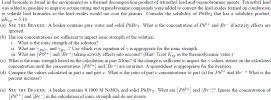 Lead bromide is found in the environment as a thermal decomposition product of tetraethyl lead and organobromine agents. Tetraethyl lead was added to gasoline to improve octane rating and organobromine compounds were added to convert the lead oxides formed on combustion to volatile lead bromides so the lead oxides would not coat the pistons. Consider the solubility of PbBr_2 that has a solubility product. pK_sp = 5.18. (a) SEE THE BEAKER: A beaker contains pure water and solid PbBr_2= What...
Consider the equilibrium shown. PbBr (s)Pb2 (aq) +2 Br (aq) Kp 2.10 x 10⁻⁶ Determine the...
 Consider the equilibrium shown. PbBr (s)Pb2 (aq) +2 Br (aq) Kp 2.10 x 10⁻⁶ Determine the concentrations of Pb + and Br in a saturated solution of PbBr, in pure water (assume u = 0 M). Pb2 +10.0375 М [Br]= 0.0749 м Determine the concentrations of Pb+ and Br in a saturated solution of PbBr, in a solution with an ionic strength of 0.010 M. Pb2+1 0.010 М Br]= 0.02 м Determine the concentrations of Pb+ and Br in a...
 ents Determine the molar solubility of lead(II) bromide (PbBr2) in a solution that contains 0.125 M potassium bromide (KB). Kup of PbBr2 - 4.67 x 100 3.74 x 10⁻⁵M 2.99 x 10-M 0.125 M 1.05 x 10⁻²M 3.34 x 10⁻² M
 Lead bromide is found in the environment as a thermal decomposition product of tetraethyl lead and organobromine agents. Tetraethyl lead was added to gasoline to improve octane rating and organobromine compounds were added to convert the lead oxides formed on combustion to volatile lead bromides so the lead oxides would not coat the pistons. Consider the solubility of PbBr_2 that has a solubility product. pK_sp = 5.18. (a) SEE THE BEAKER: A beaker contains pure water and solid PbBr_2= What...
 Consider the equilibrium shown. PbBr (s)Pb2 (aq) +2 Br (aq) Kp 2.10 x 10⁻⁶ Determine the concentrations of Pb + and Br in a saturated solution of PbBr, in pure water (assume u = 0 M). Pb2 +10.0375 М [Br]= 0.0749 м Determine the concentrations of Pb+ and Br in a saturated solution of PbBr, in a solution with an ionic strength of 0.010 M. Pb2+1 0.010 М Br]= 0.02 м Determine the concentrations of Pb+ and Br in a...
Most questions answered within 3 hours.
-
Where is the error in this code sequence?
String s1 = "Hello";
String s2 = "ello";...
asked 10 months ago -
Financial data for Joel de Paris, Inc., for last year
follow:
Joel de Paris, Inc.
Balance...
asked 10 months ago -
Consider this reaction:
Al2(SO4)3 (aq)+ BaCl3
(aq) Al2Cl6 (aq)- +
3BaSO4(s) . What is the...
asked 10 months ago -
Suppose that Savneet is considering increasing her
recent random sample from 20 car rentals to 40...
asked 10 months ago -
Trucks arrive at an unloading terminal at an average rate of 120
per hour.
Trucks arrive...
asked 10 months ago -
Why are methanol and ethanol completely soluble in water while
octanol is not very little soluble....
asked 10 months ago -
A facilities manager at a university reads in a research report
that the mean amount of...
asked 10 months ago -
When the CuSO4 is rehydrated by adding water to the anhydrous
compound, is this an endothermic...
asked 10 months ago -
A ray of sunlight is passing from diamond into crown glass; the
angle of incidence is...
asked 10 months ago -
A block of mass 0.249 kg is placed on top of a light, vertical
spring of...
asked 10 months ago -
how do the kidneys compensate in the presences of acidosis
a) trigger hyperventilate
b) reserve acid...
asked 10 months ago -
Question 501 pts
The rental rate of capital to the firm increases. Which of the
following...
asked 10 months ago