Compare and contrast the role of promoters versus enhancers in controlling gene expression by answering the...
-
Compare and contrast the role of promoters versus enhancers in controlling gene expression by answering the following questions.
-
Are they cis- or trans- acting components of the regulatory machinery? Explain why this label applies to each?
-
Where are they located relative to the transcription start site (TSS) of a gene?
-
What kinds of transcription factors (TFs) does each element bind, and what are the particular TFs’ role in gene expression?
-
Homework Answers
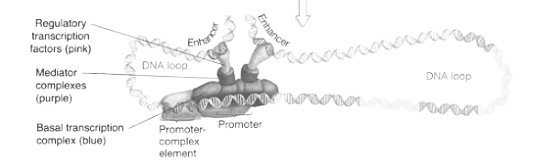
1. Promoter are the region in the DNA where the transcription start and enhancer is the region of DNA where different proteins binds to increase the transcription of gene. Promoter is situated close to the gene that is being transcribed and hence are trans-acting where's enhancer may or may not be situated close to gene being transcribed and hence cis-acting .
2. Promoter are located upstream of the gene sequencnce that is going to transcribe whereas enhancers of the gene sequence could be located either on the upstream and downstream of the gene being transcribed.
3. Transcriptions factor that bind to the promoter region are a part of transcriptions initiation complex whereas transcriptions factor bind to the enhancer region only increase the rate of transcription, that are not a part of transcriptions initiation complex .
Add Answer to:
Compare and contrast the role of promoters versus enhancers in
controlling gene expression by answering the...
Promoters are cis-acting. The promoter is considered a cis-acting site because: A it influences the expression...
Promoters are cis-acting. The promoter is considered a cis-acting site because: A it influences the expression of a family of genes within a protein domain. B it exclusively influences the expression of genes to which the promoter is proximal. C it activates the gene it is proximal to while inhibiting the expression of all others. D it regulates the transcription of both alleles of an allele pair. E promoters bind to the sigma subunit.
3. Prokaryotic and eukaryotic gene expression compared. Below is an incomplete table of prokaryotic and eukaryotic...
 3. Prokaryotic and eukaryotic gene expression compared. Below is an incomplete table of prokaryotic and eukaryotic gene expression in comparison. Fill in the blank using PPT slides, notes and the textbook. Prokaryotic gene expression Eukaryotic gene expression Overview Steps Transcription and translation Yes Transcription and translation coupled? Gene structure No introns Epigenetic modification (chromosome remodeling) transcription, translation, RNA processing, protein processing Transcription in the nucleus and translation in the cytoplasm Interrupted gene with exons and introns RNAPI, II, III Which...
1. trans-acting factors are able to regulate target genes from any chromosome, whereas cis-acting elements can...
1. trans-acting factors are able to regulate target genes from any chromosome, whereas cis-acting elements can only regulate genes located in the same chromosome. a. True only in operons. In Eukaryotic systems, trans-acting factors only regulate genes in the same chromosome. b. True only in Eukaryotes. Prokaryotes don’t have cis-acting elements. c. True for any organism. d. False. The statement is erroneous 2. Unlike activators, repressors never affect chromatin structure. Repressors inhibit transcription only by binding to the binding sites...
The following is a diagram of the LCT (lactase gene) gene regulation system in humans. When...
 The following is a diagram of the LCT (lactase gene) gene
regulation system in humans. When the LCT gene is transcriptionally
active, the cell produces the enzyme lactase, which is
needed to digest the lactose in many dairy products. Based on what
you know about enhancers and promoters from your reading, predict
how the following scenarios might influence LCT gene expression and
thus lactase production in cells:
The enhancer sequence is inverted, but remains intact so that
Oct1 still binds...
The following is a diagram of the LCT (lactase gene) gene
regulation system in humans. When the LCT gene is transcriptionally
active, the cell produces the enzyme lactase, which is
needed to digest the lactose in many dairy products. Based on what
you know about enhancers and promoters from your reading, predict
how the following scenarios might influence LCT gene expression and
thus lactase production in cells:
The enhancer sequence is inverted, but remains intact so that
Oct1 still binds...
1. According to the paper, what does lactate dehydrogenase (LDH) do and what does it allow...
 1. According to the paper, what does lactate dehydrogenase
(LDH) do and what does it allow to happen within the myofiber? (5
points)
2. According to the paper, what is the major disadvantage of
relying on glycolysis during high-intensity exercise? (5
points)
3. Using Figure 1 in the paper, briefly describe the different
sources of ATP production at 50% versus 90% AND explain whether you
believe this depiction of ATP production applies to a Type IIX
myofiber in a human....
1. According to the paper, what does lactate dehydrogenase
(LDH) do and what does it allow to happen within the myofiber? (5
points)
2. According to the paper, what is the major disadvantage of
relying on glycolysis during high-intensity exercise? (5
points)
3. Using Figure 1 in the paper, briefly describe the different
sources of ATP production at 50% versus 90% AND explain whether you
believe this depiction of ATP production applies to a Type IIX
myofiber in a human....
 3. Prokaryotic and eukaryotic gene expression compared. Below is an incomplete table of prokaryotic and eukaryotic gene expression in comparison. Fill in the blank using PPT slides, notes and the textbook. Prokaryotic gene expression Eukaryotic gene expression Overview Steps Transcription and translation Yes Transcription and translation coupled? Gene structure No introns Epigenetic modification (chromosome remodeling) transcription, translation, RNA processing, protein processing Transcription in the nucleus and translation in the cytoplasm Interrupted gene with exons and introns RNAPI, II, III Which...
 The following is a diagram of the LCT (lactase gene) gene
regulation system in humans. When the LCT gene is transcriptionally
active, the cell produces the enzyme lactase, which is
needed to digest the lactose in many dairy products. Based on what
you know about enhancers and promoters from your reading, predict
how the following scenarios might influence LCT gene expression and
thus lactase production in cells:
The enhancer sequence is inverted, but remains intact so that
Oct1 still binds...
The following is a diagram of the LCT (lactase gene) gene
regulation system in humans. When the LCT gene is transcriptionally
active, the cell produces the enzyme lactase, which is
needed to digest the lactose in many dairy products. Based on what
you know about enhancers and promoters from your reading, predict
how the following scenarios might influence LCT gene expression and
thus lactase production in cells:
The enhancer sequence is inverted, but remains intact so that
Oct1 still binds...
 1. According to the paper, what does lactate dehydrogenase
(LDH) do and what does it allow to happen within the myofiber? (5
points)
2. According to the paper, what is the major disadvantage of
relying on glycolysis during high-intensity exercise? (5
points)
3. Using Figure 1 in the paper, briefly describe the different
sources of ATP production at 50% versus 90% AND explain whether you
believe this depiction of ATP production applies to a Type IIX
myofiber in a human....
1. According to the paper, what does lactate dehydrogenase
(LDH) do and what does it allow to happen within the myofiber? (5
points)
2. According to the paper, what is the major disadvantage of
relying on glycolysis during high-intensity exercise? (5
points)
3. Using Figure 1 in the paper, briefly describe the different
sources of ATP production at 50% versus 90% AND explain whether you
believe this depiction of ATP production applies to a Type IIX
myofiber in a human....
Most questions answered within 3 hours.
-
Where is the error in this code sequence?
String s1 = "Hello";
String s2 = "ello";...
asked 11 months ago -
Financial data for Joel de Paris, Inc., for last year
follow:
Joel de Paris, Inc.
Balance...
asked 11 months ago -
Consider this reaction:
Al2(SO4)3 (aq)+ BaCl3
(aq) Al2Cl6 (aq)- +
3BaSO4(s) . What is the...
asked 11 months ago -
Suppose that Savneet is considering increasing her
recent random sample from 20 car rentals to 40...
asked 11 months ago -
Trucks arrive at an unloading terminal at an average rate of 120
per hour.
Trucks arrive...
asked 11 months ago -
Why are methanol and ethanol completely soluble in water while
octanol is not very little soluble....
asked 11 months ago -
A facilities manager at a university reads in a research report
that the mean amount of...
asked 11 months ago -
When the CuSO4 is rehydrated by adding water to the anhydrous
compound, is this an endothermic...
asked 11 months ago -
A ray of sunlight is passing from diamond into crown glass; the
angle of incidence is...
asked 11 months ago -
A block of mass 0.249 kg is placed on top of a light, vertical
spring of...
asked 11 months ago -
how do the kidneys compensate in the presences of acidosis
a) trigger hyperventilate
b) reserve acid...
asked 11 months ago -
Question 501 pts
The rental rate of capital to the firm increases. Which of the
following...
asked 11 months ago