A small insect is placed 5.25 cm from a +6.16 cm focal-length lens. (Use the correct...
A small insect is placed 5.25 cm from a +6.16 cm focal-length lens. (Use the correct sign conventions for the following answers.)
(a) Calculate the position of the image.
cm (from the lens)
(b) Calculate the magnification.
x
Homework Answers
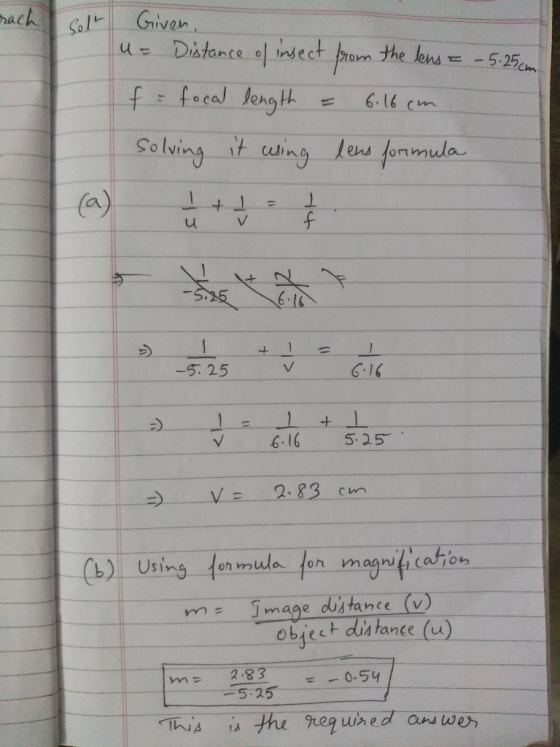
Using the lens formula and magnification formula both the part
can be solved
Add Answer to:
A small insect is placed 5.25 cm from a +6.16 cm focal-length
lens. (Use the correct...
A small insect is placed 5.45 cm from a 6.00-cm-focal-length lens. Part A Calculate the position...
A small insect is placed 5.45 cm from a 6.00-cm-focal-length lens. Part A Calculate the position of the image. Follow the sign conventions. Part B Calculate the angular magnification.
A small insect is placed 5.50 cm from a 6.00-cm-focal-length lens. a) Calculate the position of...
A small insect is placed 5.50 cm from a 6.00-cm-focal-length lens. a) Calculate the position of the image. Follow the sign conventions. Express your answer using two significant figures and include appropriate units. b) Calculate the angular magnification. Express your answer using two significant figures.
A small insect is placed 4.35 cm from a 5.00-cm-focal-length lens. A) Calculate the position of...
A small insect is placed 4.35 cm from a 5.00-cm-focal-length lens. A) Calculate the position of the image. Follow the sign conventions. Express your answer using two significant figures and include the appropriate units. B) Calculate the angular magnification. Express your answer using two significant figures.
A small insect is placed 6.50 cm from a 7.00-cm-focal-length lens. Calculate the angular magnification. Express...
 A small insect is placed 6.50 cm from a 7.00-cm-focal-length
lens. Calculate the angular magnification. Express your answer
using two significant figures.
calculate the angular magnification, the distance of the image is
-91cm
<Ch 25 HW Problem 25.26 A small insect is placed 6.50 cm from a 7.00-cm-focal-length lens.
A small insect is placed 6.50 cm from a 7.00-cm-focal-length
lens. Calculate the angular magnification. Express your answer
using two significant figures.
calculate the angular magnification, the distance of the image is
-91cm
<Ch 25 HW Problem 25.26 A small insect is placed 6.50 cm from a 7.00-cm-focal-length lens.
A small insect is placed 7.65 cm from a 8.00 cm -focal-length lens. Calculate the angular...
A small insect is placed 7.65 cm from a 8.00 cm -focal-length lens. Calculate the angular magnification.
An object 2.00 cm high is placed 45.3 cm to the left of a converging lens...
An object 2.00 cm high is placed 45.3 cm to the left of a converging lens having a focal length of 40.3 cm. A diverging lens having a focal length of −20.0 cm is placed 110 cm to the right of the converging lens. (Use the correct sign conventions for the following answers.) (a) Determine the final position and magnification of the final image. (Give the final position as the image distance from the second lens.) final position cm magnification...
Alighted candle is placed 36 cm in front of a converging lens of focal length 12...
 Alighted candle is placed 36 cm in front of a converging lens of focal length 12 cm, which in turn is 58 cm in front of another converging lens of focal length 17 cm (Figure 11 Part A Calculate the image distance of the final image relative the second lens. Follow the sign conventions. Express your answer to two significant figures and include the appropriate units. ? de = 32 m Submit Previous Answers Best Answer X Incorrect; Try Again;...
A 2.70-cm-high insect is 1.45 m from a 131-mm-focal-length lens. Where is the image? Follow the sign conventions.
 A) A 2.70-cm-high insect is 1.45 m from a 131-mm-focal-length lens. Where is the image? Follow the sign conventions.B) How high is the image? Follow the sign conventions.C) What type is the image?
An object is placed 14.2 cm from a first converging lens of focal length 10.5 cm....
An object is placed 14.2 cm from a first converging lens of focal length 10.5 cm. A second converging lens with focal length 5.00 cm is placed 10.0 cm to the right of the first converging lens. (a) Find the position q1 of the image formed by the first converging lens. (Enter your answer to at least two decimal places.) cm (b) How far from the second lens is the image of the first lens? (Enter your answer to at...
39 points I Previous Answers SerCP11 23.5.P046. An object is placed 17:4 cm from a first converging lens of focal length 11.9 cm. A second converging lens with focal length $.00 em is placed 10.0...
 39 points I Previous Answers SerCP11 23.5.P046. An object is placed 17:4 cm from a first converging lens of focal length 11.9 cm. A second converging lens with focal length $.00 em is placed 10.0 cm to the right of the first converging ens (a) Find the position q1 of the image formed by the first converging lens. (Enter your answer to at least two decimal places.) X cm (b) How far from the second lens is the im 27.64...
 A small insect is placed 6.50 cm from a 7.00-cm-focal-length
lens. Calculate the angular magnification. Express your answer
using two significant figures.
calculate the angular magnification, the distance of the image is
-91cm
<Ch 25 HW Problem 25.26 A small insect is placed 6.50 cm from a 7.00-cm-focal-length lens.
A small insect is placed 6.50 cm from a 7.00-cm-focal-length
lens. Calculate the angular magnification. Express your answer
using two significant figures.
calculate the angular magnification, the distance of the image is
-91cm
<Ch 25 HW Problem 25.26 A small insect is placed 6.50 cm from a 7.00-cm-focal-length lens.
 Alighted candle is placed 36 cm in front of a converging lens of focal length 12 cm, which in turn is 58 cm in front of another converging lens of focal length 17 cm (Figure 11 Part A Calculate the image distance of the final image relative the second lens. Follow the sign conventions. Express your answer to two significant figures and include the appropriate units. ? de = 32 m Submit Previous Answers Best Answer X Incorrect; Try Again;...
 39 points I Previous Answers SerCP11 23.5.P046. An object is placed 17:4 cm from a first converging lens of focal length 11.9 cm. A second converging lens with focal length $.00 em is placed 10.0 cm to the right of the first converging ens (a) Find the position q1 of the image formed by the first converging lens. (Enter your answer to at least two decimal places.) X cm (b) How far from the second lens is the im 27.64...
Most questions answered within 3 hours.
-
Where is the error in this code sequence?
String s1 = "Hello";
String s2 = "ello";...
asked 10 months ago -
Financial data for Joel de Paris, Inc., for last year
follow:
Joel de Paris, Inc.
Balance...
asked 10 months ago -
Consider this reaction:
Al2(SO4)3 (aq)+ BaCl3
(aq) Al2Cl6 (aq)- +
3BaSO4(s) . What is the...
asked 10 months ago -
Suppose that Savneet is considering increasing her
recent random sample from 20 car rentals to 40...
asked 10 months ago -
Trucks arrive at an unloading terminal at an average rate of 120
per hour.
Trucks arrive...
asked 10 months ago -
Why are methanol and ethanol completely soluble in water while
octanol is not very little soluble....
asked 10 months ago -
A facilities manager at a university reads in a research report
that the mean amount of...
asked 10 months ago -
When the CuSO4 is rehydrated by adding water to the anhydrous
compound, is this an endothermic...
asked 10 months ago -
A ray of sunlight is passing from diamond into crown glass; the
angle of incidence is...
asked 10 months ago -
A block of mass 0.249 kg is placed on top of a light, vertical
spring of...
asked 10 months ago -
how do the kidneys compensate in the presences of acidosis
a) trigger hyperventilate
b) reserve acid...
asked 10 months ago -
Question 501 pts
The rental rate of capital to the firm increases. Which of the
following...
asked 10 months ago