After the Sun exhausts its nuclear fuel, its ultimate fate may be to collapse to a...
After the Sun exhausts its nuclear fuel, its ultimate fate may be to collapse to a white dwarf state. In this state, it would have approximately the same mass as it has now, but its radius would be equal to the radius of the Earth. (a) Calculate the average density of the white dwarf. ____kg/m3 (b) Calculate the surface free-fall acceleration. ____m/s2 (c) Calculate the gravitational potential energy associated with a 2.83-kg object at the surface of the white dwarf.
Homework Answers


Add Answer to:
After the Sun exhausts its nuclear fuel, its ultimate fate may
be to collapse to a...
After our Sun exhausts its nuclear fuel, its ultimate fate may be to collapse to a...
 After our Sun exhausts its nuclear fuel, its ultimate fate may be to collapse to a white dwarf state, in which it has approximately the same mass as it has now but a radius equal to roughly the size of the Earth's radius. (a) Calculate the average density of this white dwarf if the Sun were to collapse to a radius of 6.18 x 10 m. O kg/m3 (b) Calculate the free-fall acceleration at its surface. Cm/s2 (c) Calculate the...
After our Sun exhausts its nuclear fuel, its ultimate fate may be to collapse to a...
 After our Sun exhausts its nuclear fuel, its ultimate fate may be to collapse to a white dwarf state, in which it has approximately the same mass as it has now but a radius equal to roughly the size of the Earth's radius. (a) Calculate the average density of this white dwarf if the Sun were to collapse to a radius of 6.25 x 10°m. kg/m (b) Calculate the free-fall acceleration at its surface. m/s2 (c) Calculate the gravitational potential...
When a star exhausts its nuclear fuel, the gravitational force causes it to col- lapse. As...
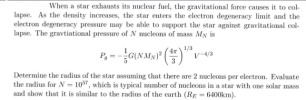 When a star exhausts its nuclear fuel, the gravitational force causes it to col- lapse. As the density increases, the star enters the electron degeneracy limit and the electron degeneracy pressure may be able to support the star against gravitational col- lapse. The gravtiational pressure of N nucleons of mass MN is 1/3 P, - G(NM)?(45 V-4/3 Determine the radius of the star assuming that there are 2 nucleons per electron. Evaluate the radius for N - 1057, which is...
The radius of the Sun is about 7 x10⁸m. If a photon could travel from the...
 The radius of the Sun is about 7 x10⁸m. If a photon could travel from the core to the surface of the Sun without being hindered by the convection zone, how long would it take? (2 pts) You detect a star and determine its mass to be four times that of the Sun's. What is your prediction for the ultimate fate of this star and why? Your options are Red Giant, White Dwarf, Neutron Star, and Black Hole. (2 pts)
4、15 pts Some five billion years from now, the Sun will have exhausted its hydrogen fuel...
 4、15 pts Some five billion years from now, the Sun will have exhausted its hydrogen fuel and blown off its outer layers. The remaining core of the sun will be a hot, dense white dwarf star. Assuming that the white dwarf has a radius roughly equivalent to Earth's and a remaining mass of 0.60 Mo, what is the acceleration due to gravity at its surface? (Mo is the present day mass of the sun). Compare this value to-g. the acceleration...
C. i. As a star runs out of hydrogen to fuel nuclear fusion in its core,...
 C. i. As a star runs out of hydrogen to fuel nuclear fusion in its core, changes within the star usually cause it to leave the main sequence, expanding and cooling as it does so. Would a star with a radius 100 times that of the Sun, but a surface temperature 0.4 times that of the Sun, be more, or less luminous than the Sun? Show and explain your reasoning. You may assume the surface area of a sphere is...
5) A star (no matter what its mass) spends most of its life Select one: a....
5) A star (no matter what its mass) spends most of its life Select one: a. as a protostar. b. as a main-sequence star. c. as a planetary nebula. d. as a red giant or supergiant. 6) What is the ultimate fate of an isolated white dwarf? Select one: a. It will cool down and become a cold black dwarf. b. As gravity overwhelms the electron degeneracy pressure, it will explode as a nova. c. As gravity overwhelms the electron...
In a newly discovered exoplanetary system one planet orbits its star in 56 days with an...
 In a newly discovered exoplanetary system one planet orbits its star in 56 days with an average orbital radius of 107,588,122 kilometers. It is observed that another planet in the same system has orbital period of 373 days. What is its average orbital radius of the second planet? Express your answer in kilometers, use scientific notation and round the coefficient to two decimals. In a newly discovered exoplanetary system one planet orbits its star in 57 days with an average...
 After our Sun exhausts its nuclear fuel, its ultimate fate may be to collapse to a white dwarf state, in which it has approximately the same mass as it has now but a radius equal to roughly the size of the Earth's radius. (a) Calculate the average density of this white dwarf if the Sun were to collapse to a radius of 6.18 x 10 m. O kg/m3 (b) Calculate the free-fall acceleration at its surface. Cm/s2 (c) Calculate the...
 After our Sun exhausts its nuclear fuel, its ultimate fate may be to collapse to a white dwarf state, in which it has approximately the same mass as it has now but a radius equal to roughly the size of the Earth's radius. (a) Calculate the average density of this white dwarf if the Sun were to collapse to a radius of 6.25 x 10°m. kg/m (b) Calculate the free-fall acceleration at its surface. m/s2 (c) Calculate the gravitational potential...
 When a star exhausts its nuclear fuel, the gravitational force causes it to col- lapse. As the density increases, the star enters the electron degeneracy limit and the electron degeneracy pressure may be able to support the star against gravitational col- lapse. The gravtiational pressure of N nucleons of mass MN is 1/3 P, - G(NM)?(45 V-4/3 Determine the radius of the star assuming that there are 2 nucleons per electron. Evaluate the radius for N - 1057, which is...
 The radius of the Sun is about 7 x10⁸m. If a photon could travel from the core to the surface of the Sun without being hindered by the convection zone, how long would it take? (2 pts) You detect a star and determine its mass to be four times that of the Sun's. What is your prediction for the ultimate fate of this star and why? Your options are Red Giant, White Dwarf, Neutron Star, and Black Hole. (2 pts)
 4、15 pts Some five billion years from now, the Sun will have exhausted its hydrogen fuel and blown off its outer layers. The remaining core of the sun will be a hot, dense white dwarf star. Assuming that the white dwarf has a radius roughly equivalent to Earth's and a remaining mass of 0.60 Mo, what is the acceleration due to gravity at its surface? (Mo is the present day mass of the sun). Compare this value to-g. the acceleration...
 C. i. As a star runs out of hydrogen to fuel nuclear fusion in its core, changes within the star usually cause it to leave the main sequence, expanding and cooling as it does so. Would a star with a radius 100 times that of the Sun, but a surface temperature 0.4 times that of the Sun, be more, or less luminous than the Sun? Show and explain your reasoning. You may assume the surface area of a sphere is...
 In a newly discovered exoplanetary system one planet orbits its star in 56 days with an average orbital radius of 107,588,122 kilometers. It is observed that another planet in the same system has orbital period of 373 days. What is its average orbital radius of the second planet? Express your answer in kilometers, use scientific notation and round the coefficient to two decimals. In a newly discovered exoplanetary system one planet orbits its star in 57 days with an average...
Most questions answered within 3 hours.
-
Where is the error in this code sequence?
String s1 = "Hello";
String s2 = "ello";...
asked 11 months ago -
Financial data for Joel de Paris, Inc., for last year
follow:
Joel de Paris, Inc.
Balance...
asked 11 months ago -
Consider this reaction:
Al2(SO4)3 (aq)+ BaCl3
(aq) Al2Cl6 (aq)- +
3BaSO4(s) . What is the...
asked 11 months ago -
Suppose that Savneet is considering increasing her
recent random sample from 20 car rentals to 40...
asked 11 months ago -
Trucks arrive at an unloading terminal at an average rate of 120
per hour.
Trucks arrive...
asked 11 months ago -
Why are methanol and ethanol completely soluble in water while
octanol is not very little soluble....
asked 11 months ago -
A facilities manager at a university reads in a research report
that the mean amount of...
asked 11 months ago -
When the CuSO4 is rehydrated by adding water to the anhydrous
compound, is this an endothermic...
asked 11 months ago -
A ray of sunlight is passing from diamond into crown glass; the
angle of incidence is...
asked 11 months ago -
A block of mass 0.249 kg is placed on top of a light, vertical
spring of...
asked 11 months ago -
how do the kidneys compensate in the presences of acidosis
a) trigger hyperventilate
b) reserve acid...
asked 11 months ago -
Question 501 pts
The rental rate of capital to the firm increases. Which of the
following...
asked 11 months ago