I have a question about my physics worksheet. 2. Two collision experiments are performed with a...
I have a question about my physics worksheet.
2. Two collision experiments are performed with a small clay ball and a wooden rod in a frictionless, weightless environment. The ball and the rod are not in contact with any other objects. Each has the same mass.
In both experiments, the ball initially has speed v0 and moves without spinning to the right toward a rod that is initially at rest. The ball sticks to the rod in each case.
In Experiment 1, the ball moves toward the center of the rod.
In Experiment 2, the ball moves toward a point near the end of the rod.
Point A is a fixed location in space. Before the collision, the center of the rod is at point A. (If the rod starts to move, its center may leave point A.)
a. During the collision, does the magnitude of the total linear momentum of the ball/rod system in experiment 1 increase, decrease, or remain the same?
b. During the collision, does the magnitude of the total linear momentum of the ball/rod system in experiment 2 increase, decrease, or remain the same?
c. Is the final speed of the center of mass of the system in experiment 1 greater than, less than, or equal to the final speed of the center of mass of the system in experiment 2?
Homework Answers
a. The magnitude of the total linear mometum of the ball/rod system in experiment1 remain same, because total linear momentum is conserved for all types collisions.
b. The magnitude of the total linear mometum of the ball/rod system in experiment2 remain same, because total linear momentum is conserved for all types collisions
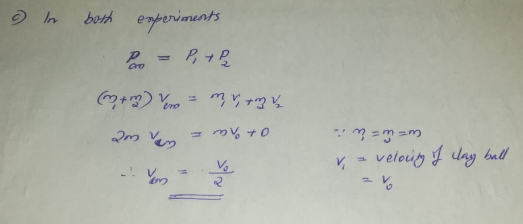
c. The final speed of the center of mass of the system in experiment 1 is equal to the final speed of the center of mass of the system in experiment 2
detailed explation in the image
Add Answer to:
I have a question about my physics worksheet.
2. Two collision experiments are performed with a...
HW-65 problem concerns three collision experiments performed on a frictionless surface with Tiers A and B,...
 HW-65 problem concerns three collision experiments performed on a frictionless surface with Tiers A and B, with masses mA and mg, respectively. In all three experiments, the instantaneous seeds of gliders A and B are initially w, and 0, respectively. If not given enough information is given to answer any of the parts, state so explicitly. a. In experiment 1, the track is level, and the gliders are repelled by magnets, so they do not come into contact. At time...
i need help with these questions about physics. Elastic Collision Question 8 A 2 kg ball...
 i need help with these questions about physics.
Elastic Collision Question 8 A 2 kg ball initially at rest rolls down a 30-degree inclined plane from a height of 4 meters (assume kinetic and rolling friction are negligible). A 2 kg box initially at rest slides down a 30-degree directionless inclined plane from a height of 4 meters. How do the velocities of the ball and the box compare when they both reach the bottom of their respective inclined planes?...
i need help with these questions about physics.
Elastic Collision Question 8 A 2 kg ball initially at rest rolls down a 30-degree inclined plane from a height of 4 meters (assume kinetic and rolling friction are negligible). A 2 kg box initially at rest slides down a 30-degree directionless inclined plane from a height of 4 meters. How do the velocities of the ball and the box compare when they both reach the bottom of their respective inclined planes?...
1) Consider a head-on collision between two carts of equal mass. One is initially at rest...
1) Consider a head-on collision between two carts of equal mass. One is initially at rest and the other moves toward it with velocity v0. Use conservation of momentum and conservation of kinetic energy (assuming perfectly elastic) to determine the final velocity of each cart after the collision. 2) Draw a position vs time and velocity vs time graph for each ball covering the time span from just before the collision to just after the collision.
IN IwODIMENSIONMOMENTUM Me HV Name Two objects are arranged on a level, frictionless table as shown. Two experiments are conducted in which object A is launched toward the stationary block B. The ini...
 IN IwODIMENSIONMOMENTUM Me HV Name Two objects are arranged on a level, frictionless table as shown. Two experiments are conducted in which object A is launched toward the stationary block B. The initial speed of object A is the same in both experiments; the direction is not. The initial and final velocities of object A in each experiment are shown 1. The mass of block B is four times that of object A (m 4m). Top views Velocity vectors (drawn...
Before Collision After Collision D=0 (1/3) [20 points) In each of three experiments, puck A (of...
 Before Collision After Collision D=0 (1/3) [20 points) In each of three experiments, puck A (of mass m) is launched on a frictionless surface with speed v, toward stationary pucks X, Y, and Exp. 1 Z. Pucks X, Y, and Z all have the same mass M, which is greater than the mass of puck A (M > m). X, Y, and Z are made of different materials. Exp. 21 The collisions are not necessarily elastic. In Exp. 1, puck...
how do I prove Lf = L/2*mv? A thin rod of mass M and length L...
 how do I prove Lf = L/2*mv?
A thin rod of mass M and length L is struck at one end by a ball of clay of mass in, moving with speed v as shown in the figure. The ball sticks to the rod. Determine the angular momentum of the clay-rod system about A (the midpoint of the rod) after the collision.
how do I prove Lf = L/2*mv?
A thin rod of mass M and length L is struck at one end by a ball of clay of mass in, moving with speed v as shown in the figure. The ball sticks to the rod. Determine the angular momentum of the clay-rod system about A (the midpoint of the rod) after the collision.
answer please 192WLCdhuckleb 1: Spring-2019-PHYS-17200-Lectures/ HWO6 Extra 3.10.03 Consider the head-on collision of two identical bowling...
 answer please
192WLCdhuckleb 1: Spring-2019-PHYS-17200-Lectures/ HWO6 Extra 3.10.03 Consider the head-on collision of two identical bowling balls, each with mass 5.0 kg (see figure). Ball A with velocity V-<9, o, o> m/s strikes ball B, which was at rest. Then ball A stops and ball B moves with the same velocity V that ball A had initially. m/s Initially at rest Initial state (before collision) Final state (after collision) Now at rest (a) Choose a system consisting only of ball...
answer please
192WLCdhuckleb 1: Spring-2019-PHYS-17200-Lectures/ HWO6 Extra 3.10.03 Consider the head-on collision of two identical bowling balls, each with mass 5.0 kg (see figure). Ball A with velocity V-<9, o, o> m/s strikes ball B, which was at rest. Then ball A stops and ball B moves with the same velocity V that ball A had initially. m/s Initially at rest Initial state (before collision) Final state (after collision) Now at rest (a) Choose a system consisting only of ball...
in one dimension Mech COnscretion of moment HW-62 3. Two astronauts A and B. narticipate in...
 in one dimension Mech COnscretion of moment HW-62 3. Two astronauts A and B. narticipate in three collision experiments in a weightless, friction environment. In each experiment, astronaut B is initially at rest, and astronaut A has an initial momentum of 20 kg-m/s to the right. (The velocities of the astronauts are measured with me to a nearby space station.) After Before Experiments 1, 2, and 3 At rest 13. J = 20 kg-m's At rest The astronauts push on...
in one dimension Mech COnscretion of moment HW-62 3. Two astronauts A and B. narticipate in...
 in one dimension Mech COnscretion of moment HW-62 3. Two astronauts A and B. narticipate in three collision experiments in a weightless, friction environment. In each experiment, astronaut B is initially at rest, and astronaut A has an initial momentum of 20 kg-m/s to the right. (The velocities of the astronauts are measured with me to a nearby space station.) After Before Experiments 1, 2, and 3 At rest 13. J = 20 kg-m's At rest The astronauts push on...
HELLO! Please answer all the questions! don't leave any of them out! Thanks! Answer all the...
 HELLO! Please answer all the questions! don't leave
any of them out! Thanks!
Answer all the questions asked please!
om 8. A ball of silly putty hits and sticks to a bowling ball that was initially at rest. After the collision, the total kinetic energy of the bowling ball and silly! putty is O (A) less than the kinetic energy of the silly putty before the collision O (B) more than the kinetic energy of the silly putty before the...
HELLO! Please answer all the questions! don't leave
any of them out! Thanks!
Answer all the questions asked please!
om 8. A ball of silly putty hits and sticks to a bowling ball that was initially at rest. After the collision, the total kinetic energy of the bowling ball and silly! putty is O (A) less than the kinetic energy of the silly putty before the collision O (B) more than the kinetic energy of the silly putty before the...
 HW-65 problem concerns three collision experiments performed on a frictionless surface with Tiers A and B, with masses mA and mg, respectively. In all three experiments, the instantaneous seeds of gliders A and B are initially w, and 0, respectively. If not given enough information is given to answer any of the parts, state so explicitly. a. In experiment 1, the track is level, and the gliders are repelled by magnets, so they do not come into contact. At time...
 i need help with these questions about physics.
Elastic Collision Question 8 A 2 kg ball initially at rest rolls down a 30-degree inclined plane from a height of 4 meters (assume kinetic and rolling friction are negligible). A 2 kg box initially at rest slides down a 30-degree directionless inclined plane from a height of 4 meters. How do the velocities of the ball and the box compare when they both reach the bottom of their respective inclined planes?...
i need help with these questions about physics.
Elastic Collision Question 8 A 2 kg ball initially at rest rolls down a 30-degree inclined plane from a height of 4 meters (assume kinetic and rolling friction are negligible). A 2 kg box initially at rest slides down a 30-degree directionless inclined plane from a height of 4 meters. How do the velocities of the ball and the box compare when they both reach the bottom of their respective inclined planes?...
 IN IwODIMENSIONMOMENTUM Me HV Name Two objects are arranged on a level, frictionless table as shown. Two experiments are conducted in which object A is launched toward the stationary block B. The initial speed of object A is the same in both experiments; the direction is not. The initial and final velocities of object A in each experiment are shown 1. The mass of block B is four times that of object A (m 4m). Top views Velocity vectors (drawn...
 Before Collision After Collision D=0 (1/3) [20 points) In each of three experiments, puck A (of mass m) is launched on a frictionless surface with speed v, toward stationary pucks X, Y, and Exp. 1 Z. Pucks X, Y, and Z all have the same mass M, which is greater than the mass of puck A (M > m). X, Y, and Z are made of different materials. Exp. 21 The collisions are not necessarily elastic. In Exp. 1, puck...
 how do I prove Lf = L/2*mv?
A thin rod of mass M and length L is struck at one end by a ball of clay of mass in, moving with speed v as shown in the figure. The ball sticks to the rod. Determine the angular momentum of the clay-rod system about A (the midpoint of the rod) after the collision.
how do I prove Lf = L/2*mv?
A thin rod of mass M and length L is struck at one end by a ball of clay of mass in, moving with speed v as shown in the figure. The ball sticks to the rod. Determine the angular momentum of the clay-rod system about A (the midpoint of the rod) after the collision.
 answer please
192WLCdhuckleb 1: Spring-2019-PHYS-17200-Lectures/ HWO6 Extra 3.10.03 Consider the head-on collision of two identical bowling balls, each with mass 5.0 kg (see figure). Ball A with velocity V-<9, o, o> m/s strikes ball B, which was at rest. Then ball A stops and ball B moves with the same velocity V that ball A had initially. m/s Initially at rest Initial state (before collision) Final state (after collision) Now at rest (a) Choose a system consisting only of ball...
answer please
192WLCdhuckleb 1: Spring-2019-PHYS-17200-Lectures/ HWO6 Extra 3.10.03 Consider the head-on collision of two identical bowling balls, each with mass 5.0 kg (see figure). Ball A with velocity V-<9, o, o> m/s strikes ball B, which was at rest. Then ball A stops and ball B moves with the same velocity V that ball A had initially. m/s Initially at rest Initial state (before collision) Final state (after collision) Now at rest (a) Choose a system consisting only of ball...
 in one dimension Mech COnscretion of moment HW-62 3. Two astronauts A and B. narticipate in three collision experiments in a weightless, friction environment. In each experiment, astronaut B is initially at rest, and astronaut A has an initial momentum of 20 kg-m/s to the right. (The velocities of the astronauts are measured with me to a nearby space station.) After Before Experiments 1, 2, and 3 At rest 13. J = 20 kg-m's At rest The astronauts push on...
 in one dimension Mech COnscretion of moment HW-62 3. Two astronauts A and B. narticipate in three collision experiments in a weightless, friction environment. In each experiment, astronaut B is initially at rest, and astronaut A has an initial momentum of 20 kg-m/s to the right. (The velocities of the astronauts are measured with me to a nearby space station.) After Before Experiments 1, 2, and 3 At rest 13. J = 20 kg-m's At rest The astronauts push on...
 HELLO! Please answer all the questions! don't leave
any of them out! Thanks!
Answer all the questions asked please!
om 8. A ball of silly putty hits and sticks to a bowling ball that was initially at rest. After the collision, the total kinetic energy of the bowling ball and silly! putty is O (A) less than the kinetic energy of the silly putty before the collision O (B) more than the kinetic energy of the silly putty before the...
HELLO! Please answer all the questions! don't leave
any of them out! Thanks!
Answer all the questions asked please!
om 8. A ball of silly putty hits and sticks to a bowling ball that was initially at rest. After the collision, the total kinetic energy of the bowling ball and silly! putty is O (A) less than the kinetic energy of the silly putty before the collision O (B) more than the kinetic energy of the silly putty before the...
Most questions answered within 3 hours.
-
Where is the error in this code sequence?
String s1 = "Hello";
String s2 = "ello";...
asked 10 months ago -
Financial data for Joel de Paris, Inc., for last year
follow:
Joel de Paris, Inc.
Balance...
asked 10 months ago -
Consider this reaction:
Al2(SO4)3 (aq)+ BaCl3
(aq) Al2Cl6 (aq)- +
3BaSO4(s) . What is the...
asked 10 months ago -
Suppose that Savneet is considering increasing her
recent random sample from 20 car rentals to 40...
asked 10 months ago -
Trucks arrive at an unloading terminal at an average rate of 120
per hour.
Trucks arrive...
asked 10 months ago -
Why are methanol and ethanol completely soluble in water while
octanol is not very little soluble....
asked 10 months ago -
A facilities manager at a university reads in a research report
that the mean amount of...
asked 10 months ago -
When the CuSO4 is rehydrated by adding water to the anhydrous
compound, is this an endothermic...
asked 10 months ago -
A ray of sunlight is passing from diamond into crown glass; the
angle of incidence is...
asked 10 months ago -
A block of mass 0.249 kg is placed on top of a light, vertical
spring of...
asked 10 months ago -
how do the kidneys compensate in the presences of acidosis
a) trigger hyperventilate
b) reserve acid...
asked 10 months ago -
Question 501 pts
The rental rate of capital to the firm increases. Which of the
following...
asked 10 months ago