Describe the general role of an a-keto acid in a transamination reaction and the ultimate goal...
Describe the general role of an a-keto acid in a transamination reaction and the ultimate goal that makes a transamination reaction necessary.
So my question is what is the overall goal because I understand that transmination reactions basically transfer a amino group to a alpha ketoacid like oxaloacetate and alpha ketoglutarate. This is done to produce non essential amino acids. But why is this reaction done in the first place if non essential amino acids are produced especially in the citric acid cycle.
Homework Answers
A specific example is the transamination of alanine to make pyruvic acid and glutamic acid. This process is an important step by which amino acids can be synthesized by the organism. The product of transamination reactions depends on the availability of alpha-keto acids. The products usually are either alanine, aspartate or glutamate, since their corresponding alpha-keto acids are produced through metabolism of fuels through Citric acid cycle.
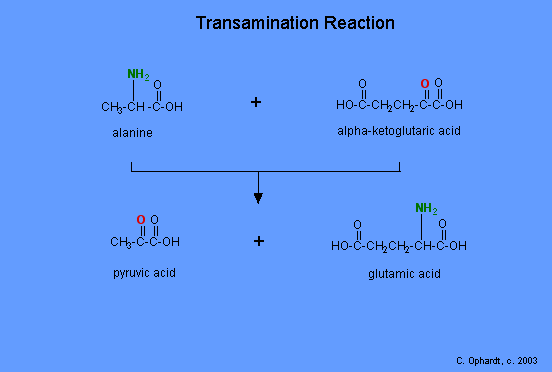
Now coming to your last question only the carbon skeletons of many non-essential amino acids are made from citric acid cycle intermediates like oxaloacetate which forms aspartate and asparagine; and alpha-ketoglutarate which forms glutamine, proline, and arginine. Thus Citric acid cycle provides only the carbon skeleton and the rest work is done by the transamination process by actually converting them to non-essential amino acids.
Add Answer to:
Describe the general role of an a-keto acid in a transamination
reaction and the ultimate goal...
Amino acids can be categorized according to the body's ability to synthesize them. Both essential and...
 Amino acids can be categorized according to the body's ability to synthesize them. Both essential and nonessential amino acids are necessary for life, but the human body is unable to synthesize some amino acids. Different pathways enable synthesis of nonessential amino acids from five precursors: pyruvate, 3-phosphoglycerate, oxaloacetate, a-ketoglutarate, and phenylalanine. Many of these pathways include a process called transamination, which is a reaction between an amino acid and an alpha-keto acid. Some non essential amino acids are synthesized in...
help with questions but short answer Amino acid catabolism in skeletal muscle: the Alanine cycle Transamination...
 help with questions but short answer
Amino acid catabolism in skeletal muscle: the Alanine cycle Transamination reactions: the relationship between alanine/pyruvate; aspartate/oxaloacetate and glutamate/a ketoglutarate. Draw these transamination reactions with structures. GPCR and RTK signaling pathways. Use your knowledge of these pathways to predict how experimental situations will influence cell signaling as discussed in class. Products of amino acids and their role in signaling. Role of hormones in regulation of metabolism.
help with questions but short answer
Amino acid catabolism in skeletal muscle: the Alanine cycle Transamination reactions: the relationship between alanine/pyruvate; aspartate/oxaloacetate and glutamate/a ketoglutarate. Draw these transamination reactions with structures. GPCR and RTK signaling pathways. Use your knowledge of these pathways to predict how experimental situations will influence cell signaling as discussed in class. Products of amino acids and their role in signaling. Role of hormones in regulation of metabolism.
Biochemistry 1. A) Tetrahydrobiopterin serves an essential role in the biosynthesis of one amino acid and...
Biochemistry 1. A) Tetrahydrobiopterin serves an essential role in the biosynthesis of one amino acid and several neurotransmitters. What is its function in all those reactions? B) Pyridoxal P (or pyridoxamine P) is an essential cofactor for what reaction during formation of tryptamine, dopamine and serotonin? What reaction does it facilitate there? C) Tetrahydrofolate is a vitamin. Why is it required for methionine resynthesis? From what non-protein amino acid is methionine resynthesized? D) What amino acid provides the C skeleton...
6. Choose the correct answer: 1. In non-oxidative deamination, amino acid is converted into........ a hydrochloric...
 6. Choose the correct answer: 1. In non-oxidative deamination, amino acid is converted into........ a hydrochloric acid b. Pyruvate C. carboxylic acid 2. Process of breakdown of amino acids to a keto acids is called... a. Amination b. transamination c. deamination 3. Function of proteins is to ........ A. catalyze biochemical reactions. c. synthesis of nucleoproteins. b. regulates reactions d. all of above. 4.Transamination is catalyzed by.......... a. hydrogenases. b. glutamate transaminase. c.dehydrogenases. 5. the source of amino acid pool...
Can someone please check my answers and aid in #12? 1. The amide nitrogen of glutamine:...
Can someone please check my answers and aid in #12? 1. The amide nitrogen of glutamine: A. represents a nontoxic transport form of ammonia. B. is a major source of ammonia for urinary excretion. C. is used in the synthesis of asparagine, purines, and pynimidines. D. can be recovered as ammonia by the action of glutaminase. E. all of the above are correct. 2- Which of the following statements about glutamate is NOT true: a It can be synthesized in...
6:35 PM Fri Apr 19 16% 242:37:15 Exit 24. In a coupled reaction that requires electrons, NADH may...
 6:35 PM Fri Apr 19 16% 242:37:15 Exit 24. In a coupled reaction that requires electrons, NADH may be oxidized to what? NADH2 NAD+ NADPH NADP 25 The high energy bond formed from the reaction between CoA and a two carbon donor is called sulfhydryl phosphodiester thioester secondary amide Submit 6:35 PM Fri Apr 19 令16% Exit 242:36:58 Б18. There are 10 reactions in glycolysis. How many reactions does it take to make glucose in gluconeogenesis? 10 12 19. Pyruvate...
I'd like to ask the answers for all of the uestions Question 1. A reaction in...
 I'd
like to ask the answers for all of the uestions
Question 1. A reaction in an anabolic pathway in a cell has a AG of +2.5 kcal/mol. Which of the following is true regarding this reaction? A. It will occur spontaneously. B. The product of the reaction has a lower free energy than the reactants. C. It can occur if it is coupled to ATP hydrolysis. D. It is an exergonic reaction. E. It is breaking a polymer into...
I'd
like to ask the answers for all of the uestions
Question 1. A reaction in an anabolic pathway in a cell has a AG of +2.5 kcal/mol. Which of the following is true regarding this reaction? A. It will occur spontaneously. B. The product of the reaction has a lower free energy than the reactants. C. It can occur if it is coupled to ATP hydrolysis. D. It is an exergonic reaction. E. It is breaking a polymer into...
Based on the document below, 1. Describe the hypothesis Chaudhuri et al ids attempting to evaluate;...
 Based on the document below,
1. Describe the hypothesis Chaudhuri et al ids attempting to
evaluate; in other words, what is the goal of this paper? Why is he
writing it?
2. Does the data presented in the paper support the hypothesis
stated in the introduction? Explain.
3.According to Chaudhuri, what is the potential role of thew
alkaline phosphatase in the cleanup of industrial waste.
CHAUDHURI et al: KINETIC BEHAVIOUR OF CALF INTESTINAL ALP WITH PNPP 8.5, 9, 9.5, 10,...
Based on the document below,
1. Describe the hypothesis Chaudhuri et al ids attempting to
evaluate; in other words, what is the goal of this paper? Why is he
writing it?
2. Does the data presented in the paper support the hypothesis
stated in the introduction? Explain.
3.According to Chaudhuri, what is the potential role of thew
alkaline phosphatase in the cleanup of industrial waste.
CHAUDHURI et al: KINETIC BEHAVIOUR OF CALF INTESTINAL ALP WITH PNPP 8.5, 9, 9.5, 10,...
Need answers. thank you VOCABULARY BUILDER Misspelled Words Find the words below that are misspelled; circle...
 Need answers. thank you
VOCABULARY BUILDER Misspelled Words Find the words below that are misspelled; circle them, and then correctly spell them in the spaces provided. Then fill in the blanks below with the correct vocabulary terms from the following list. amino acids digestion clectrolytes nutrients antioxident nutrition basal metabolic rate extracellulare oxydation calories fat-soluble presearvatives catalist glycogen processed foods cellulose homeostasis saturated fats major mineral coenzyeme trace minerals diaretics metabolism water-soluable 1. Artificial flavors, colors, and commonly added to...
Need answers. thank you
VOCABULARY BUILDER Misspelled Words Find the words below that are misspelled; circle them, and then correctly spell them in the spaces provided. Then fill in the blanks below with the correct vocabulary terms from the following list. amino acids digestion clectrolytes nutrients antioxident nutrition basal metabolic rate extracellulare oxydation calories fat-soluble presearvatives catalist glycogen processed foods cellulose homeostasis saturated fats major mineral coenzyeme trace minerals diaretics metabolism water-soluable 1. Artificial flavors, colors, and commonly added to...
10. Write a one-page summary of the attached paper? INTRODUCTION Many problems can develop in activated...
10. Write a one-page summary of the attached paper? INTRODUCTION Many problems can develop in activated sludge operation that adversely affect effluent quality with origins in the engineering, hydraulic and microbiological components of the process. The real "heart" of the activated sludge system is the development and maintenance of a mixed microbial culture (activated sludge) that treats wastewater and which can be managed. One definition of a wastewater treatment plant operator is a "bug farmer", one who controls the aeration...
 Amino acids can be categorized according to the body's ability to synthesize them. Both essential and nonessential amino acids are necessary for life, but the human body is unable to synthesize some amino acids. Different pathways enable synthesis of nonessential amino acids from five precursors: pyruvate, 3-phosphoglycerate, oxaloacetate, a-ketoglutarate, and phenylalanine. Many of these pathways include a process called transamination, which is a reaction between an amino acid and an alpha-keto acid. Some non essential amino acids are synthesized in...
 help with questions but short answer
Amino acid catabolism in skeletal muscle: the Alanine cycle Transamination reactions: the relationship between alanine/pyruvate; aspartate/oxaloacetate and glutamate/a ketoglutarate. Draw these transamination reactions with structures. GPCR and RTK signaling pathways. Use your knowledge of these pathways to predict how experimental situations will influence cell signaling as discussed in class. Products of amino acids and their role in signaling. Role of hormones in regulation of metabolism.
help with questions but short answer
Amino acid catabolism in skeletal muscle: the Alanine cycle Transamination reactions: the relationship between alanine/pyruvate; aspartate/oxaloacetate and glutamate/a ketoglutarate. Draw these transamination reactions with structures. GPCR and RTK signaling pathways. Use your knowledge of these pathways to predict how experimental situations will influence cell signaling as discussed in class. Products of amino acids and their role in signaling. Role of hormones in regulation of metabolism.
 6. Choose the correct answer: 1. In non-oxidative deamination, amino acid is converted into........ a hydrochloric acid b. Pyruvate C. carboxylic acid 2. Process of breakdown of amino acids to a keto acids is called... a. Amination b. transamination c. deamination 3. Function of proteins is to ........ A. catalyze biochemical reactions. c. synthesis of nucleoproteins. b. regulates reactions d. all of above. 4.Transamination is catalyzed by.......... a. hydrogenases. b. glutamate transaminase. c.dehydrogenases. 5. the source of amino acid pool...
 6:35 PM Fri Apr 19 16% 242:37:15 Exit 24. In a coupled reaction that requires electrons, NADH may be oxidized to what? NADH2 NAD+ NADPH NADP 25 The high energy bond formed from the reaction between CoA and a two carbon donor is called sulfhydryl phosphodiester thioester secondary amide Submit 6:35 PM Fri Apr 19 令16% Exit 242:36:58 Б18. There are 10 reactions in glycolysis. How many reactions does it take to make glucose in gluconeogenesis? 10 12 19. Pyruvate...
 I'd
like to ask the answers for all of the uestions
Question 1. A reaction in an anabolic pathway in a cell has a AG of +2.5 kcal/mol. Which of the following is true regarding this reaction? A. It will occur spontaneously. B. The product of the reaction has a lower free energy than the reactants. C. It can occur if it is coupled to ATP hydrolysis. D. It is an exergonic reaction. E. It is breaking a polymer into...
I'd
like to ask the answers for all of the uestions
Question 1. A reaction in an anabolic pathway in a cell has a AG of +2.5 kcal/mol. Which of the following is true regarding this reaction? A. It will occur spontaneously. B. The product of the reaction has a lower free energy than the reactants. C. It can occur if it is coupled to ATP hydrolysis. D. It is an exergonic reaction. E. It is breaking a polymer into...
 Based on the document below,
1. Describe the hypothesis Chaudhuri et al ids attempting to
evaluate; in other words, what is the goal of this paper? Why is he
writing it?
2. Does the data presented in the paper support the hypothesis
stated in the introduction? Explain.
3.According to Chaudhuri, what is the potential role of thew
alkaline phosphatase in the cleanup of industrial waste.
CHAUDHURI et al: KINETIC BEHAVIOUR OF CALF INTESTINAL ALP WITH PNPP 8.5, 9, 9.5, 10,...
Based on the document below,
1. Describe the hypothesis Chaudhuri et al ids attempting to
evaluate; in other words, what is the goal of this paper? Why is he
writing it?
2. Does the data presented in the paper support the hypothesis
stated in the introduction? Explain.
3.According to Chaudhuri, what is the potential role of thew
alkaline phosphatase in the cleanup of industrial waste.
CHAUDHURI et al: KINETIC BEHAVIOUR OF CALF INTESTINAL ALP WITH PNPP 8.5, 9, 9.5, 10,...
 Need answers. thank you
VOCABULARY BUILDER Misspelled Words Find the words below that are misspelled; circle them, and then correctly spell them in the spaces provided. Then fill in the blanks below with the correct vocabulary terms from the following list. amino acids digestion clectrolytes nutrients antioxident nutrition basal metabolic rate extracellulare oxydation calories fat-soluble presearvatives catalist glycogen processed foods cellulose homeostasis saturated fats major mineral coenzyeme trace minerals diaretics metabolism water-soluable 1. Artificial flavors, colors, and commonly added to...
Need answers. thank you
VOCABULARY BUILDER Misspelled Words Find the words below that are misspelled; circle them, and then correctly spell them in the spaces provided. Then fill in the blanks below with the correct vocabulary terms from the following list. amino acids digestion clectrolytes nutrients antioxident nutrition basal metabolic rate extracellulare oxydation calories fat-soluble presearvatives catalist glycogen processed foods cellulose homeostasis saturated fats major mineral coenzyeme trace minerals diaretics metabolism water-soluable 1. Artificial flavors, colors, and commonly added to...
Most questions answered within 3 hours.
-
Where is the error in this code sequence?
String s1 = "Hello";
String s2 = "ello";...
asked 11 months ago -
Financial data for Joel de Paris, Inc., for last year
follow:
Joel de Paris, Inc.
Balance...
asked 11 months ago -
Consider this reaction:
Al2(SO4)3 (aq)+ BaCl3
(aq) Al2Cl6 (aq)- +
3BaSO4(s) . What is the...
asked 11 months ago -
Suppose that Savneet is considering increasing her
recent random sample from 20 car rentals to 40...
asked 11 months ago -
Trucks arrive at an unloading terminal at an average rate of 120
per hour.
Trucks arrive...
asked 11 months ago -
Why are methanol and ethanol completely soluble in water while
octanol is not very little soluble....
asked 11 months ago -
A facilities manager at a university reads in a research report
that the mean amount of...
asked 11 months ago -
When the CuSO4 is rehydrated by adding water to the anhydrous
compound, is this an endothermic...
asked 11 months ago -
A ray of sunlight is passing from diamond into crown glass; the
angle of incidence is...
asked 11 months ago -
A block of mass 0.249 kg is placed on top of a light, vertical
spring of...
asked 11 months ago -
how do the kidneys compensate in the presences of acidosis
a) trigger hyperventilate
b) reserve acid...
asked 11 months ago -
Question 501 pts
The rental rate of capital to the firm increases. Which of the
following...
asked 11 months ago