What is the type of interaction occurring between K-Ras and Raf. Explain. (cell-signalling)
What is the type of interaction occurring between K-Ras and Raf. Explain. (cell-signalling)
Homework Answers
Answer- Downstream of RAS, mammalian cells express three RAF paralogs (ARAF, BRAF, and CRAF) that share a conserved C-terminal kinase domain (KD). They also comprise an N-terminal regulatory region (NTR) consisting of a RAS-binding domain (RBD), a cysteine-rich domain (CRD), and a Ser/Thr-rich region. The mammalian RAF family also comprises two KSR isoforms that share significant sequence identity with RAF proteins in their C-terminal kinase domain and present a related NTR organization with the exception that they contain a signature domain, called the coiled coil-sterile α motif (CC-SAM) domain, and lack an RBD domain1. In unstimulated cells, RAF proteins are sequestered in the cytoplasm as monomers in an autoinhibited state through an intramolecular interaction between their NTR and kinase domain. Upon RTK activation, GTP-bound RAS binds to the RAF RBD, which is thought to release the NTR−KD interaction. This event is accompanied by dephosphorylation of inhibitory sites and phosphorylation of activating residues that respectively contribute to membrane anchoring and kinase domain activation. Concomitantly, RAF proteins undergo kinase domain side-to-side dimerization. This step allosterically drives catalytic switching to the ON-state and is essential for kinase domain activation. Here we refer to the ON-state as dimeric full-length RAF in which NTR autoinhibition has been relieved. Activated RAF proteins convey signals by initiating a phosphorylation cascade from RAF to MEK and MEK to ERK, which culminates in the phosphorylation of an array of substrates eliciting cell-specific responses.
Add Answer to:
What is the type of interaction occurring between K-Ras
and Raf. Explain. (cell-signalling)
What other effects can ras activation have on the cell, apart from Raf activation? Be specific...
What other effects can ras activation have on the cell, apart from Raf activation? Be specific about mechanisms and outcomes. (80-200 words) Outline the mechanistic pathway from a new mutation happening at Ras position 12 in a human cell, to the promotion of cancer. (150-300 words)
2. The following is a description of a signaling pathway initiated by receptor tyrosine kinases. Ligand → RTK → Sos → Ras → Raf → MEK → ERK → Transcription factor → Cell growth A. (3pts) Which of the...
 2. The following is a description of a signaling pathway initiated by receptor tyrosine kinases. Ligand → RTK → Sos → Ras → Raf → MEK → ERK → Transcription factor → Cell growth A. (3pts) Which of these steps indicates the protein is activated after a GTP exchange step? B. (3pts) Which of these proteins can be deactivated by phosphatases? C. (4pts) Describe a mutation that would cause Ras to be permanently "on"? Would this mutation lead to high...
Hello. I need help answering this question that focuses on cell signalling pathways and insulin signalling...
Hello. I need help answering this question that focuses on cell signalling pathways and insulin signalling pathways: 3) What is the relationship between type 2 diabetes and insulin production? How is it that a drug that increases insulin sensitivity might help treating this disease?
Distinguish between the three classes of cell surface receptors with regards to associated cell signalling processes....
Distinguish between the three classes of cell surface receptors with regards to associated cell signalling processes. (24 marks)
5. Na2[Mo2(CO)10] is isolable and quite stable. What type of metal-metal interaction is occurring in this...
5. Na2[Mo2(CO)10] is isolable and quite stable. What type of metal-metal interaction is occurring in this complex given its stability? What are the oxidation states and d-counts of the metals?
38.Describe the interaction between a presynaptic and postsynaptic cell. what leads to an IPSP versus a...
38.Describe the interaction between a presynaptic and postsynaptic cell. what leads to an IPSP versus a subthreshold EPSP in the postsynaptic cell. What is one mechanism that could lead to a supra threshold EPSP in the postsynaptic cell.
help with 38 I got it wrong and dont know what it is what is ras?...
 help with 38 I got it wrong and dont know what it
is
what is ras? is what is missing sorry
lilleonine kinase receptors D) Nuclear receptors E) Tyrosine phosphatase receptors D 37. Which one (if any) of the following cellular events does NOT inci wing cellular events does NOT include a role for apoptosis: A) Immune function return to homeostasis following an infection B) Digit formation during development C Cellular response to irreparable DNA damage identified in G1 of...
help with 38 I got it wrong and dont know what it
is
what is ras? is what is missing sorry
lilleonine kinase receptors D) Nuclear receptors E) Tyrosine phosphatase receptors D 37. Which one (if any) of the following cellular events does NOT inci wing cellular events does NOT include a role for apoptosis: A) Immune function return to homeostasis following an infection B) Digit formation during development C Cellular response to irreparable DNA damage identified in G1 of...
Ras Homework Namea due April 23, 2019 Cell Proliferation ReceptorRas ERK Tyrosine Kinase Wild typ...
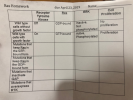 What is the answers for this chart? Thanks!
Ras Homework Namea due April 23, 2019 Cell Proliferation ReceptorRas ERK Tyrosine Kinase Wild type Off cells without growth factor Wild typeOn cells with growth factor Mutations that keep Ras in the GTP- bound form Mutations that keep Ras in the GDP. bound form Mutations that No proliferation GDP-bound Inactive, Not phosphorylated Phosphorylated GTP-bound Active Proliferation inactivate GAP Mutations that overexpress RTK
Ras Homework Namea due April 23, 2019 Cell Proliferation ReceptorRas...
What is the answers for this chart? Thanks!
Ras Homework Namea due April 23, 2019 Cell Proliferation ReceptorRas ERK Tyrosine Kinase Wild type Off cells without growth factor Wild typeOn cells with growth factor Mutations that keep Ras in the GTP- bound form Mutations that keep Ras in the GDP. bound form Mutations that No proliferation GDP-bound Inactive, Not phosphorylated Phosphorylated GTP-bound Active Proliferation inactivate GAP Mutations that overexpress RTK
Ras Homework Namea due April 23, 2019 Cell Proliferation ReceptorRas...
PA groups oft What type of interaction would you expect between the R groups of the...
 PA groups oft What type of interaction would you expect between the R groups of the following amino acids in a quaternary structure? Drag the appropriate items to their respective bins. Reset Help glutamate and arginine asparagine and tyrosine alanine and proline phenylalanine and isoleucine Hydrophobic interaction Hydrophilic interaction Salt bridge Hydrogen bond
a. Identify the type of inhibition occurring. Explain how you know. b. Describe the difference or...
 a. Identify the type of inhibition occurring. Explain how you know. b. Describe the difference or similarity between the Vmax and Km values for the different conditions C. Having identified the type of inhibitor indole is, explain what this means for where indole binds to chymotrypsin. + Inhibitor 1/VO Control (no inhibitor present) 1/[S] MacBook At 0 BASE 7
 2. The following is a description of a signaling pathway initiated by receptor tyrosine kinases. Ligand → RTK → Sos → Ras → Raf → MEK → ERK → Transcription factor → Cell growth A. (3pts) Which of these steps indicates the protein is activated after a GTP exchange step? B. (3pts) Which of these proteins can be deactivated by phosphatases? C. (4pts) Describe a mutation that would cause Ras to be permanently "on"? Would this mutation lead to high...
 help with 38 I got it wrong and dont know what it
is
what is ras? is what is missing sorry
lilleonine kinase receptors D) Nuclear receptors E) Tyrosine phosphatase receptors D 37. Which one (if any) of the following cellular events does NOT inci wing cellular events does NOT include a role for apoptosis: A) Immune function return to homeostasis following an infection B) Digit formation during development C Cellular response to irreparable DNA damage identified in G1 of...
help with 38 I got it wrong and dont know what it
is
what is ras? is what is missing sorry
lilleonine kinase receptors D) Nuclear receptors E) Tyrosine phosphatase receptors D 37. Which one (if any) of the following cellular events does NOT inci wing cellular events does NOT include a role for apoptosis: A) Immune function return to homeostasis following an infection B) Digit formation during development C Cellular response to irreparable DNA damage identified in G1 of...
 What is the answers for this chart? Thanks!
Ras Homework Namea due April 23, 2019 Cell Proliferation ReceptorRas ERK Tyrosine Kinase Wild type Off cells without growth factor Wild typeOn cells with growth factor Mutations that keep Ras in the GTP- bound form Mutations that keep Ras in the GDP. bound form Mutations that No proliferation GDP-bound Inactive, Not phosphorylated Phosphorylated GTP-bound Active Proliferation inactivate GAP Mutations that overexpress RTK
Ras Homework Namea due April 23, 2019 Cell Proliferation ReceptorRas...
What is the answers for this chart? Thanks!
Ras Homework Namea due April 23, 2019 Cell Proliferation ReceptorRas ERK Tyrosine Kinase Wild type Off cells without growth factor Wild typeOn cells with growth factor Mutations that keep Ras in the GTP- bound form Mutations that keep Ras in the GDP. bound form Mutations that No proliferation GDP-bound Inactive, Not phosphorylated Phosphorylated GTP-bound Active Proliferation inactivate GAP Mutations that overexpress RTK
Ras Homework Namea due April 23, 2019 Cell Proliferation ReceptorRas...
 PA groups oft What type of interaction would you expect between the R groups of the following amino acids in a quaternary structure? Drag the appropriate items to their respective bins. Reset Help glutamate and arginine asparagine and tyrosine alanine and proline phenylalanine and isoleucine Hydrophobic interaction Hydrophilic interaction Salt bridge Hydrogen bond
 a. Identify the type of inhibition occurring. Explain how you know. b. Describe the difference or similarity between the Vmax and Km values for the different conditions C. Having identified the type of inhibitor indole is, explain what this means for where indole binds to chymotrypsin. + Inhibitor 1/VO Control (no inhibitor present) 1/[S] MacBook At 0 BASE 7
Most questions answered within 3 hours.
-
Where is the error in this code sequence?
String s1 = "Hello";
String s2 = "ello";...
asked 10 months ago -
Financial data for Joel de Paris, Inc., for last year
follow:
Joel de Paris, Inc.
Balance...
asked 10 months ago -
Consider this reaction:
Al2(SO4)3 (aq)+ BaCl3
(aq) Al2Cl6 (aq)- +
3BaSO4(s) . What is the...
asked 10 months ago -
Suppose that Savneet is considering increasing her
recent random sample from 20 car rentals to 40...
asked 10 months ago -
Trucks arrive at an unloading terminal at an average rate of 120
per hour.
Trucks arrive...
asked 10 months ago -
Why are methanol and ethanol completely soluble in water while
octanol is not very little soluble....
asked 10 months ago -
A facilities manager at a university reads in a research report
that the mean amount of...
asked 10 months ago -
When the CuSO4 is rehydrated by adding water to the anhydrous
compound, is this an endothermic...
asked 10 months ago -
A ray of sunlight is passing from diamond into crown glass; the
angle of incidence is...
asked 10 months ago -
A block of mass 0.249 kg is placed on top of a light, vertical
spring of...
asked 10 months ago -
how do the kidneys compensate in the presences of acidosis
a) trigger hyperventilate
b) reserve acid...
asked 10 months ago -
Question 501 pts
The rental rate of capital to the firm increases. Which of the
following...
asked 10 months ago