An experiment, in the Cellular and Molecular Biology lab,on the Chlamydomonas reinharditii was done. The effects...
An experiment, in the Cellular and Molecular Biology lab,on the Chlamydomonas reinharditii was done. The effects of the Neomycin and Cyclohexamide were observed. Their effect on the flagella and their regeneration was observed. So, under the microscope, the number of NONMOVING cell were counted. Please write the hypothesis, null hypothesis, prediction, and explanation for each Neomycin and Cyclohexamide (separately). Please write if the number of NONMOVING cells will increase or decrease when neomycin is applied and when cyclohexamide is applied.
Thank you!
Homework Answers
when both the flagella are amputated, on application of cyclohexamide which will inhibit formation of proteins, is known to cause regrowth of less than one - third of each flagellum. on the other hand if only one of the flagella are removed and the effects are then observed, then the regrowth levels of removed flagellum are found to be greater as compared to when both were removed. therefore in first case, where both flagella were removed, nonmoving cells would increase in number.
on application of neomycin, before exposure of chlamydomonas to stress environments or removal of flagella, it is observed that deflagellation was prevented whereas if neomycin was added after flagella removal, did not block flagellar assembly which can result in decrease in number of nonmoving cells under microscope.
Add Answer to:
An experiment, in the Cellular and Molecular Biology lab,on the
Chlamydomonas reinharditii was done. The effects...
PLEASE ANSWER Lab Prep Part A and Part B - guard cells cuticle epidermis - USA...
 PLEASE ANSWER Lab Prep Part A and Part B
- guard cells cuticle epidermis - USA Toysclerenchyma SANDALER spongy mesophyll - vessels of xylem oooo. O Oo 00 . Y .. 10 el sieve-tube Ab bo element of phloem sclerenchyma fibers Figure 1. Cross section of a monocot leaf. → In a simple experiment, researchers placed one group of geranium leaves in a well-lit area for 36 hours, and kept a second group of geranium leaves in the dark for...
PLEASE ANSWER Lab Prep Part A and Part B
- guard cells cuticle epidermis - USA Toysclerenchyma SANDALER spongy mesophyll - vessels of xylem oooo. O Oo 00 . Y .. 10 el sieve-tube Ab bo element of phloem sclerenchyma fibers Figure 1. Cross section of a monocot leaf. → In a simple experiment, researchers placed one group of geranium leaves in a well-lit area for 36 hours, and kept a second group of geranium leaves in the dark for...
II. TESTING EXPERIMENT: IS MOTION NECESSARY FOR INDUCING ELECTRIC CURRENT IN A COIL NOT CONNECTED TO...
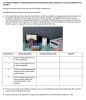 II. TESTING EXPERIMENT: IS MOTION NECESSARY FOR INDUCING ELECTRIC CURRENT IN A COIL NOT CONNECTED TO A BATTERY? The goal of this experiment to test the rule you invented in Experiment I. Available equipment: Computer with internet connection a) In this experiment you have two coils: one (coil A on the left) connected to a large galvanometer and one (coil B on the right) connected to a power supply and current indicator (another small galvanometer). Use the rule you invented...
lake-up Micro Lab: Identifying Unknown bacteria: dentify the Unknown Bacteria Lab Experiment elow are results from...
 lake-up Micro Lab: Identifying Unknown bacteria: dentify the Unknown Bacteria Lab Experiment elow are results from the unknown lab experiment. The identity of this bacteria is not known. Your ask is to use the data below to form a hypothesis of the identity of this bacteria. Record your results on he chart (Table 1) below and make a prediction on the bacteria based on your results. There is a list of ossible bacteria below. You may need to look back...
2. An experiment was conducted to test the effects of nitrogen fertilizer on lettuce production. Five...
2. An experiment was conducted to test the effects of nitrogen fertilizer on lettuce production. Five rates of ammonium nitrate were applied to four replicate plots in a completely randomized design. The data are the number of heads of lettuce harvested from the plot. Treatment (lb N/acre) Head of lecture/plot 0 104 114 90 140 50 134 130 144 174 100 146 142 152 156 150 147 160 160 163 200 131 148 154 163 Write the linear statistical model...
Please help with explanations (a) In a Lab Experiment involving inorganic syntheses of molecular precursors to...
 Please help with explanations
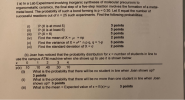
(a) In a Lab Experiment involving inorganic syntheses of molecular precursors to organometallic ceramics, the final step of a five-step reaction involves the formation of a metal- metal bond. The probability of such a bond forming is p = 0.30. Let X equal the number of successful reactions out of n = 25 such experiments. Find the following probabilities: O (ii) (ii) (iv) (v) (vi) P (X is at most 5) P (X is at least...
Please help with explanations
(a) In a Lab Experiment involving inorganic syntheses of molecular precursors to organometallic ceramics, the final step of a five-step reaction involves the formation of a metal- metal bond. The probability of such a bond forming is p = 0.30. Let X equal the number of successful reactions out of n = 25 such experiments. Find the following probabilities: O (ii) (ii) (iv) (v) (vi) P (X is at most 5) P (X is at least...
Bio 121 I need to make (yeast fermentation) lab report. This is the lab experiment and...
 Bio 121
I need to make (yeast fermentation) lab
report.
This is the lab experiment and results:
This is a guide to making the lab report:
General Biology BIO121 Yeast Fermentation Lab Introduction Organisms stay alive by the utilization of energy through metabolism. The energy acquiring pathways in photosynthesis convert radiant energy from the sun into the chemical bond energy of carbohydrates. This photosynthetic process is limited to the producers or autotrophs, which include plants, photosynthetic bacteria and some protists....
Bio 121
I need to make (yeast fermentation) lab
report.
This is the lab experiment and results:
This is a guide to making the lab report:
General Biology BIO121 Yeast Fermentation Lab Introduction Organisms stay alive by the utilization of energy through metabolism. The energy acquiring pathways in photosynthesis convert radiant energy from the sun into the chemical bond energy of carbohydrates. This photosynthetic process is limited to the producers or autotrophs, which include plants, photosynthetic bacteria and some protists....
just the prelab worksheet, no data yet Lab Six: Fermentation Learning Objectives: • Explain the biochemistry...
 just the prelab worksheet, no data yet
Lab Six: Fermentation Learning Objectives: • Explain the biochemistry of fermentation, substrates and products, conditions, and purpose for cells • Describe alcoholic fermentation of yeast, naming reactants and products Perform a pre-designed experiment to measure the rate of yeast fermentation of glucose under two different conditions. Propose hypotheses and make predictions based on them. Design and perform a novel experiment to test additional substrates for yeast fermentation using findings of the pre-designed experiment....
just the prelab worksheet, no data yet
Lab Six: Fermentation Learning Objectives: • Explain the biochemistry of fermentation, substrates and products, conditions, and purpose for cells • Describe alcoholic fermentation of yeast, naming reactants and products Perform a pre-designed experiment to measure the rate of yeast fermentation of glucose under two different conditions. Propose hypotheses and make predictions based on them. Design and perform a novel experiment to test additional substrates for yeast fermentation using findings of the pre-designed experiment....
Pre lab Introduction Your instructor has prepared an extract of chloroplast pigments from fresh green grass...
 Pre lab
Introduction Your instructor has prepared an extract of chloroplast pigments from fresh green grass or fresh spinach. A blender was used to rupture the cells, and the pigments were then extracted with acetone, an organic solvent. Work- ing with one other student, begin this exercise by separating the pigments extracted using paper chromatography. To do this, you will apply the pig- ment extract to a cylinder of chromatographic paper. You will then place the ylinder in a jar...
Pre lab
Introduction Your instructor has prepared an extract of chloroplast pigments from fresh green grass or fresh spinach. A blender was used to rupture the cells, and the pigments were then extracted with acetone, an organic solvent. Work- ing with one other student, begin this exercise by separating the pigments extracted using paper chromatography. To do this, you will apply the pig- ment extract to a cylinder of chromatographic paper. You will then place the ylinder in a jar...
Homework Assigiment Chapters 1 and 2 Instructions: Read each question carefully, and consult the textbook chapters...
 Homework Assigiment Chapters 1 and 2 Instructions: Read each question carefully, and consult the textbook chapters noted above and the applicable slide handouts to choose the BEST and MOST SPECIFIC answer from the choices provided. Write that answer in the answer blank AFTER you have completed this worksheet, go to the matching quiz on Canwas and submit your answers before 11.59 PM on the due date, or you will receive ZERO points. Don't forget to click the Submit button at...
QUESTION: Please write a one paragraph lab report introduction based on the following experiment below: Organisms...
QUESTION: Please write a one paragraph lab report introduction based on the following experiment below: Organisms must forage for food and other resources that are scattered around a heterogeneous environment. Food availability varies from site to site, but so do environmental conditions that foragers experience (e.g., temperature and wind) and the risks to which they are exposed. Foraging by any organism involves trading off the gains to be made by collecting food against the costs of doing so, including costs...
 PLEASE ANSWER Lab Prep Part A and Part B
- guard cells cuticle epidermis - USA Toysclerenchyma SANDALER spongy mesophyll - vessels of xylem oooo. O Oo 00 . Y .. 10 el sieve-tube Ab bo element of phloem sclerenchyma fibers Figure 1. Cross section of a monocot leaf. → In a simple experiment, researchers placed one group of geranium leaves in a well-lit area for 36 hours, and kept a second group of geranium leaves in the dark for...
PLEASE ANSWER Lab Prep Part A and Part B
- guard cells cuticle epidermis - USA Toysclerenchyma SANDALER spongy mesophyll - vessels of xylem oooo. O Oo 00 . Y .. 10 el sieve-tube Ab bo element of phloem sclerenchyma fibers Figure 1. Cross section of a monocot leaf. → In a simple experiment, researchers placed one group of geranium leaves in a well-lit area for 36 hours, and kept a second group of geranium leaves in the dark for...
 II. TESTING EXPERIMENT: IS MOTION NECESSARY FOR INDUCING ELECTRIC CURRENT IN A COIL NOT CONNECTED TO A BATTERY? The goal of this experiment to test the rule you invented in Experiment I. Available equipment: Computer with internet connection a) In this experiment you have two coils: one (coil A on the left) connected to a large galvanometer and one (coil B on the right) connected to a power supply and current indicator (another small galvanometer). Use the rule you invented...
 lake-up Micro Lab: Identifying Unknown bacteria: dentify the Unknown Bacteria Lab Experiment elow are results from the unknown lab experiment. The identity of this bacteria is not known. Your ask is to use the data below to form a hypothesis of the identity of this bacteria. Record your results on he chart (Table 1) below and make a prediction on the bacteria based on your results. There is a list of ossible bacteria below. You may need to look back...
 Please help with explanations
(a) In a Lab Experiment involving inorganic syntheses of molecular precursors to organometallic ceramics, the final step of a five-step reaction involves the formation of a metal- metal bond. The probability of such a bond forming is p = 0.30. Let X equal the number of successful reactions out of n = 25 such experiments. Find the following probabilities: O (ii) (ii) (iv) (v) (vi) P (X is at most 5) P (X is at least...
Please help with explanations
(a) In a Lab Experiment involving inorganic syntheses of molecular precursors to organometallic ceramics, the final step of a five-step reaction involves the formation of a metal- metal bond. The probability of such a bond forming is p = 0.30. Let X equal the number of successful reactions out of n = 25 such experiments. Find the following probabilities: O (ii) (ii) (iv) (v) (vi) P (X is at most 5) P (X is at least...
 Bio 121
I need to make (yeast fermentation) lab
report.
This is the lab experiment and results:
This is a guide to making the lab report:
General Biology BIO121 Yeast Fermentation Lab Introduction Organisms stay alive by the utilization of energy through metabolism. The energy acquiring pathways in photosynthesis convert radiant energy from the sun into the chemical bond energy of carbohydrates. This photosynthetic process is limited to the producers or autotrophs, which include plants, photosynthetic bacteria and some protists....
Bio 121
I need to make (yeast fermentation) lab
report.
This is the lab experiment and results:
This is a guide to making the lab report:
General Biology BIO121 Yeast Fermentation Lab Introduction Organisms stay alive by the utilization of energy through metabolism. The energy acquiring pathways in photosynthesis convert radiant energy from the sun into the chemical bond energy of carbohydrates. This photosynthetic process is limited to the producers or autotrophs, which include plants, photosynthetic bacteria and some protists....
 just the prelab worksheet, no data yet
Lab Six: Fermentation Learning Objectives: • Explain the biochemistry of fermentation, substrates and products, conditions, and purpose for cells • Describe alcoholic fermentation of yeast, naming reactants and products Perform a pre-designed experiment to measure the rate of yeast fermentation of glucose under two different conditions. Propose hypotheses and make predictions based on them. Design and perform a novel experiment to test additional substrates for yeast fermentation using findings of the pre-designed experiment....
just the prelab worksheet, no data yet
Lab Six: Fermentation Learning Objectives: • Explain the biochemistry of fermentation, substrates and products, conditions, and purpose for cells • Describe alcoholic fermentation of yeast, naming reactants and products Perform a pre-designed experiment to measure the rate of yeast fermentation of glucose under two different conditions. Propose hypotheses and make predictions based on them. Design and perform a novel experiment to test additional substrates for yeast fermentation using findings of the pre-designed experiment....
 Pre lab
Introduction Your instructor has prepared an extract of chloroplast pigments from fresh green grass or fresh spinach. A blender was used to rupture the cells, and the pigments were then extracted with acetone, an organic solvent. Work- ing with one other student, begin this exercise by separating the pigments extracted using paper chromatography. To do this, you will apply the pig- ment extract to a cylinder of chromatographic paper. You will then place the ylinder in a jar...
Pre lab
Introduction Your instructor has prepared an extract of chloroplast pigments from fresh green grass or fresh spinach. A blender was used to rupture the cells, and the pigments were then extracted with acetone, an organic solvent. Work- ing with one other student, begin this exercise by separating the pigments extracted using paper chromatography. To do this, you will apply the pig- ment extract to a cylinder of chromatographic paper. You will then place the ylinder in a jar...
 Homework Assigiment Chapters 1 and 2 Instructions: Read each question carefully, and consult the textbook chapters noted above and the applicable slide handouts to choose the BEST and MOST SPECIFIC answer from the choices provided. Write that answer in the answer blank AFTER you have completed this worksheet, go to the matching quiz on Canwas and submit your answers before 11.59 PM on the due date, or you will receive ZERO points. Don't forget to click the Submit button at...
Most questions answered within 3 hours.
-
Where is the error in this code sequence?
String s1 = "Hello";
String s2 = "ello";...
asked 10 months ago -
Financial data for Joel de Paris, Inc., for last year
follow:
Joel de Paris, Inc.
Balance...
asked 10 months ago -
Consider this reaction:
Al2(SO4)3 (aq)+ BaCl3
(aq) Al2Cl6 (aq)- +
3BaSO4(s) . What is the...
asked 10 months ago -
Suppose that Savneet is considering increasing her
recent random sample from 20 car rentals to 40...
asked 10 months ago -
Trucks arrive at an unloading terminal at an average rate of 120
per hour.
Trucks arrive...
asked 10 months ago -
Why are methanol and ethanol completely soluble in water while
octanol is not very little soluble....
asked 10 months ago -
A facilities manager at a university reads in a research report
that the mean amount of...
asked 10 months ago -
When the CuSO4 is rehydrated by adding water to the anhydrous
compound, is this an endothermic...
asked 10 months ago -
A ray of sunlight is passing from diamond into crown glass; the
angle of incidence is...
asked 10 months ago -
A block of mass 0.249 kg is placed on top of a light, vertical
spring of...
asked 10 months ago -
how do the kidneys compensate in the presences of acidosis
a) trigger hyperventilate
b) reserve acid...
asked 10 months ago -
Question 501 pts
The rental rate of capital to the firm increases. Which of the
following...
asked 10 months ago