Q. In Raman or FTIR microscopy how is the resolution of the image related to the...
Q. In Raman or FTIR microscopy how is the resolution of the image related to the wavelength of light? Explain.
Homework Answers

Add Answer to:
Q. In Raman or FTIR microscopy how is the resolution of the
image related to the...
(15 pts.) Infrared microscopy is valuable technique for characterizing materials. A. Explain the spatial resolution of...
 (15 pts.) Infrared microscopy is valuable technique for characterizing materials. A. Explain the spatial resolution of infrared microscopy is significantly worse than the spatial resolution of Raman microscopy although they both are vibrational spectroscopy techniques. B. Why is a CCD not an appropriate detector for infrared imaging, but it is a useful detector for Raman imaging? 3.
Why is wavelength the main limiting factor on limit of resolution in light microscopy? (please explain)
Why is wavelength the main limiting factor on limit of resolution in light microscopy? (please explain)
What quality of microscopy is enhanced by the use of shorter wavelength of electron beams in...
What quality of microscopy is enhanced by the use of shorter wavelength of electron beams in electron microscopy versus the longer wavelength of visible light utilized in light microscopy? aperture focal depth resolution contrast
2 mocular microscope used to calculate total Because the image only one ocular to reach Both...
 2 mocular microscope used to calculate total Because the image only one ocular to reach Both gors through eyes. 2 What is the to wat is the total magnification for all 45x, and 97 x objectives lensest e m microscope with 15 x oculars and 4%, 10% 4X, 10X, 5 Assunting that all other riables remain constant, explain wory light of shorter wavelength will produce a clearer image than light of longer wavelengths. 4 Why is wavelength the main limiting...
1. Fill out the following table by indicating which general technique (light microscopy (LM) or electron...
 1. Fill out the following table by indicating which general technique (light microscopy (LM) or electron microscopy (EM]) could be used to observe each structure or phenomenon. Put "no" in the box if the technique could not be used. If light microscopy can be used, name one technique (bright-field, phase-contrast, fluorescence, etc.) that you think would be effective. You will find some useful information in Appendix 1 of this manual and Chapter 18 of your textbook. Structure or phenomenon Could...
Q. Explain the difference between Rayleigh, Stokes Raman and anti-Stokes Raman scattering.
Q. Explain the difference between Rayleigh, Stokes Raman and anti-Stokes Raman scattering.
Phase contract microscopy, used to visualize cyanobacteria from Antarctica in this figure, relies on image. Click...
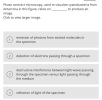 Phase contract microscopy, used to visualize cyanobacteria from Antarctica in this figure, relies on image. Click to view larger image. to produce an emission of photons from excited molecules in the specimen 2) detection of electrons passing through a specimer destructive interference between light waves passing through the specimen versus light passing through the medium 3 4) reflection of light of the specimen
QUESTIONS 1. What is resolution "resolving power"? II. um. What does this 2. The resolving power...
 QUESTIONS 1. What is resolution "resolving power"? II. um. What does this 2. The resolving power of the compound light microscope is value mean? 3. Define parfocal, and explain the significance of understanding this concept when using the compound light microscope? 4. What is the total magnification of a compound light microscope? 38 MICROSCOPY and instrumentation Part II: MICROSCOPY: Lab Activity 1
RESOLUTION: This property of the compound microscope is the degree to which the detail in the...
 RESOLUTION: This property of the compound microscope is the degree to which the detail in the specimen is retained in the magnified image. It is the ability of a microscope to distinguish two closely spaced objects as separate and distinct entities. Conventional light microscopes have a resolution of about 0.2 μm. RESOLVING POWER (d) is the closest spacing between two points at which the points can still be seen rly as separate entities. The smaller the resolving power, the smaller...
8. With regard to microscopy: a. What are the different types and why are they useful?...
 8. With regard to microscopy: a. What are the different types and why are they useful? What is the magnification limit and resolving power of each? b. Explain the importance of resolution and know how it's calculated C. Describe the importance of magnification and contrast d. What are the ways to provide contrast? What are the specific stains, why is each used, and how do they work?
 (15 pts.) Infrared microscopy is valuable technique for characterizing materials. A. Explain the spatial resolution of infrared microscopy is significantly worse than the spatial resolution of Raman microscopy although they both are vibrational spectroscopy techniques. B. Why is a CCD not an appropriate detector for infrared imaging, but it is a useful detector for Raman imaging? 3.
 2 mocular microscope used to calculate total Because the image only one ocular to reach Both gors through eyes. 2 What is the to wat is the total magnification for all 45x, and 97 x objectives lensest e m microscope with 15 x oculars and 4%, 10% 4X, 10X, 5 Assunting that all other riables remain constant, explain wory light of shorter wavelength will produce a clearer image than light of longer wavelengths. 4 Why is wavelength the main limiting...
 1. Fill out the following table by indicating which general technique (light microscopy (LM) or electron microscopy (EM]) could be used to observe each structure or phenomenon. Put "no" in the box if the technique could not be used. If light microscopy can be used, name one technique (bright-field, phase-contrast, fluorescence, etc.) that you think would be effective. You will find some useful information in Appendix 1 of this manual and Chapter 18 of your textbook. Structure or phenomenon Could...
 Phase contract microscopy, used to visualize cyanobacteria from Antarctica in this figure, relies on image. Click to view larger image. to produce an emission of photons from excited molecules in the specimen 2) detection of electrons passing through a specimer destructive interference between light waves passing through the specimen versus light passing through the medium 3 4) reflection of light of the specimen
 QUESTIONS 1. What is resolution "resolving power"? II. um. What does this 2. The resolving power of the compound light microscope is value mean? 3. Define parfocal, and explain the significance of understanding this concept when using the compound light microscope? 4. What is the total magnification of a compound light microscope? 38 MICROSCOPY and instrumentation Part II: MICROSCOPY: Lab Activity 1
 RESOLUTION: This property of the compound microscope is the degree to which the detail in the specimen is retained in the magnified image. It is the ability of a microscope to distinguish two closely spaced objects as separate and distinct entities. Conventional light microscopes have a resolution of about 0.2 μm. RESOLVING POWER (d) is the closest spacing between two points at which the points can still be seen rly as separate entities. The smaller the resolving power, the smaller...
 8. With regard to microscopy: a. What are the different types and why are they useful? What is the magnification limit and resolving power of each? b. Explain the importance of resolution and know how it's calculated C. Describe the importance of magnification and contrast d. What are the ways to provide contrast? What are the specific stains, why is each used, and how do they work?
Most questions answered within 3 hours.
-
Where is the error in this code sequence?
String s1 = "Hello";
String s2 = "ello";...
asked 10 months ago -
Financial data for Joel de Paris, Inc., for last year
follow:
Joel de Paris, Inc.
Balance...
asked 10 months ago -
Consider this reaction:
Al2(SO4)3 (aq)+ BaCl3
(aq) Al2Cl6 (aq)- +
3BaSO4(s) . What is the...
asked 10 months ago -
Suppose that Savneet is considering increasing her
recent random sample from 20 car rentals to 40...
asked 10 months ago -
Trucks arrive at an unloading terminal at an average rate of 120
per hour.
Trucks arrive...
asked 10 months ago -
Why are methanol and ethanol completely soluble in water while
octanol is not very little soluble....
asked 10 months ago -
A facilities manager at a university reads in a research report
that the mean amount of...
asked 10 months ago -
When the CuSO4 is rehydrated by adding water to the anhydrous
compound, is this an endothermic...
asked 10 months ago -
A ray of sunlight is passing from diamond into crown glass; the
angle of incidence is...
asked 10 months ago -
A block of mass 0.249 kg is placed on top of a light, vertical
spring of...
asked 10 months ago -
how do the kidneys compensate in the presences of acidosis
a) trigger hyperventilate
b) reserve acid...
asked 10 months ago -
Question 501 pts
The rental rate of capital to the firm increases. Which of the
following...
asked 10 months ago