QUESTION 2 Iraw the hol chiatrain raptrintel on Elia ririe alatticher latif alien IIIIIIIII marks 01...
QUESTION 2 Iraw the hol chiatrain raptrintel on Elia ririe alatticher latif alien IIIIIIIII marks 01 - 10 : ( h ] E llith this diffier cette between tin open lips systerin situ a cles loip system , Give Onc example of a playsical systeral tit cael system 3 miatrks ] CLG2 LO2C4
Homework Answers
A report that contains some striking similarities to Mrs. Moreland’s story of more than eight years before was investigated by C. Reed Ricks, who sent NICAP the details. On the night of December 8, 1967, Marilyn Wilding, age 15, of Idaho Falls, went out on her front step to look for a friend coming by to pick her up.
It was about 7:40 p.m. The evening was dark and overcast, cold, with snow on the ground. Miss Wilding’s attention was attracted to a light source reflecting on the snow and glancing upward she saw a large light above, partially obscured by the roof of her house.
Stepping out into the yard, she saw a large, brightly lighted object hovering not far above the end of her home. It was so bright that she was unable to perceive any other color than white. The object was circular in shape, «about as big as a car.»
She told the NICAP investigator that it was close enough for some one to have thrown a rock at it and hit it. As she stood looking, the object tipped and rotated partly so that she was able to see that it had a domed top. In the dome, which was transparent, she could make out the indistinct outlines of two figures, but she was unable to make out any details because of the glare.
She ran into her house and called for her younger sister to come and look, but the youngster was barefoot and did not come out. Miss Wilding then ran back outside in time to see the object begin to rotate, in a clockwise direction as seen from below.
It maintained its tilted attitude while rotating, and therefore gave the appearance of wobbling. With this motion, it began moving away toward the north. As it receded into the distance, the light dimmed and turned orange in color.
Add Answer to:
QUESTION 2 Iraw the hol chiatrain raptrintel on Elia
ririe alatticher latif alien IIIIIIIII marks 01...
MECH641- Process Instrumentation and Control (Assignment 3) Answer the following: (Each Question carries 5 marks) 1....
 MECH641- Process Instrumentation and Control (Assignment 3) Answer the following: (Each Question carries 5 marks) 1. List the difference between open loop and closed loop control system with suitable example. 2. Draw the block diagram representation of a heating system. 3. Explain in detail the ratio control with suitable example. Rubrics Rubrics for descriptive questions: 5 marks: complete correct answer. 4 marks: correct answer with minor mistakes. 1-3 marks: partially correct answer (Deduction Method applies) 0 marks: incorrect answer.
Question 9 (6 marks) Question 9.1 (3 marks) What is the difference between maskable and non-maskable...
 Question 9 (6 marks) Question 9.1 (3 marks) What is the difference between maskable and non-maskable interrupts? Question 9.2 (3 marks) Give an example of a situation when it would be preferable to use a maskable interrupt.
QUESTION 3 (20 marks) a) Discuss the reasons for the accounting profession's adopting a code of...
 QUESTION 3 (20 marks) a) Discuss the reasons for the accounting profession's adopting a code of conduct. (10 marks) b) Explain the difference between an Adverse and a Qualified audit report. (5 marks) c) Do interim reports give management opportunities to manipulate results of operations for a quarter? Explain the reason/s for your answer or give an example. (5 marks)
Question 5 [2 + 2 + 2 + 3 + 3 = 12 marks ] (a)...
 Question 5 [2 + 2 + 2 + 3 + 3 = 12 marks ] (a) Briefly explain why we cannot find simultaneous eigenfunctions of Lg, Ly and Lz. An electron in a hydrogen atom is in the n = 2 state. Ignoring spin, write down the list of possible quantum numbers {n, l, m}. (b) For two qubits briefly explain, giving examples, the difference between a product state and an entangled state (c) Consider a system of identical bosons...
Question 3 (20 Marks) The plane z 0 forms the boundary between free space (z> 0)...
 Question 3 (20 Marks) The plane z 0 forms the boundary between free space (z> 0) and perfect conductor (z < 0). t 0 and H(0,0,0*) = H ( +2) cos at. (10 Marks) a. Find J, (0,0,0) at b. Find p,(0,00) at t-0 and D(0,0,0*) = E, cos at. (10 Marks)
Question 3 (20 Marks) The plane z 0 forms the boundary between free space (z> 0) and perfect conductor (z
Question 3 (20 Marks) The plane z 0 forms the boundary between free space (z> 0) and perfect conductor (z < 0). t 0 and H(0,0,0*) = H ( +2) cos at. (10 Marks) a. Find J, (0,0,0) at b. Find p,(0,00) at t-0 and D(0,0,0*) = E, cos at. (10 Marks)
Question 3 (20 Marks) The plane z 0 forms the boundary between free space (z> 0) and perfect conductor (z
QUESTION 1 [TOTAL MARKS: 25] Q 1(a) [5 Marks] i. What is the State postulate? [2...
 QUESTION 1 [TOTAL MARKS: 25] Q 1(a) [5 Marks] i. What is the State postulate? [2 marks] ii. Using a sketch, briefly explain the difference(s) between a Closed System and an Isolated system. [3 Marks] Q 1(b) [20 Marks] Table 1 contains property information. The working fluid is water. Complete the table. You must show all calculations and/or explain how you determined your values, where applicable. [15] Plot the values on a P-v diagram. You should identify the phases for...
Question 3 (20 marks) With regard to the geotechnical parameters used for footing design in your Phase 2 submission a)...
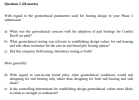 Question 3 (20 marks) With regard to the geotechnical parameters used for footing design in your Phase 2 submission a) What was the geotechnical concern with the adoption of pad footings for Conifer Knoll car park? b) What geotechnical testing was relevant to establishing design values for end bearing and side shear resistance for the cast-in-situ bored pile footing option? c) Did this comprise field testing, laboratory testing or both? More generally d) With regard to cast-in-situ bored piles, what...
QUESTION 2 (12 marks) The step response of an LTI system is given by g(t) =...
 QUESTION 2 (12 marks) The step response of an LTI system is given by g(t) = (1 - e-3t)u(t) (a) Determine the impulse response, h(t), of the system. (b) Use the linearity and time invariance properties to determine the response of the system to the input x(t) = 38(t) + 2u(t – 2). (c) Determine the frequency response of the system H(jw). [Hint: Use the tables in the formula sheet]. (d) Hence determine the output y(t) for the input signal...
- Question 3. [25 marks] Consider the execution of the following function (written in the C...
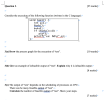 - Question 3. [25 marks] Consider the execution of the following function (written in the C language). void test() { int a=1; fork(); a=a+2; if (fork()==0) H a=2*3;4 printf("la: %d\nma); 3(a) Draw the process graph for the execution of “test”. [10 marks] 3(b) Give an example of infeasible output of “test”. Explain why it is infeasible output. [8 marks] 3(c) The output of “test” depends on the scheduling of processes on CPU. There can be many feasible output of “test”....
Question No.1 (Marks 10) For an LTI System x(t) = sgn(-t) + u(t + 2) h(t) = e-su(t) Compute g (t) = dx(t) * h(t)...
 Question No.1 (Marks 10) For an LTI System x(t) = sgn(-t) + u(t + 2) h(t) = e-su(t) Compute g (t) = dx(t) * h(t)
Question No.1 (Marks 10) For an LTI System x(t) = sgn(-t) + u(t + 2) h(t) = e-su(t) Compute g (t) = dx(t) * h(t)
Question No.1 (Marks 10) For an LTI System x(t) = sgn(-t) + u(t + 2) h(t) = e-su(t) Compute g (t) = dx(t) * h(t)
 MECH641- Process Instrumentation and Control (Assignment 3) Answer the following: (Each Question carries 5 marks) 1. List the difference between open loop and closed loop control system with suitable example. 2. Draw the block diagram representation of a heating system. 3. Explain in detail the ratio control with suitable example. Rubrics Rubrics for descriptive questions: 5 marks: complete correct answer. 4 marks: correct answer with minor mistakes. 1-3 marks: partially correct answer (Deduction Method applies) 0 marks: incorrect answer.
 Question 9 (6 marks) Question 9.1 (3 marks) What is the difference between maskable and non-maskable interrupts? Question 9.2 (3 marks) Give an example of a situation when it would be preferable to use a maskable interrupt.
 QUESTION 3 (20 marks) a) Discuss the reasons for the accounting profession's adopting a code of conduct. (10 marks) b) Explain the difference between an Adverse and a Qualified audit report. (5 marks) c) Do interim reports give management opportunities to manipulate results of operations for a quarter? Explain the reason/s for your answer or give an example. (5 marks)
 Question 5 [2 + 2 + 2 + 3 + 3 = 12 marks ] (a) Briefly explain why we cannot find simultaneous eigenfunctions of Lg, Ly and Lz. An electron in a hydrogen atom is in the n = 2 state. Ignoring spin, write down the list of possible quantum numbers {n, l, m}. (b) For two qubits briefly explain, giving examples, the difference between a product state and an entangled state (c) Consider a system of identical bosons...
 Question 3 (20 Marks) The plane z 0 forms the boundary between free space (z> 0) and perfect conductor (z < 0). t 0 and H(0,0,0*) = H ( +2) cos at. (10 Marks) a. Find J, (0,0,0) at b. Find p,(0,00) at t-0 and D(0,0,0*) = E, cos at. (10 Marks)
Question 3 (20 Marks) The plane z 0 forms the boundary between free space (z> 0) and perfect conductor (z
Question 3 (20 Marks) The plane z 0 forms the boundary between free space (z> 0) and perfect conductor (z < 0). t 0 and H(0,0,0*) = H ( +2) cos at. (10 Marks) a. Find J, (0,0,0) at b. Find p,(0,00) at t-0 and D(0,0,0*) = E, cos at. (10 Marks)
Question 3 (20 Marks) The plane z 0 forms the boundary between free space (z> 0) and perfect conductor (z
 QUESTION 1 [TOTAL MARKS: 25] Q 1(a) [5 Marks] i. What is the State postulate? [2 marks] ii. Using a sketch, briefly explain the difference(s) between a Closed System and an Isolated system. [3 Marks] Q 1(b) [20 Marks] Table 1 contains property information. The working fluid is water. Complete the table. You must show all calculations and/or explain how you determined your values, where applicable. [15] Plot the values on a P-v diagram. You should identify the phases for...
 Question 3 (20 marks) With regard to the geotechnical parameters used for footing design in your Phase 2 submission a) What was the geotechnical concern with the adoption of pad footings for Conifer Knoll car park? b) What geotechnical testing was relevant to establishing design values for end bearing and side shear resistance for the cast-in-situ bored pile footing option? c) Did this comprise field testing, laboratory testing or both? More generally d) With regard to cast-in-situ bored piles, what...
 QUESTION 2 (12 marks) The step response of an LTI system is given by g(t) = (1 - e-3t)u(t) (a) Determine the impulse response, h(t), of the system. (b) Use the linearity and time invariance properties to determine the response of the system to the input x(t) = 38(t) + 2u(t – 2). (c) Determine the frequency response of the system H(jw). [Hint: Use the tables in the formula sheet]. (d) Hence determine the output y(t) for the input signal...
 - Question 3. [25 marks] Consider the execution of the following function (written in the C language). void test() { int a=1; fork(); a=a+2; if (fork()==0) H a=2*3;4 printf("la: %d\nma); 3(a) Draw the process graph for the execution of “test”. [10 marks] 3(b) Give an example of infeasible output of “test”. Explain why it is infeasible output. [8 marks] 3(c) The output of “test” depends on the scheduling of processes on CPU. There can be many feasible output of “test”....
 Question No.1 (Marks 10) For an LTI System x(t) = sgn(-t) + u(t + 2) h(t) = e-su(t) Compute g (t) = dx(t) * h(t)
Question No.1 (Marks 10) For an LTI System x(t) = sgn(-t) + u(t + 2) h(t) = e-su(t) Compute g (t) = dx(t) * h(t)
Question No.1 (Marks 10) For an LTI System x(t) = sgn(-t) + u(t + 2) h(t) = e-su(t) Compute g (t) = dx(t) * h(t)
Most questions answered within 3 hours.
-
Where is the error in this code sequence?
String s1 = "Hello";
String s2 = "ello";...
asked 11 months ago -
Financial data for Joel de Paris, Inc., for last year
follow:
Joel de Paris, Inc.
Balance...
asked 11 months ago -
Consider this reaction:
Al2(SO4)3 (aq)+ BaCl3
(aq) Al2Cl6 (aq)- +
3BaSO4(s) . What is the...
asked 11 months ago -
Suppose that Savneet is considering increasing her
recent random sample from 20 car rentals to 40...
asked 11 months ago -
Trucks arrive at an unloading terminal at an average rate of 120
per hour.
Trucks arrive...
asked 11 months ago -
Why are methanol and ethanol completely soluble in water while
octanol is not very little soluble....
asked 11 months ago -
A facilities manager at a university reads in a research report
that the mean amount of...
asked 11 months ago -
When the CuSO4 is rehydrated by adding water to the anhydrous
compound, is this an endothermic...
asked 11 months ago -
A ray of sunlight is passing from diamond into crown glass; the
angle of incidence is...
asked 11 months ago -
A block of mass 0.249 kg is placed on top of a light, vertical
spring of...
asked 11 months ago -
how do the kidneys compensate in the presences of acidosis
a) trigger hyperventilate
b) reserve acid...
asked 11 months ago -
Question 501 pts
The rental rate of capital to the firm increases. Which of the
following...
asked 11 months ago